

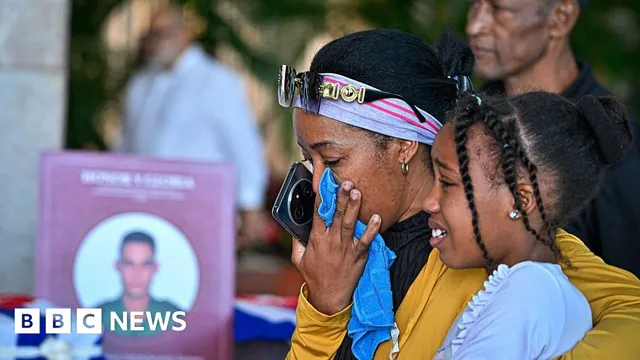
Cuba mourns 32 soldiers killed in US attack on Venezuela
Cuba mourns 32 soldiers killed in US attack on Venezuela
- Cuba mourned the loss of 32 soldiers killed during a US military intervention in Venezuela on January 3, 2026.
- The soldiers were part of Nicolás Maduro's security detail and their bodies were received in Havana with military honors.
- Cuba remains committed to its alliance with Venezuela, facing increased pressures from the United States.
Story
Cuba recently received the remains of 32 soldiers who died during a US military operation in Venezuela on January 3. The soldiers, members of Cuba's armed forces and intelligence agencies, were part of the security detail for Venezuelan President Nicolás Maduro when US forces captured him in Caracas. Their repatriation ceremony was held on January 15, 2026, in Havana, where thousands attended to pay their respects. The fallen soldiers were honored as national heroes by high-ranking officials, including President Miguel Díaz-Canel and former leader Raúl Castro, with military honors and ceremonies throughout the country to commemorate their sacrifice. The US military intervention aimed at removing Maduro, who is currently detained in New York facing drug trafficking charges, resulted in widespread casualties, including over 100 deaths reported by Venezuela's government. This aggressive maneuver from the US has heightened tensions not only between the US and Venezuela but also between these countries and Cuba, which has historically supported the Venezuelan regime. The US administration under President Donald Trump has made threats to cut off oil supplies and economic support from Venezuela to Cuba, measures that could significantly impact Cuba's struggling economy. The economic ties between the two nations have been strained by US sanctions and Cuban reliance on Venezuelan oil over the past 25 years. The response from the Cuban government included a declaration of mourning and called the deceased soldiers
Context
The relationship between Cuba and Venezuela is characterized by a long history of political, economic, and social ties that have significantly influenced both nations, particularly since the rise of Hugo Chávez in Venezuela. The two countries share a common ideological foundation rooted in socialism and anti-imperialist sentiments, which has strengthened their bonds over the years. This partnership emerged prominently during the late 1990s when Chávez initiated his Bolivarian Revolution, which sought to redistribute wealth and empower the working class. Cuba, under Fidel Castro, provided essential support in the form of medical professionals, educational programs, and military assistance to bolster Chávez's government. In return, Venezuela became a major supplier of oil to Cuba, allowing the island's economy to stabilize despite U.S. sanctions and other external pressures. This mutual dependency laid the groundwork for a resilient alliance that has persisted through various regional and international challenges. The historical significance of Cuba-Venezuela relations has deepened since 2013 with the passing of Chávez and the subsequent challenges faced by his successor, Nicolás Maduro. Despite internal strife, economic downturns, and widespread protests within Venezuela, the partnership with Cuba has remained a focal point of Maduro's administration. The close ties have afforded Cuba diplomatic support in international forums, where it often faces criticism for its human rights record and economic policies. Concurrently, Cuba has relied on Venezuelan oil to sustain its energy needs, which is vital given the crippling austerity measures imposed by U.S. sanctions on both nations. The comprehensive collaboration also extends to military alliances and intelligence sharing, making their relationship one of mutual survival against perceived external threats, particularly from the United States. During the contemporary geopolitical climate characterized by shifting alliances and increasing tensions in Latin America, Cuba and Venezuela have maintained a united front. Both countries continuously advocate for regional autonomy from U.S. influence and imperialism, as evidenced by their participation in leftist movements across the continent. The Cuban government has also sent its medical brigades to provide support during crises in Venezuela, reinforcing the notion of solidarity between the two nations. However, the sustainability of this relationship is fundamentally challenged by the severe economic crisis in Venezuela, leading to reduced oil exports and financial strains on Cuba. The effects of the Venezuelan crisis are palpable in Cuba, where shortages have escalated, forcing the Cuban government to pursue alternative economic partnerships and reforms to alleviate burgeoning hardships. As of early 2026, the future of Cuba-Venezuela relations remains uncertain, shaped by domestic challenges and external pressures. Both countries are navigating a complex landscape defined by economic turmoil, declining international support, and increasing isolation. Nevertheless, the ideological frameworks that underpin their relationship continue to serve as a foundation for cooperation. The resilience of this partnership will depend on the ability of both nations to adapt to evolving circumstances while maintaining their commitment to shared principles of socialism and self-determination. The ongoing dynamics of their relationship will be critical not only for their respective domestic situations but also for the broader geopolitical landscape in Latin America.


