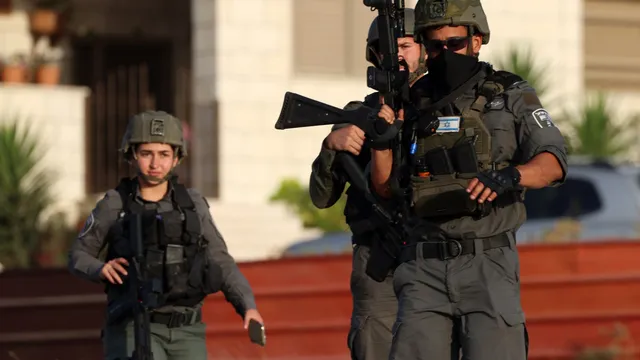
Israeli forces escalate violence against Palestinians in West Bank
military conflicts
tragic
controversial

Israeli forces escalate violence against Palestinians in West Bank

10
(Update: )
Arab ethnic group who mostly adhere to Islam
  • Israeli soldiers have intensified military operations in the occupied West Bank and East Jerusalem, raiding multiple towns and villages.
  • The actions have led to home demolitions and numerous arrests of Palestinians, raising concerns among the local population.
  • The situation has drawn international condemnation, with calls for urgent action to address the violence and protect Palestinian civilians.
Share opinion
1

Story

In the occupied West Bank and East Jerusalem, Israeli soldiers have significantly increased their military operations, raiding at least 20 towns and villages. This escalation has resulted in the demolition of homes and the arrest of dozens of Palestinians. Reports indicate that the Israeli forces stormed areas such as Jabal Salman in Beita and Nilin, west of Ramallah, where demolition operations were carried out. Additionally, the town of Arrabeh in Jenin was also targeted, with military bulldozers accompanying the raids. The situation has led to heightened tensions and fear among the Palestinian population, who feel increasingly vulnerable. The ongoing military actions have been met with widespread condemnation from various Arab states and organizations, including the Arab League. Palestinian President Mahmoud Abbas has reached out to global leaders, urging them to take immediate action against what he describes as Israeli aggression and settler violence. The Arab League has warned that the situation is nearing a critical point, calling for international intervention to prevent further escalation. The violence has not only affected the Palestinian civilians but has also drawn attention from international bodies, with calls for accountability and an end to the impunity enjoyed by Israeli settlers. Reports from the ground indicate that Israeli settlers have intensified their attacks against Palestinians, particularly at night, often targeting homes and properties. Al Jazeera's correspondents have highlighted instances where Israeli forces have intervened not to protect Palestinians but to conduct arrests among them, further exacerbating the sense of helplessness felt by the local population. The settlers' actions have been described as systematic and violent, with some officials labeling them as pogroms against defenseless civilians. The situation remains dire, with nearly 1,200 Palestinians reported killed in the occupied West Bank since October 2023, alongside significant casualties in Gaza. The Israeli military's actions, coupled with the lack of accountability for settler violence, have created an environment of fear and desperation among Palestinians. As the Israeli government faces internal pressures, particularly with upcoming elections, the cycle of violence appears to be escalating, raising concerns about the potential for a broader conflict in the region.

Context

The Israeli-Palestinian conflict is a long-standing and complex dispute that has its roots in the late 19th and early 20th centuries, primarily revolving around national identity, territorial claims, and historical grievances. The conflict intensified with the rise of nationalist movements among both Jews and Arabs in the region, particularly with the establishment of the Zionist movement advocating for a Jewish homeland in Palestine, which was then part of the Ottoman Empire. Following World War I and the subsequent British mandate over Palestine, tensions escalated as Jewish immigration increased, leading to violent confrontations between Jewish and Arab communities. The 1947 United Nations partition plan aimed to create separate Jewish and Arab states, but it was rejected by Arab leaders, resulting in the 1948 Arab-Israeli War and the establishment of the State of Israel, which further complicated the situation and led to the displacement of hundreds of thousands of Palestinians, an event known as the Nakba or "catastrophe." In the decades that followed, the conflict saw several key events, including the Six-Day War in 1967, during which Israel captured the West Bank, Gaza Strip, and East Jerusalem, territories that are central to the Palestinian claim for statehood. The occupation of these territories has been a significant point of contention, leading to ongoing disputes over land, resources, and the rights of Palestinian people. The late 20th century witnessed the rise of the Palestinian Liberation Organization (PLO) and the first Intifada, or uprising, against Israeli rule, which brought international attention to the plight of Palestinians and the need for a resolution to the conflict. Efforts to achieve peace have included various negotiations, such as the Oslo Accords in the 1990s, which aimed to establish a framework for a two-state solution. However, these efforts have often been undermined by violence, political divisions, and mutual distrust. The second Intifada in the early 2000s marked a significant escalation in violence, leading to a cycle of retaliatory attacks and military operations. The situation has been further complicated by the internal Palestinian political divide between Fatah, which governs the West Bank, and Hamas, which controls Gaza, creating challenges for unified representation in peace talks. As of 2026, the Israeli-Palestinian conflict remains unresolved, with ongoing disputes over settlements, security, and the status of Jerusalem. The international community continues to advocate for a negotiated settlement, but the path to peace is fraught with challenges, including deep-seated historical grievances, competing national narratives, and the impact of regional dynamics. The humanitarian situation in the occupied territories remains dire, with calls for greater attention to human rights and the need for a sustainable solution that addresses the aspirations of both Israelis and Palestinians.