

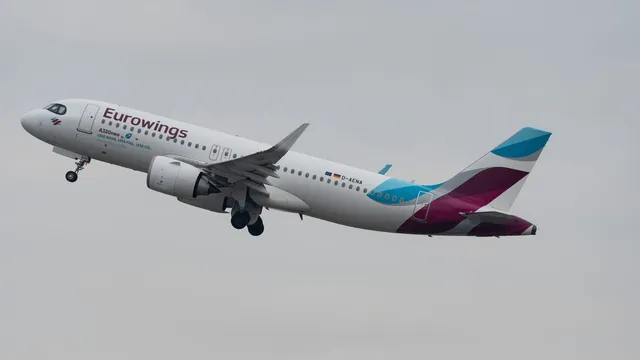
Eurowings flight delayed 11 hours due to Iranian airspace tensions
Eurowings flight delayed 11 hours due to Iranian airspace tensions
- A Eurowings flight from Dubai to Stuttgart experienced significant delays and diversions due to the closure of Iranian airspace.
- The flight had to stop for refueling in Thessaloniki and ultimately diverted to Nuremberg after failing to arrive by a nighttime curfew in Stuttgart.
- This incident illustrates the broader trend of airlines adapting routes in response to geopolitical tensions in the region.
Story
In January 2026, a Eurowings flight from the UAE to Germany encountered significant delays due to geopolitical tensions surrounding Iranian airspace. The flight, designated as Flight 1153, departed from Dubai en route to Stuttgart but had to alter its course when Iranian airspace was closed. This maneuver was a direct result of comments from President Donald Trump that suggested potential U.S. intervention in Iran, prompting airlines worldwide to rethink flight paths in that region for safety reasons. Many carriers, including the Lufthansa Group, decided it was prudent to avoid both Iranian and Iraqi airspace altogether. The impact of this decision was evident on January 24, when Flight 1153 experienced two diversions during its journey. The aircraft was redirected to Thessaloniki airport in Greece for an unscheduled refueling stop, which added critical hours to the overall travel time. FlightAware data indicated that the Airbus A320neo spent just over six hours in the air to reach Thessaloniki, a diversion far longer than the typical flight duration of six to seven hours for this route without interruptions. Following the refueling, the flight was unable to land at Stuttgart due to existing landing curfews, culminating in its final destination being altered to Nuremberg. Upon arrival in Nuremberg around 1:30 AM the following morning, passengers found themselves delayed by a total of 11 hours compared to the standard flight schedule. Eurowings acknowledged the situation, stating that some flights from Dubai to Germany had required similar stops and adjustments due to extended flight distances and stronger headwinds. They also indicated that strict night flight restrictions at many German airports compelled airlines to devise alternative landing strategies. The ongoing situation surrounding Iranian airspace has led numerous international airlines to reconsider their operational routes. Many are opting to reroute their flights over Afghanistan or Saudi Arabia, reflecting heightened tensions in the region associated with U.S.-Iran relations. The Federal Aviation Administration (FAA) has upheld a ban on U.S. carriers flying through Iranian airspace since early 2020, which has now been officially extended to October 2027. Additionally, the European Union Aviation Safety Agency (EASA) advised airlines against operating in Iranian airspace at all altitudes citing the risk of escalating conflicts and potential retaliatory strikes in response to U.S. military actions. In this context, any airline navigating these areas faces significant operational challenges, especially considering ongoing global geopolitical instability.


