

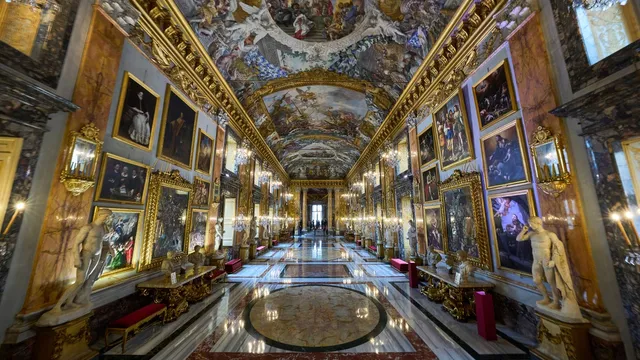
Colonna Palace preserves history amid modern tourism challenges
Colonna Palace preserves history amid modern tourism challenges
- Colonna Palace is a private home-museum that allows limited access to small groups led by art historians.
- The Colonna family, part of the black nobility, has owned the palace since the 12th century and preserved its treasures during challenging times.
- Today, the palace remains a key part of Rome's artistic heritage while balancing its exclusivity with a desire for public appreciation.
Story
In Rome, millions of visitors flock to famous attractions like the Colosseum and the Sistine Chapel; however, only a few have the opportunity to explore the exclusive Colonna Palace. This private home-museum spans four wings over an entire city block and provides a unique glimpse into a storied lineage, as it has belonged to the Colonna family since the 12th century. Don Prospero Colonna, the family’s sitting prince, still resides there and permits limited access for small groups guided by art historians on select weekends. Elisabetta Cecchini, a palace restorer, emphasizes the importance of preserving the art without succumbing to mass tourism, as the family intends to maintain its private character rather than commoditize their heritage. Events hosted at the palace are rare, with a notable occasion in 2005 marking the launch of Pope John Paul II’s book and another in 2018 showcasing a Catholic fashion exhibition from the Metropolitan Museum of Art. These instances reveal the palace's reluctance to attract journalists and tourists, supporting a philosophy that such heirlooms showcase historical understanding rather than commercial interests. The Colonna family, identified as part of the 'black nobility' due to their loyalty to the Pope during the annexation of Rome in the 19th century, played a significant role in shaping Italy's history. This family loyalty during a tumultuous period enabled them to preserve their artistic treasures through challenging circumstances, such as World War II, when Princess Isabella Colonna cleverly safeguarded artworks from Nazi soldiers by hiding them within the palace. The palace today stands as a testament to the intertwining stories of Rome and the Colonna family, echoing the sentiment that both entities are inseparable in their historical significance. Visitors to the palace are reminded of its rich narrative intertwined with the broader history of Rome, leaving lasting impressions as they engage with its legacy.
Context
The Colonna family, one of the most prominent noble families in Italy, has played a significant role in the political, military, and cultural landscape of the country since the 13th century. Originating from a lineage that claimed descent from the Roman aristocracy, the Colonnas established themselves as powerful players in both the ecclesiastical and secular realms of Italy. Their influence peaked during the Middle Ages and the Renaissance when they produced several popes, cardinals, and other notable figures. The family was particularly known for its rivalry with the Orsini family, which led to conflicts that were emblematic of the broader power struggles among noble families in Rome and beyond. This rivalry not only shaped their own fate but also had far-reaching implications for the governance and social order of the time. The Colonna family's contributions extended beyond political spheres; they were significant patrons of the arts and education. The Renaissance, in particular, saw the Colonnas invest heavily in architecture, literature, and the visual arts, thereby leaving an indelible mark on Italian culture. Their residences, especially the Palazzo Colonna in Rome, are showcases of Baroque architecture and art, embodying the grandeur of the family’s status and contributions to the cultural landscape. Through their support for artists and intellectuals, the Colonnas helped foster a conducive environment for creative expression during a period renowned for innovation and humanism. Moreover, throughout the centuries, the Colonna family maintained a complex relationship with the Catholic Church, often intertwining their fortunes with papal politics. They were instrumental in various ecclesiastical appointments, and several Colonnas served as cardinals and popes. This connection not only solidified their wealth and influence but also placed them at the center of crucial theological debates and reforms within the church. Their intertwining of political ambition with religious authority is a testament to the family's ability to navigate the complexities of power dynamics in Italy, which were often steeped in both political intrigue and spiritual authority. In modern times, the legacy of the Colonna family continues to be felt in Italy and beyond. Their historical significance and cultural contributions are celebrated, and they remain a symbol of noble heritage. As contemporary society pays more attention to the history of noble families and their contributions, the Colonna family serves as a vital link to understanding Italy's past. Their story illustrates the intricate tapestry of power, art, and religion that has defined Italy for centuries, and it continues to be a subject of interest in historical studies aimed at unpacking the complexities of Italian aristocracy.


