

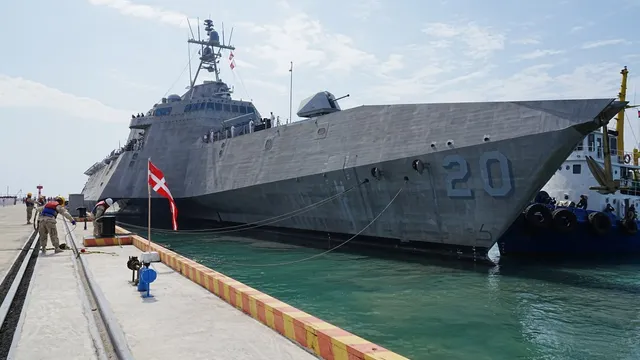
US navy warship docks at Cambodian naval base amid rising tensions with China
US navy warship docks at Cambodian naval base amid rising tensions with China
- The USS Cincinnati docked at Cambodia's Ream Naval Base, marking the first U.S. naval visit since the base's renovation.
- The five-day visit includes joint exercises and meetings focused on enhancing maritime security between U.S. and Cambodian naval forces.
- This engagement underscores the gradual warming of military relations amid ongoing concerns regarding China's influence in the region.
Story
On January 24, 2026, the USS Cincinnati, an Independence-class littoral combat ship, made a significant port call at Cambodia’s Ream Naval Base. This marked the first visit by a U.S. Navy warship since the base was renovated with Chinese assistance, emphasizing the renewed military engagement between the United States and Cambodia. The port visit is a reflection of a thaw in relations, following years of tension regarding military access to the strategic Gulf of Thailand port. This visit is particularly noteworthy as it symbolizes a growing partnership between the U.S. and Cambodia, showcasing an era of increased military cooperation. Notably, the last attendance of a U.S. military vessel at a Cambodian port was in 2024, indicating the shift towards warmer diplomatic ties has begun to take shape. The USS Cincinnati's presence at Ream is seen by many as a counter to China's growing influence in the region, as there have been concerns about exclusive access potentially granted to Beijing. During its five-day stay from January 24th to January 28th, naval officers from both nations are scheduled to engage in meetings and joint exercises. These activities are expected to focus on maritime security and enhance operational coordination between the two navies. Additionally, this engagement will include community interactions where the crew is set to participate in various events in the nearby city of Sihanoukville. Cambodian authorities have touted the base’s renovations as a success, asserting that it welcomes maritime cooperation with all friendly nations; this includes the U.S., along with other allies such as Australia and Japan. Prime Minister Hun Manet has reiterated that the Ream Naval Base is open to collaboration for joint military exercises, which aligns with Cambodia's diplomatic efforts to maintain a balance between the U.S. and China. Amid ongoing concerns regarding Cambodia's strategic alignment, particularly its military ties with China, the U.S. continues to emphasize the importance of maintaining a favorable military presence in the Indo-Pacific region, a strategy that reflects continuing adjustments in response to evolving global dynamics.
Context
The history of US-Cambodia military relations has undergone significant transformations since the mid-20th century. Initially, Cambodia, under King Norodom Sihanouk, maintained a policy of neutrality during the Vietnam War while the United States was deeply involved with South Vietnam. However, the geopolitical landscape shifted dramatically following the US incursion into Cambodia in 1970, amid a crack-down on North Vietnamese sanctuaries. This led to the overthrow of Sihanouk and the establishment of a US-backed government under General Lon Nol, igniting a civil conflict that culminated in the rise of the Khmer Rouge in 1975. The US's direct military involvement ultimately contributed to regional instability, creating a complex legacy that still influences military relations today. Following the fall of Phnom Penh to the Khmer Rouge, US-Cambodia relations reached a nadir, characterized by a lack of engagement as the Khmer Rouge regime perpetrated widespread atrocities. It was not until the 1990s and the Paris Peace Agreements that US involvement re-emerged in a more constructive manner, focusing on humanitarian assistance and promoting peace-building initiatives. In the wake of the UN-led elections in 1993, US military aid began to flow back into Cambodia, aimed at stabilizing the nation and facilitating democratic processes, signaling a renewed commitment to Cambodian sovereignty and security. In the 21st century, US-Cambodia military relations have evolved, with a focus on building capabilities to address regional security challenges. The US has engaged in numerous joint exercises, training programs, and defense cooperation agreements with Cambodia, all aiming to strengthen the country's military capacities and foster interoperability. These efforts have been particularly important in the context of Cambodia's strategic location within Southeast Asia, amidst rising tensions and assertiveness in the South China Sea by regional powers. The US has also emphasized military-to-military ties, recognizing the importance of a stable Cambodia for regional security and countering transnational threats, such as terrorism and human trafficking. Despite these advancements, US-Cambodia relations face ongoing challenges. Concerns about human rights issues and governance in Cambodia have occasionally strained military ties, particularly in light of the Cambodian government's increasing authoritarianism under Prime Minister Hun Sen. As the US balances its strategic interests in Southeast Asia with its commitment to support democratic values, it is compelled to navigate a complex relationship with Cambodia. Continued bilateral dialogue and engagement remain essential to address both countries' security needs while fostering a partnership that promotes stability throughout the region. The future of US-Cambodia military relations will likely depend on the evolving domestic and international political landscape, as both nations seek to enhance their cooperation amidst shifting geopolitical dynamics.


