

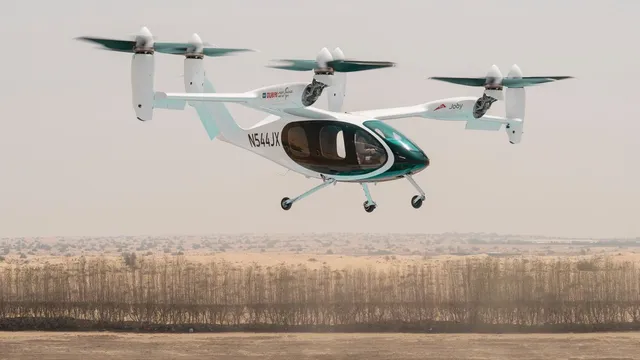
Joby Aviation launches air taxi service in Dubai next year
Joby Aviation launches air taxi service in Dubai next year
- Joby Aviation is set to launch air taxi services in Dubai next year, focusing on urban transportation.
- The air taxis will operate at speeds of up to 200 mph, reducing travel times significantly compared to traditional vehicles.
- The success of this service could pave the way for similar initiatives in other regions, overcoming challenges in American cities.
Story
In Dubai, United Arab Emirates, a revolutionary air taxi service is expected to debut next year, marking a significant milestone in urban transportation. Joby Aviation, Inc., an American company, has been focusing on developing electric vertical takeoff and landing (eVTOL) aircraft for ride-hailing services. The technology has been crafted at Edwards Air Force Base in Texas and tested in the UAE, where Joby recently became the first electric air taxi company to complete a flight, showcasing its commitment to advanced air mobility. This new transportation method will allow passengers to utilize a ride-hailing app to summon aircraft for quick travel between specially designated vertiports. Joby Aviation plans to establish four vertiports in Dubai, including a key site at Al Maktoum International Airport. With the capability to fly at speeds of up to 200 mph, the air taxi can significantly reduce travel time; a trip from the airport to downtown, normally taking 45 minutes by car, will only take about 10 minutes. This speed and efficiency are expected to transform urban mobility, especially in congested areas. As test flights and preparatory operations unfold, experts express optimism regarding the service’s potential to cater to luxury tourism and premium transportation demands in the Middle East. While Joby has made strides, challenges remain, particularly concerning the economic viability of air taxi services. Aviation expert Robert L. Ditchey has voiced skepticism over the possibility of air taxis operating in densely populated American cities. He cites concerns about air traffic volume, airspace safety, and the financial feasibility of such services without governmental support. Despite these challenges, the market landscape in the Middle East appears more promising, with American air taxi manufacturers actively pursuing partnerships and collaborating with local entities to facilitate operations. The growing interest and investment in eVTOL technology reflect a broader trend toward modernizing urban transport systems worldwide. Competition in the air taxi sector is escalating, as various U.S. companies—including Joby and Archer—forge agreements to test their aircraft in Saudi Arabia and the UAE. With substantial backing from local governments and the aviation industry, these firms aim to integrate their services into luxury tourism sectors, boosting economic growth and providing cutting-edge mobility solutions for citizens and travelers alike.
Context
The impact of air taxis on transportation infrastructure represents a transformative shift in how we perceive and utilize urban mobility. Air taxis, often referred to as vertical takeoff and landing (VTOL) vehicles, promise to alleviate congestion on traditional ground transport systems, which have been strained by increasing urban populations and the corresponding rise in vehicular traffic. These air vehicles are designed to transport passengers and cargo through urban airspace, thereby bypassing ground-level congestion and optimizing travel times. The advent of these aerial modes of transport necessitates a reconsideration of existing infrastructure, ranging from helipads to advanced air traffic management systems that can handle a higher volume of airborne vehicles smoothly and safely. To effectively integrate air taxis into the existing urban ecosystem, cities will need to invest in dedicated infrastructure. This includes establishing vertiports—designated takeoff and landing zones for air taxis—similar to how airports function for traditional planes. These vertiports must be strategically located near major urban centers, transit hubs, and high-demand areas to ensure efficiency and accessibility. Additionally, cities must coordinate with aviation authorities to create regulations that govern airspace usage, noise abatement, and safety protocols, which are crucial for maintaining public trust and ensuring the seamless operation of air taxis alongside other forms of transportation. The integration of air taxis also presents opportunities for economic growth and job creation. As this industry matures, it will require skilled workers for various roles, including pilots, maintenance technicians, and air traffic controllers. Moreover, the infrastructure development surrounding air taxi implementation could stimulate local economies by attracting investment and tourism, promoting a multi-modal transportation network that connects various transit options such as buses, trains, and bicycles, ultimately creating a more cohesive urban mobility system. However, challenges remain to be addressed regarding the environmental impact and public acceptance of air taxis. The aviation industry is under increasing pressure to reduce carbon emissions; thus, air taxis must adopt sustainable technologies. The development of electric or hybrid propulsion systems would not only address environmental concerns but also enhance operational efficiency. Public perception will also play a critical role in the successful integration of air taxis; addressing safety concerns and providing clear communication about the benefits can foster community support. As air taxis evolve, they offer the potential to redefine transportation within urban landscapes, making cities more connected, reducing travel times, and paving the way for smarter, more sustainable urban environments.


