

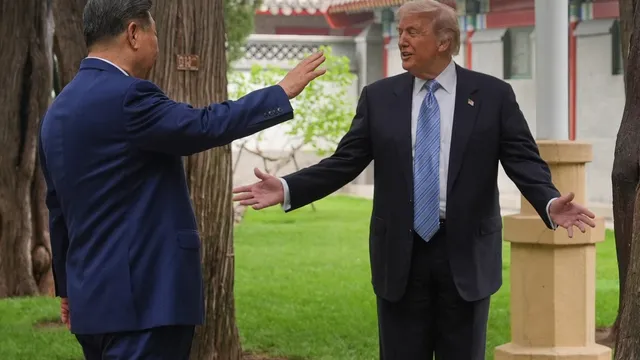
Taiwan asserts independence amid Trump’s warnings
Taiwan asserts independence amid Trump’s warnings
- Taiwan's President Lai Ching-te emphasized that the island is a sovereign nation that only its people can decide upon.
- Trump indicated he does not seek to engage in military conflict regarding Taiwan during his visit to China.
- Taiwan appears determined to maintain its independence while navigating complex diplomatic relations with the U.S. and China.
Story
In recent days, Taiwan's government reaffirmed its stance on independence after U.S. President Donald Trump warned against a formal declaration of independence during his summit in Beijing. Trump cautioned that the self-governing island, claimed by China, should avoid escalating tensions with the mainland. Consequently, Taiwanese President Lai Ching-te emphasized that the future of Taiwan lies solely in the hands of its people and declared that Taiwan is already a sovereign nation that does not need a formal declaration of independence. This position reflects Taiwan's commitment to maintaining its current status with China while asserting its self-governance. The context of these statements is rooted in the historical tension between Taiwan and China. Following the Chinese Civil War in 1949, the defeated Kuomintang fled to Taiwan, where they established a separate government. Over the decades, Beijing has expressed a desire to reunify Taiwan with the mainland, which many Taiwanese perceive as a threat to their democratic way of life. Trump’s remarks came shortly after discussions with Chinese President Xi Jinping, during which Taiwan was highlighted as a critical issue in U.S.-China relations. Trump stated he preferred not to engage in military conflict thousands of miles away to defend Taiwan. The U.S. has historically maintained a policy of strategic ambiguity regarding its military commitments to Taiwan. While legally obligated to provide Taiwan with defensive means, the U.S. does not have formal relations with the island. As a result, any discussion around arms sales or military support generates significant diplomatic implications, particularly in relation to Beijing. Despite the ambiguity, there is a consistent undercurrent of support from U.S. lawmakers for Taiwan's defense, with some urging continued arms sales to prevent potential aggression from China. In light of ongoing geopolitical tensions, Taiwan's leadership remains cautious yet assertive, promoting its right to self-determination while avoiding formal declarations that would escalate conflicts. As both Trump and Xi address the Taiwan situation, the balance between U.S. support for Taiwan and the management of U.S.-China relations continues to be a delicate and pivotal issue. The Taiwanese perspective emphasizes that the island's inhabitants should decide their future, which complicates any external pressures from both Washington and Beijing. Such dynamics are crucial not just for Taiwan's political landscape but also for regional stability in East Asia as both superpowers navigate their strategic interests.
Context
analysis policy geopolitical economic data data data analysis market economic strategic geopolitical geopolitical strategic policy policy market shift trends economic economic insight global shift market economic economic market analysis policy global insight trends insight strategic shift insight trends trends economic economic shift impact policy market policy geopolitical trends strategic impact geopolitical insight analysis global economic insight trends policy analysis impact economic data market shift economic global policy insight geopolitical global analysis analysis trends global shift analysis impact strategic geopolitical data...


