

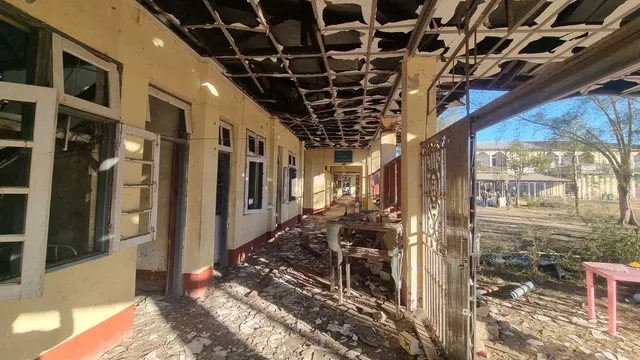
Myanmar military airstrike kills dozens at hospital in Rakhine
Myanmar military airstrike kills dozens at hospital in Rakhine
- Myanmar's military conducted an airstrike on a hospital in Mrauk-U township, Rakhine, resulting in the deaths of 34 individuals, including staff and patients.
- The airstrike has been described by experts as a potential war crime, raising concerns over the ongoing conflict in the region.
- International organizations and local authorities demand accountability and humanitarian support in light of the devastating attack.
Story
Myanmar is in a state of conflict following a military coup in February 2021 that overthrew the government of Aung San Suu Kyi. On Wednesday night, an airstrike conducted by Myanmar's military targeted a hospital in Mrauk-U township, located in the western state of Rakhine. This region is controlled by the Arakan Army, an ethnic rebel group seeking autonomy. Reports indicate that two bombs were dropped, one hitting the recovery ward and the other striking the vicinity of the main hospital building, leading to significant destruction and widespread casualties. The attack resulted in the tragic deaths of 34 patients and medical personnel, with 80 others suffering injuries, according to rescue workers and independent media. Local authorities observed that 17 women and 17 men were among the deceased. The hospital was crucial for healthcare delivery in an area with limited medical services due to ongoing violence and civil unrest. Human rights experts have classified this incident as a potential war crime, highlighting the increasing brutality of Myanmar's military against civilian populations in conflict zones. Rescue services in the region expressed the need for urgent international intervention following the incident. Eyewitness accounts and photographs circulated online display the destructed hospital premises, emphasizing the scale of the devastation. The situation in Rakhine is exacerbated by the tensions between ethnic communities, following the 2017 military operations that forcibly displaced thousands of Rohingya Muslims. The Arakan Army has gained ground since its offensive that began in November 2023, controlling a significant number of townships, which has resulted in heightened military responses from the government, including airstrikes against perceived threats. The National Unity Government, a shadow administration formed by ousted lawmakers, condemned the airstrike and called for global pressure on the military regime to halt its violent actions. This ongoing conflict has left many regions in Myanmar embroiled in warfare, where civilians face perils not only from armed confrontations but also from direct military actions targeting healthcare facilities and other essential services.
Context
The Arakan Army conflict in Myanmar is rooted in a complex interplay of ethnic, political, and historical factors, particularly focusing on the Rakhine State, which has been a site of tension for decades. The Arakan Army (AA), founded in 2009, aims to establish a federal system of governance that recognizes the rights of the Rakhine people, a predominantly Buddhist ethnic group that has faced marginalization from the central government since Myanmar's independence in 1948. The conflict gained prominence in 2018 when the AA intensified its military activities against the Myanmar military, leading to a significant escalation in violence and humanitarian crises, including the displacement of thousands of civilians. The Rakhine State has witnessed numerous clashes, as the AA employs guerrilla tactics against a backdrop of longstanding grievances over land rights, cultural recognition, and resource allocation in the region. Internationally, the conflict has drawn attention not only due to its humanitarian implications but also because of the ongoing Rohingya crisis, which began to unfold dramatically in 2015. The Rohingya, a Muslim ethnic group, have faced severe persecution in the Rakhine State, prompting a mass exodus to Bangladesh amidst reports of atrocities by the military. While the plight of the Rohingya has driven much of the global narrative surrounding Myanmar, the dynamics involving the Arakan Army signify an internal struggle for autonomy and recognition that complicates the situation further. The AA's movements and increased visibility reflect a broader context of ethnic armed conflicts in Myanmar, where multiple groups seek self-determination against a backdrop of neglect and discrimination from the central authorities. Various actors, including local communities, international NGOs, and foreign governments, have become embroiled in this conflict, advocating for human rights and calling for resolutions to the violence. The international community has largely criticized the Myanmar military for its heavy-handed tactics and has imposed sanctions on senior military officials in response to alleged human rights abuses. However, peace talks between the AA and the Myanmar government have been sporadic and often unproductive, as both sides have deeply entrenched positions regarding authority and governance in Rakhine State. The dialogue process remains complicated by the presence of other ethnic armed groups and the general distrust towards the military, especially in light of recent events where civilian populations have continued to bear the brunt of the conflict. The future of the Arakan Army conflict is uncertain but highlights the need for comprehensive dialogue and reconciliation to address the issues of governance, ethnic rights, and social justice for the people of Rakhine State. Addressing these factors requires not only a sensitivity to the local dynamics but also a commitment from the Myanmar government to recognize the diverse ethnic identities within its borders. As the conflict unfolds, it is essential for local and international stakeholders to prioritize humanitarian assistance and protection for vulnerable populations affected by the ongoing violence, ensuring that the mistakes of the past are not repeated in the pursuit of peace and stability in the region.


