
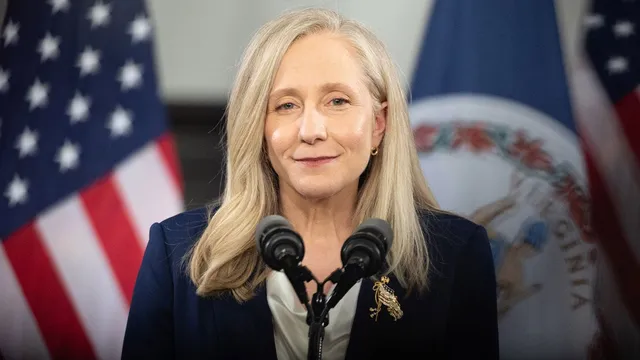
Abigail Spanberger delivers key Democratic response to Trump's address
- Abigail Spanberger, Virginia's governor, is delivering the Democratic Party's response to President Trump's State of the Union.
- She aims to address economic challenges faced by Americans and highlight her moderate Democratic views.
- The rebuttal is a strategic opportunity for Democrats ahead of the upcoming midterm elections.
Story
In the United States, Abigail Spanberger, the newly elected governor of Virginia, is set to deliver the Democratic Party's response to President Donald Trump's State of the Union address. The event is scheduled for February 24, 2026, at 9 p.m. ET, following Trump's address to Congress. This rebuttal provides an important platform for the Democratic Party as they prepare for the midterm elections in November 2026, presenting their policy priorities and contrasting their positions against those of Trump. Spanberger is a former CIA officer known for her moderate Democratic views, which she describes as 'passionate pragmatism.' As she addresses the nation, she aims to highlight current struggles faced by Americans, including rising living costs, community unrest, and a pervasive sense of fear regarding daily challenges. The Democratic response is also a strategic move by party leaders to resonate with voters, showcasing Spanberger’s successful campaign in Virginia where she secured the governorship by a substantial margin, the largest for a Democratic candidate in 60 years. The response will be delivered from Colonial Williamsburg, linking contemporary issues to Virginia's historical fight against British rule. Despite the time constraints—having significantly less time than Trump, who took 1 hour and 40 minutes for his last address—Democrats are hopeful that Spanberger's message centered around affordability will connect with the audience. Following the Capitol Hill address, various Democrats, including some governors and senators, will engage in alternative events like the 'People’s State of the Union' rally to drive home their priorities, which often counter Trump’s policies. As the Democratic Party navigates the complexities of the political landscape ahead of the midterm elections, Spanberger’s upcoming rebuttal provides them a high-stakes opportunity to articulate their vision and respond directly to the president's policies. This is particularly critical as they seek to capitalize on recent Democratic victories in special elections and maintain momentum heading into the electoral season.
Context
The State of the Union address is a yearly tradition in the United States, rooted in the Constitution, which mandates that the President periodically give Congress information on the state of the union. This practice dates back to 1790, during George Washington's presidency, when he delivered the first address before a joint session of Congress in New York City. Originally, these addresses were meant to inform Congress of the President's agenda and the challenges facing the nation, with their frequency established on a by-annual basis. Over time, this address evolved into a key public event, with Presidents delivering it annually, typically in January or February. The address serves as an opportunity not only to report on the nation’s condition but also to propose new policies and legislative goals, setting the tone for the upcoming year in governance and politics. The format of the State of the Union address has transformed significantly over the years. Initially delivered in person, the introduction of radio and television in the 20th century broadened its reach. Today, the address is broadcast live across multiple media platforms, allowing millions of Americans to engage with the proceedings directly. The style of delivery has also changed; whereas earlier addresses were read verbatim, modern presidents often adopt a more conversational tone, employing storytelling and emotional appeals to connect with their audience. This evolution reflects broader changes in American society and the media landscape, which have both shaped and been shaped by the address. Historically, the State of the Union address has served as a platform for presidents to highlight their administration's achievements, outline future initiatives, and rally support for their priorities. It has often been strategically timed to coincide with significant moments, such as the inauguration of a new president or the release of pivotal policy proposals. Notably, certain addresses have become iconic, such as Franklin D. Roosevelt's "Four Freedoms" address in 1941 and Lyndon B. Johnson's focus on civil rights and the Great Society in the 1960s. These speeches have had lasting impacts on national policy and public sentiment, often reflecting the challenges and aspirations of the American people during the respective eras. The State of the Union address also serves as a pivotal moment for political discourse in the United States. It often sets the stage for the opposition party's response, typically delivered immediately following the address. This response is an opportunity for the opposing party to critique the President's policies and lay out their vision for the country. In recent years, the address has also sparked protests, demonstrations, and political polarization, reflecting the deep divides within the American political landscape. Despite these challenges, the State of the Union remains a significant event in American politics, symbolizing the ongoing dialogue between the government and its citizens about the nation's direction and values.
