
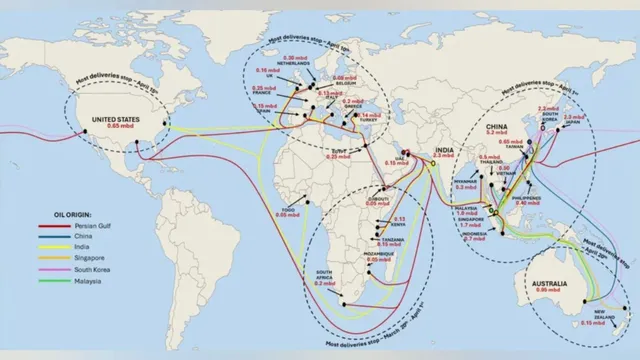
Oil deliveries to the U.S. could stop by mid-April 2026
- Recent military strikes by the U.S. on Iranian targets have prompted significant disruptions in oil shipments through the Strait of Hormuz.
- J.P. Morgan has mapped out the timeline for oil delivery halts, predicting stops for the U.S. by mid-April 2026.
- Analysts suggest that while physical shortages may not occur, higher prices and fuel supply issues are likely to arise.
Story
In recent updates, J.P. Morgan has outlined a map indicating when oil deliveries to various regions, including the United States, are expected to cease. The evaluation comes during heightened tensions following U.S. strikes targeting key Iranian military leaders, including Supreme Leader Ayatollah Ali Khamenei. These military actions have intensified shipping disruptions through the vital Strait of Hormuz, a significant passage for global trade. As a result, about 20 percent of the world's oil passes through this narrow corridor, and recent conflicts are causing widespread concerns over oil supply chain reliability. The map indicates that most oil deliveries to central, southern, and eastern Africa are expected to stop by April 2026, with those in parts of Asia, including major importers such as China, Japan, South Korea, and regions within India, also affected around the same time. A larger zone encompassing Europe, which includes several countries such as the UK, France, and Spain, anticipates similarly significant disruptions beginning around April 10. The United States is specifically projected to see most oil deliveries halt in mid-April, with an estimate dated around April 20 for completion. Analysts warn that these delivery stoppages signify a shift in the oil market dynamics from simply facing a flow shock to grappling with stock depletion. Such transitions indicate that timing, rather than merely volumes, will critically determine the impact felt worldwide. Already, regions such as Asia are experiencing pressure on their oil supplies, and Europe and the U.S. could follow shortly after. Economists predict that while physical shortages may not materialize, Americans may encounter higher prices and issues related to the availability of refined fuels. The Biden administration remains cautious, with White House spokesperson Kush Desai emphasizing a focus on resilience in the face of these challenges. He cited ongoing military operations aimed at neutralizing threats posed by Iran while also underlining commitments to domestic economic measures that ensure energy availability. Amid these circumstances, gas prices in the U.S. recently surged above $4 per gallon, a significant increase not seen in over three years, possibly straining consumers and the broader economy as disturbances in oil supply chains materialize. With tensions escalating in the Middle East and demonstrable shifts in global oil flows, monitoring the situation will be vital in understanding future energy landscapes.
Context
The impact of conflicts in Iran on global oil supplies has become a pressing concern for policymakers, economists, and industry stakeholders, particularly in light of the country's significant role in the global energy market. Iran holds some of the largest proven oil reserves in the world and is a key member of the Organization of the Petroleum Exporting Countries (OPEC). Any disruption in its oil production or exports can lead to volatility in oil prices, affecting economies worldwide. As tensions have escalated in the region, the potential for conflict has raised alarms about the stability of oil supplies, leading to increased speculation and market reactions that can reverberate far beyond the Middle East. This has a direct impact on energy security, especially for countries heavily reliant on Iranian oil, such as China, India, and several European nations. The interconnectedness of global supply chains means that any significant decline in oil availability from Iran could lead to an increase in global oil prices, trigger inflationary pressures, and even create a ripple effect that impacts economic growth rates across various continents. Furthermore, the geopolitical landscape surrounding Iran is notoriously complex, with various external actors involved, from the United States to regional adversaries like Saudi Arabia and Israel. The imposition of sanctions on Iran's oil exports has often been a tool of Western foreign policy, aimed at curtailing its nuclear program and regional influence. These sanctions have historically led to a decrease in Iranian oil exports, which not only affects Iran's economy but also contributes to fluctuations in global oil supply levels. The uncertainty surrounding the potential for sanctions relief or further sanctions can create volatility in the oil market, affecting not just supply but also the investments made in oil production infrastructure within Iran itself. Any military action or escalation could lead to a rapid spike in oil prices as markets react to perceived risks, creating a challenging scenario for global economies that depend on stable and predictable oil supplies. Moreover, the impact of conflicts in Iran extends beyond traditional oil supplies. The rising tensions can also have implications for investments in renewable energy, as countries may expedite their transition to alternative energy sources in response to the instability in fossil fuel markets. This shift is particularly relevant in the current context of international climate agreements and efforts to reduce carbon emissions. The potential for armed conflict in the region may compel nations to reassess their energy strategies, leading to increased investments in clean energy technologies and diversification of energy sources. This long-term perspective may ultimately reshape the global energy landscape, as nations seek to bolster their energy independence and enhance resilience against geopolitical shocks. In conclusion, the effects of conflicts in Iran on global oil supplies are multifaceted, presenting a blend of immediate and long-term implications for the energy market and economic stability worldwide. As global stakeholders navigate these challenges, they must remain vigilant and responsive to the evolving situation in Iran, understanding that the ramifications of conflict extend far beyond the borders of the nation itself. The intricacies of oil supply chains, energy dependence, and international relations underscore the need for collaborative efforts to ensure energy security and economic resilience amid a backdrop of persistent geopolitical tensions.
