

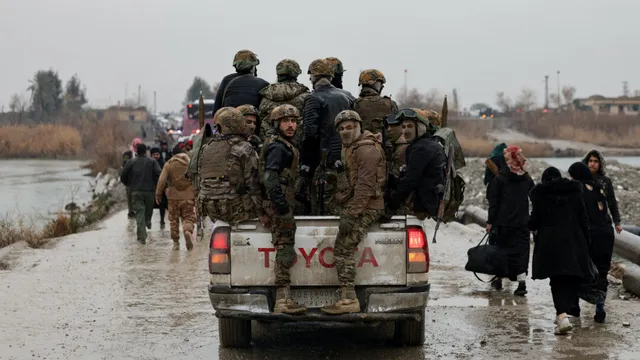
ISIS claims responsibility for attacks on Syrian army in Syria
ISIS claims responsibility for attacks on Syrian army in Syria
- ISIS announced it targeted Syrian army personnel during two separate attacks in Syria.
- The first attack occurred in Mayadin with a pistol, while the second involved machine guns in Raqqa.
- These attacks mark a new phase of operations against the Syrian regime, signaling an increased aggression from ISIS.
Story
In an escalation of its violent actions, the Islamic State of Iraq and Syria (ISIS) claimed responsibility for two targeted attacks against Syrian army personnel on February 21, 2026. The group announced these actions through its Dabiq news agency, emphasizing a new phase of operations aimed at destabilizing the Syrian government's forces. The first attack occurred in the city of Mayadin, located in the Deir al-Zor province, where an ISIS member used a pistol to target an individual identified as part of the 'apostate Syrian regime.' This assassination attempt represents a strategic move to intimidate the Syrian government and showcase ISIS's ongoing operational capabilities despite recent territorial losses. In a second incident, military personnel in Raqqa were attacked with machine guns, indicating a shift towards bolder assaults. This change in tactics reflects a broader strategy by ISIS, aiming to regain influence and instill fear within the ranks of the Syrian military. Such actions are not merely isolated incidents; they signal a revitalization of ISIS's operational framework and a concerted effort to challenge the Syrian government’s authority as well as the regional stability. The situation underscores the ongoing complexities of the Syrian conflict, as various factions continue to vie for control and influence in a landscape marked by instability and violence.
Context
The impact of ISIS on the Syrian conflict has been profound and multifaceted, shaping the trajectory of the war and influencing both local and international responses. Since its rise in the early 2010s, ISIS has capitalized on the chaos created by the Syrian civil war, establishing a significant territorial presence and operating through brutal tactics. The group's ideology, rooted in a fundamentalist interpretation of Islam, and its ruthless strategies, including systematic violence and terrorism, have fueled sectarian divisions within the country. As a result, the conflict in Syria has escalated, transforming from a struggle against the Assad regime into a complex war involving diverse actors, including various rebel groups, Kurdish forces, and international coalitions focused on combating ISIS's expansion and influence. The group's actions have not only complicated peace efforts but have also contributed to a humanitarian crisis, displacing millions of civilians and exacerbating suffering among the populace. Over the past years, the international community has mobilized against ISIS, leading to significant military campaigns aimed at degrading its operational capabilities. The US-led coalition, alongside Kurdish forces, has made major strides in reclaiming territory seized by ISIS. However, these military successes come with their own challenges. The vacuum left by ISIS in liberated areas has often led to power struggles among local factions, further complicating efforts to establish stable governance. Additionally, the enduring presence of extremist ideologies among disenfranchised populations poses a long-term threat to peace and stability in the region, as new generations may be drawn to radicalism in the absence of effective governance and economic opportunities. The role of ISIS in the Syrian conflict extends beyond military engagements; it has significantly influenced the geopolitical landscape of the Middle East. The emergence of the group has prompted a realignment of alliances, with countries such as Russia and Iran intensifying their support for the Assad regime as a countermeasure to perceived threats from both ISIS and other rebel factions. Meanwhile, the US and its allies have found it necessary to reassess their strategies in the region, balancing the fight against ISIS with the complexities of supporting anti-Assad forces without exacerbating the situation. These interactions have led to a climate of increased tension and conflict between regional and global powers, making the resolution of the Syrian crisis even more intricate. Despite the losses ISIS has suffered in recent years, the group remains a potent threat, capable of inspiring acts of violence beyond Syria through its propaganda and networks. The long-term implications of its ideology continue to resonate, as returning foreign fighters and the radicalization of individuals within Syria and neighboring countries present ongoing risks. Addressing the legacy of ISIS within the broader context of the Syrian conflict requires a comprehensive approach that prioritizes not only military solutions but also political engagement, economic development, and community reconciliation. Only through such multifaceted strategies can there be hope for a sustainable resolution to the conflict and a path towards lasting peace in Syria.


