

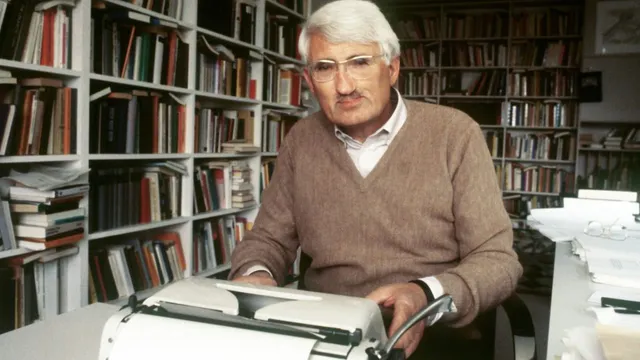
Jürgen Habermas, influential philosopher, passes away at 96
Jürgen Habermas, influential philosopher, passes away at 96
- Jürgen Habermas, a critical philosopher and social thinker, passed away at the age of 96.
- His notable works include "Theory of Communicative Action," which impacted various fields of study such as sociology and communication.
- Habermas's death signifies the loss of a key intellectual figure who influenced philosophical and political thought in post-war Germany.
Story
Germany has lost one of its most significant intellectual figures, Jürgen Habermas, who passed away on March 13, 2026, in Starnberg, near Munich. A prominent philosopher and social critic, Habermas was born in Düsseldorf on June 18, 1929. He became a pivotal figure in post-war German philosophy, known for his work in communication, rationality, and sociology. His rise coincided with a period of profound historical change, as he came of age during the fallout of World War II and the subsequent reevaluation of Nazi Germany's legacy. Throughout his career, Habermas made contributions that transcended academic and philosophical boundaries. He drew attention to the role of rational dialogue in sustaining human societies, positing it as more crucial than traditional notions of political or economic power. His best-known works include the two-volume "Theory of Communicative Action," published in 1981, which influenced fields ranging from political theory to communication studies. He played an essential role in the Frankfurt School, a movement that critiqued capitalism from a distinct 'new left' perspective, diverging from traditional Marxism. Habermas also engaged in political discourse throughout his life, often weighing in on contemporary issues. In the late 1960s, he supported the left-wing student movements and recognized their role in liberalizing German society, although he also expressed concern over certain radical elements within these movements. He critiqued conservative historians during the Historians' Dispute in the 1980s, advocating for a more profound understanding of Nazi crimes and the Holocaust. His political engagement continued as he analyzed the shifts in German governance, notably criticizing Chancellor Angela Merkel's technocratic approach during his long career. As a thinker dedicated to European unity, Habermas viewed the complexities of identity, nationalism, and history within the broader context of the continent. He highlighted the importance of dialogue and mutual understanding in overcoming divisions. His death marked the end of an era, but his philosophical contributions will continue to resonate in both academic circles and public discourse, influencing future generations of thinkers and activists around the world.
Context
Jürgen Habermas is a prominent German philosopher and sociologist known for his contributions to critical theory and public discourse. Born on June 18, 1929, in Düsseldorf, Germany, Habermas emerged as one of the leading figures of the Frankfurt School and is widely recognized for his ideas on communicative rationality and the public sphere. His academic career began after World War II, during which he engaged deeply with the philosophical traditions of Kant, Hegel, and Marx, striving to update Marxist theory within a new democratic framework. His most significant works include "The Structural Transformation of the Public Sphere" (1962), which analyzes the emergence of public opinion and its relationship with the evolving democracy, and "Theory of Communicative Action" (1981), where he elaborates on his concept of communicative rationality, highlighting the importance of communication in understanding social interactions and achieving consensus. Habermas's philosophical outlook is rooted in the idea that rational communication among individuals is essential for societal integration and democratic governance. He argues that the modern public sphere must be a space for rational discourse, where citizens can engage in dialogue to work through differences and arrive at mutual understanding. This view leads to his advocacy for deliberative democracy, a model of democracy that emphasizes the role of discussion and argumentation in political decision-making as a means to ensure legitimacy and responsiveness in governance. His emphasis on dialogue and participation challenges authoritarian forms of governance and seeks to stimulate active engagement among citizens in democratic practices. Throughout his career, Habermas has not only engaged in philosophical discourse but also actively participated in significant political debates in Germany and Europe. His writings often confront contemporary social issues, extending the relevance of his theories to matters such as globalization, the European Union, and the rise of populism. He stresses the necessity for an engaged citizenry that can resist the forces threatening democracy and public discourse. His critical stance towards the commodification of communication under the conditions of capitalism underscores the need for a free and open public discourse that transcends socio-economic barriers, allowing rational debate to thrive. As of today, Jürgen Habermas remains a relevant and influential voice in social theory and philosophy, often participating in public discussions and contributing to ongoing debates about democracy, ethics, and the future of democratic societies. His works continue to inspire scholars, activists, and political theorists to seek out modes of communication that foster understanding and collaboration in an increasingly complex and fragmented world. Habermas's persistent commitment to rational discourse and deliberation positions him as a central figure in the ongoing exploration of the principles that underlie democratic society, cementing his legacy as a thought leader in modern philosophy.


