

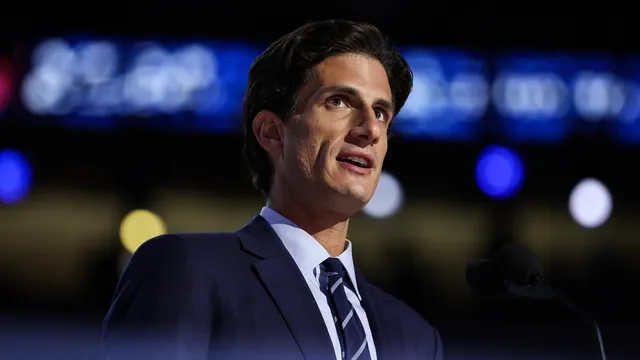
Jack Schlossberg runs for Congress and accuses RFK Jr. of danger
Jack Schlossberg runs for Congress and accuses RFK Jr. of danger
- Jack Schlossberg has officially declared his candidacy for the U.S. House representing New York's 12th district, which is currently held by retiring Jerrold Nadler.
- Schlossberg is leveraging his substantial social media presence to engage younger voters while addressing significant political issues.
- His campaign highlights both personal ambition and a reaction to the current political dynamics, especially concerns over potential constitutional violations by former President Trump.
Story
In 2023, Jack Schlossberg, the grandson of John F. Kennedy, announced his intention to run for a seat in the U.S. House of Representatives representing New York's 12th congressional district. This district is currently held by Jerrold Nadler, who has decided to retire after three decades in office. Schlossberg, 32, expressed the need for representation that harnesses the creativity and energy of the district, pinpointing the significance of having political influence in Washington, particularly amid concerns over a potential unconstitutional third term for former President Donald Trump. His candidacy serves not just as a personal ambition but also as a response to the current political climate, indicating that without control, progress may stall. Schlossberg is not only focused on political issues, but he has also gained a large social media following, amassing over 2 million followers across various platforms. He uses this platform to engage young voters, discussing political commentary with a mix of humor and seriousness. This engagement has helped him become a prominent figure, especially among Generation Z, as he approaches his campaign with modern strategies in mind. Notably, he has been vocal on various issues, including criticizing his cousin Robert F. Kennedy Jr. for his views and actions as the Health Secretary, labeling them as dangerous. His background and lineage as part of the Kennedy family contribute to his public image, with many viewing the Kennedy name as a symbol of political royalty in the United States. New York's 12th district, which comprises influential areas such as the Upper East Side and Midtown Manhattan, serves as a fitting backdrop for Schlossberg’s aspirations to create an impact in Congress. The district's demographic and its connection to the Kennedy legacy enhances the dynamic of his campaign. Jack Schlossberg's foray into politics not only highlights his personal career trajectory but also reflects broader societal questions about generational change in politics, as younger candidates like him challenge older political figures. The dual-focus on engaging in genuine political discourse while maintaining a relatable persona has made him a significant figure in current political discussions, ensuring that his actions—and perhaps his legacy—will continue to be relevant in the evolving American political landscape.
Context
The Kennedy family has had a profound impact on American politics, shaping the landscape of the nation through a combination of charisma, wealth, and tragedy. The political legacy began with Joseph P. Kennedy, a successful businessman and diplomat, whose ambitions set the stage for future generations. His sons, John F. Kennedy, Robert F. Kennedy, and Edward "Ted" Kennedy each carved out unique political paths, influencing policies and public perceptions in significant ways. John F. Kennedy's presidency from 1961 to 1963 brought forth initiatives such as the New Frontier, which aimed to address civil rights, economic equality, and space exploration. His charismatic leadership during the Cuban Missile Crisis solidified his role as a pivotal figure in American history, demonstrating how decisively he could navigate through Cold War tensions. Robert F. Kennedy, who initially served as his brother's Attorney General, emerged as a prominent voice advocating for civil rights and social justice after the assassination of John. His campaign for the presidency in 1968 was marked by his dedication to ending the Vietnam War and his appeal to young voters and marginalized communities. Tragically, his assassination that same year underscored the political violence of the era and left an indelible mark on the American psyche. Meanwhile, Ted Kennedy became a long-serving senator, focusing on healthcare reform and education, and became known as the "Lion of the Senate." His efforts and legislative achievements contributed significantly to shaping the Democratic Party's platform and advancing social welfare policies. The Kennedy family's influence extended beyond individual achievements; it created a political dynasty that emphasized public service and engagement. Their ability to connect with the American public through their personal stories, combined with the challenges they faced, resonated deeply with voters. The concept of the "Kennedy mystique" remains a powerful element in American politics, often invoked by political leaders seeking to capture the same spirit of idealism and change that defined their era. Today, the legacy of the Kennedy family endures through various charitable foundations, political organizations, and the continued involvement of family members in public service. The impact of their efforts is evident in ongoing debates about healthcare, civil rights, and foreign policy. The Kennedy family has demonstrated the potential for political change rooted in empathy and dedication to societal improvement, influencing generations of politicians and activists who seek to follow in their footsteps. Their story remains a testament to the power of political legacy in America, illustrating how individual actions can reverberate through time, shaping the nation's course.


