

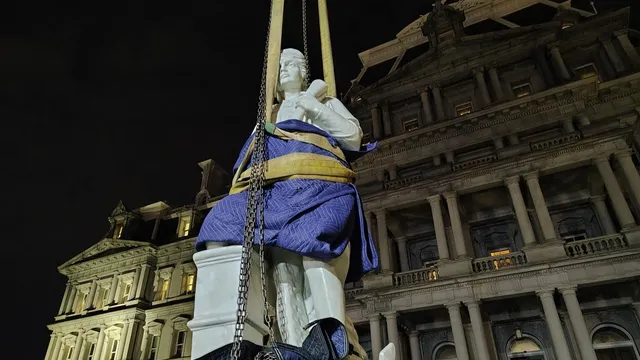
Trump honors Columbus by placing statue near the White House
Trump honors Columbus by placing statue near the White House
- A replica of a Christopher Columbus statue, previously toppled during protests, is now displayed near the White House.
- The statue symbolizes a traditional narrative embraced by some, contrasting with modern movements for Indigenous recognition.
- Trump's administration aims to honor Columbus as a vital historical figure despite growing critique of his legacy.
Story
In Annapolis, Maryland, a replica of a statue of Christopher Columbus has been placed on the grounds of the Eisenhower Executive Office Building, which is adjacent to the White House. The installation was part of President Donald Trump’s administration's efforts to recognize Columbus, a figure often associated with European colonization. The statue was originally toppled by protestors in Baltimore during racial injustice protests in 2020 following George Floyd's death. Trump's decision reflects his endorsing the traditional view of Columbus as a hero while contrasting with recent movements that promote Indigenous Peoples Day instead of Columbus Day. The statue, once part of Baltimore's Little Italy, was unveiled by President Ronald Reagan in 1984 and became a point of contention amidst growing awareness of historical injustices against indigenous peoples. The production and placement of this statue were facilitated by the Italian American Organizations United, whose president, John Pica, agreed to loan it to the government. The restored sculpture, created by Will Hemsley, symbolizes a broader cultural struggle over how history is remembered and who is celebrated in American society. Trump's actions signal a commitment to honoring Columbus against the backdrop of changing societal views on colonialism. Supporters of the installation believe that Columbus' contributions to the New World should not be forgotten, while critiques emphasize the violence and displacement faced by native populations during European exploration. The choice to reestablish the statue symbolizes a nostalgic return to traditional narratives that some communities, particularly among Italian-Americans, associate with their heritage. This juxtaposition aligns with Trump’s larger political narrative, promoting a patriotic interpretation of America’s founding story, contrasting with the acknowledgment of Indigenous narratives that many activists and some state policies are now embracing. In 2021, President Joe Biden made history by being the first U.S. president to mark Indigenous Peoples Day with an official proclamation, thereby shifting the national discourse surrounding Columbus. The controversy surrounding Columbus statues became emblematic of a nation grappling with its colonial past and its implications on modern identity. Trump’s decision to embrace Columbus amid this cultural landscape raises critical questions regarding national identity, historical memory, and the political motivations behind honoring figures with contested legacies.
Context
Columbus Day and Indigenous Peoples Day represent two contrasting perspectives on American history, particularly surrounding the legacy of Christopher Columbus and the experiences of Indigenous peoples in the Americas. Columbus Day, celebrated on the second Monday of October, has historically commemorated Columbus's landing in the New World in 1492, which was long viewed as a moment of discovery and progress. However, this celebration has fueled a growing debate concerning the implications of colonization, including the violence, exploitation, and cultural erasure faced by Native populations following Columbus's arrival. As awareness of these historical truths has increased, many communities have reconsidered how their history is represented, leading to the introduction of alternative observances that honor Indigenous peoples and their histories. Indigenous Peoples Day, which seeks to replace or coexist alongside Columbus Day, emerged as an effort to acknowledge and celebrate Indigenous cultures, histories, and contributions while providing a platform to reflect on the injustices they faced due to European colonization. The recognition of this day varies across the United States; in recent years, several states and municipalities have officially adopted Indigenous Peoples Day to commemorate the resilience and sacrifices of Native American communities. This shift reflects a broader movement towards social justice and the recognition of marginalized narratives in American history, allowing for a more inclusive approach to historical commemoration. The transition from Columbus Day to Indigenous Peoples Day exemplifies a broader societal change in how history is understood and taught. Advocates for Indigenous Peoples Day highlight the need for educational reforms that incorporate diverse perspectives, emphasizing the importance of teaching about the history and cultures of Native peoples rather than romanticized stories of exploration. The conversation surrounding this change is critical in fostering a more equitable society where all perspectives are acknowledged and respected. By embracing Indigenous Peoples Day, societies not only honor the past but also promote reconciliation and healing, encouraging a deeper understanding of historical relationships between colonizers and Indigenous groups. Opposition remains regarding the complete abolition of Columbus Day, with supporters arguing that it represents an important historical figure and the broader age of exploration. Nevertheless, as discussions continue, the movement towards a more accurate retelling of history is gaining momentum. Recognizing Indigenous Peoples Day aligns with efforts across the globe to confront colonial legacies and establish a future grounded in equity and respect for all cultures. This ongoing dialogue not only reshapes national narratives but also invites individuals to consider their roles in addressing historical injustices and fostering a more inclusive society.


