

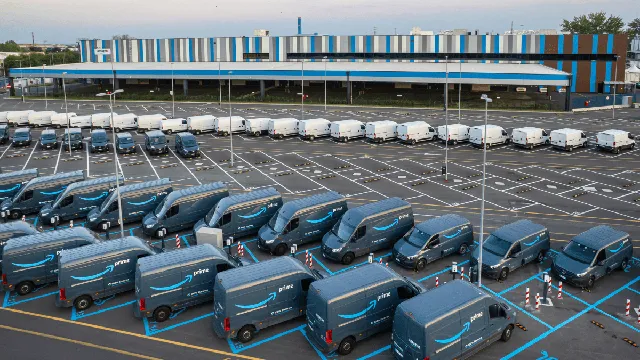
Amazon accelerates delivery with 30-minute service rollout
Amazon accelerates delivery with 30-minute service rollout
- Amazon has introduced Amazon Now, a 30-minute delivery service, in major U.S. metropolitan areas.
- The service aims to meet urgent shopping needs for everyday items and complements Amazon's faster delivery options.
- The expansion of quick delivery services may redefine consumer shopping habits and challenge traditional retail markets.
Story
In recent months, Amazon has announced the rollout of a new delivery service named Amazon Now, designed to provide consumers with urgent access to essential items in under 30 minutes. This service is currently being launched in several major metropolitan areas across the United States, aiming to establish Amazon as a leading provider in the quick commerce sector. Already available in cities such as Atlanta, Dallas-Fort Worth, Philadelphia, and Seattle, the expansion of Amazon Now is set to cover additional locations, with rapid growth in cities like Austin and Phoenix. The introduction of Amazon Now comes alongside a significant enhancement of its Prime delivery offerings, which now include one-hour and three-hour delivery options for over 90,000 products. These delivery services are available not only in major urban centers like Los Angeles and Chicago but also extend to smaller towns, emphasizing Amazon's strategy to reach consumers who may not live in top-tier cities. By implementing these delivery windows, Amazon aims to compete with supermarkets, convenience stores, and food delivery apps for everyday necessities. Additionally, the company is working towards expanding same-day and next-day delivery services to over 4,000 smaller communities across the U.S. This initiative is underpinned by a multi-billion-dollar investment to enhance its delivery network, reflecting Amazon’s commitment to improving access to fast shipping even for rural customers. The company is focusing on making essential items like batteries and dog food available closer to customers' locations to cater to urgent needs. However, while the fast delivery strategy appears promising, Amazon is also pursuing drone delivery options through its Prime Air service. This initiative faces various technical and regulatory challenges but represents a futuristic aspect of Amazon's delivery vision. Ultimately, the company's push into ultra-fast delivery services aims to position Amazon as a default choice for consumers' immediate shopping demands, effectively reshaping the retail landscape in the United States.
Context
The rise of quick commerce has significantly altered the landscape of traditional retail, introducing new dynamics that challenge established business models. Quick commerce, or q-commerce, refers to rapid delivery services that enable consumers to receive products within a short time frame, often within an hour of placing an order. This development has been fueled by advancements in technology, increased mobile device usage, and changing consumer expectations for convenience and speed. As a result, traditional retailers find themselves in a race against time, seeking to adapt and integrate swift delivery solutions into their existing operations to meet customer demands. Traditional retail has long operated on a model that relies on physical store locations and in-person shopping experiences. However, the emergence of q-commerce platforms has shifted consumer preferences toward the convenience of online shopping and swift deliveries. This shift has led to an accelerated decline in foot traffic to brick-and-mortar stores, particularly in urban centers where q-commerce is most prevalent. Retailers now face the daunting task of not only enhancing their online presence but also re-evaluating their supply chains to ensure they can compete with the speed and efficiency that q-commerce providers offer. Additionally, the competitive pressure exerted by q-commerce has prompted traditional retailers to innovate and diversify their service offerings. Many are exploring partnerships with third-party logistics providers to streamline their delivery processes or investing in their proprietary delivery systems. Some retailers are also leveraging advanced data analytics and artificial intelligence to optimize inventory management, ensuring they can meet quick delivery promises while still offering consumers a wide selection of products. This transformation is not without its challenges, as transitioning to a q-commerce model requires significant investment and strategic planning. In conclusion, the impact of quick commerce on traditional retail is profound, compelling retailers to rethink their strategies in order to remain relevant in a rapidly evolving marketplace. As consumer behavior continues to shift towards valuing convenience and speed, traditional retailers must adapt by embracing technology and reimagining their operations. The successful integration of quick commerce solutions will not only enhance consumer satisfaction but also determine the survival and competitiveness of traditional retail players in the long term.


