

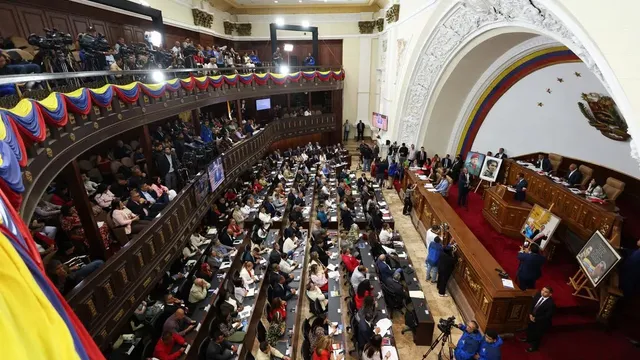
Venezuela considers amnesty law for political prisoners amid turmoil
Venezuela considers amnesty law for political prisoners amid turmoil
- An amnesty law is proposed in Venezuela to grant clemency to individuals jailed for political dissent.
- The law aims to restore assets to the detainees and facilitate their return to the country.
- This proposed legislation reflects the ongoing political tensions and civil unrest in Venezuela, highlighting the need for reform.
Story
In Venezuela, political tensions have intensified following the capture and deposition of President Nicolas Maduro by U.S. forces. An amnesty law was introduced in early February 2026 by the interim president Delcy Rodriguez, aimed at granting clemency to individuals jailed for engaging in political protests. This proposed law includes provisions for the return of assets to those detained and aims to cancel international measures against them, allowing them to return home without legal repercussions. The law, however, specifically excludes those guilty of serious crimes such as human rights violations and corruption, indicating a government attempt to balance political stability with public accountability. Many Venezuelans express concerns about the ongoing turmoil and its implications on their daily lives. Reports depict an environment of confusion, anxiety, and heightened security measures, as police checkpoints and rumors of roadblocks managed by pro-government groups circulate. Citizens have described feeling unsafe while voicing political dissent and live in a constant state of uncertainty regarding the future. While the economy has shown signs of improvement in terms of food availability, the lack of money and resources significantly hinders access, pushing many individuals to stock up on essentials. The proposed amnesty law comes in response to mounting pressure from civil society and international observers following numerous political protests that resulted in substantial arrests over the years, particularly after contested elections and social unrest experienced in 2007, 2014, 2017, 2019, and most recently in 2024. The proposed law reflects the ruling party's ongoing negotiations with the U.S., focusing particularly on oil deals while addressing the plight of opposition members classified as political prisoners. Even as the government contemplates the law's implications, its effectiveness remains under scrutiny by human rights organizations, which seek to ensure broader protections for those wrongfully jailed. The situation in Venezuela continues to evolve as lawmakers deliberate the specifics of the amnesty bill, and public opinion remains divided. While some citizens express support for the ruling party's social policies that provided improvements during Hugo Chávez's presidency, others grapple with the realities of corruption, violence, and erosion of political freedom under Maduro's regime. This latest legislative effort is a critical indicator of the current administration's stance towards political dissenters and its broader intentions in the volatile political landscape of Venezuela.
Context
Venezuela has a complex history of political protests that can be traced back to the early 20th century but gained significant momentum in the late 20th and early 21st centuries. The protests often stemmed from widespread discontent with the government’s economic policies and political repression. Political unrest became particularly pronounced during Hugo Chavez's presidency from 1999 to 2013, as his authoritarian style and socialist reforms garnered opposition from various sectors of society. Chavez’s populist policies initially garnered widespread support among the poor, but over time economic mismanagement led to rampant inflation, shortages of basic goods, and increased political polarization, setting the stage for civil unrest. The opposition grew stronger with widespread protests in 2002, which attempted a coup against Chavez and subsequently led to a national dialogue on democracy and governance, showcasing the deep divisions in Venezuelan society at the time. Following Chavez's death in 2013, his successor, Nicolas Maduro, faced intensified protests fueled by declining living standards and allegations of electoral fraud. The situation worsened in the years leading to 2019 as a multi-faceted crisis unfolded, including severe humanitarian conditions, economic collapse, and political instability. The opposition leader Juan Guaido declared himself interim president in January 2019, leading to massive protests against Maduro's government, supported by various international actors. These protests mobilized millions of Venezuelans, who expressed their frustrations associated with the deteriorating situation, but despite the unrest, Maduro’s regime has persisted, employing heavy-handed tactics to suppress dissent and maintain control. The international community's response to the protests has been mixed. While organizations such as the European Union and the Organization of American States have condemned the crackdown on protests and called for dialogue, countries like Russia and China have provided political and economic support to the Maduro government, complicating efforts for a peaceful resolution. The protests in Venezuela have frequently turned violent, resulting in numerous deaths and injuries, with reports of human rights violations by security forces. Furthermore, the role of citizen-led organizations and social movements has been crucial in articulating dissent and galvanizing support for protests, even in the face of repression. Sustained civil society activism has provided a counter-narrative to the government’s portrayal of the situation, demonstrating the complexity of the protests and the varied motivations behind them. As of early 2026, the political landscape in Venezuela remains fraught with tension as economic challenges continue and the opposition struggles to unify against a backdrop of persistent state repression. The protests have shifted in character over time, reflecting the evolving grievances of the population amidst attempts by the government to stifle dissent. The long-standing economic, social, and political crises in Venezuela suggest that the cycle of protests may continue, with the potential for new movements arising as societal conditions deteriorate further. Understanding the historical context of protests in Venezuela is critical for analyzing the current dynamics and anticipating future developments in this deeply divided nation.


