

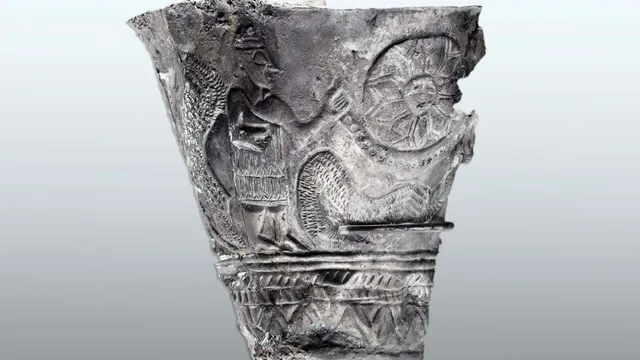
Ancient goblet reveals oldest creation myth imagery
Ancient goblet reveals oldest creation myth imagery
- A 4300-year-old silver goblet discovered in the Palestinian West Bank features imagery depicting the cosmos forming from chaos.
- The goblet's scenes include a snake and a chimera, suggesting narratives of cosmic order prevailing over chaos.
- This discovery points to a significant understanding of early creation myths and their artistic representations in ancient societies.
Story
Recently, archaeologists discovered a silver goblet in the Palestinian West Bank that dates back over 4300 years. This artifact features artistic depictions believed to represent the formation of the universe from chaos, marking it as the oldest known visual representation of a creation myth. The goblet's imagery includes a large snake facing a chimera standing over a small circle, and another scene with a snake under a larger circle adorned with a smiling face. Researchers assert that these visuals suggest a narrative where chaos is ruled by a powerful entity, depicted as the snake, while the sun is portrayed as powerless beneath the chimera's legs. The analysis led by researcher Zangger and his team posits that the imagery on the goblet offers insights into early cosmological beliefs, aligning with certain cuneiform texts from the Fertile Crescent that describe how deities separated the heavens from the Earth. This discovery highlights how ancient civilizations conceptualized creation, evidenced by the absence of traditional battle scenes which are common in later mythologies. Instead, it points toward an interpretation of harmonious cosmic order emerging from chaos. The scholarly community has sparked a debate around the interpretation of the artwork, with several researchers suggesting alternative meanings, such as its symbolism relating to seasonal cycles representing birth and death. However, Zangger and colleagues believe their interpretation of the chaos and celestial transition is closer to the original intent of the artisans who crafted the goblet. Moreover, the discovery challenges previous assumptions about the region's artistic and mythological history by connecting it with much older structures like Göbekli Tepe, which also features celestial motifs. This relationship indicates a shared cultural heritage among ancient societies and prompts further exploration into the cosmological narratives that shaped their worldviews. Ultimately, this ancient artifact serves not only as an artistic achievement but also as a significant piece of historical evidence regarding early human beliefs about the cosmos.


