

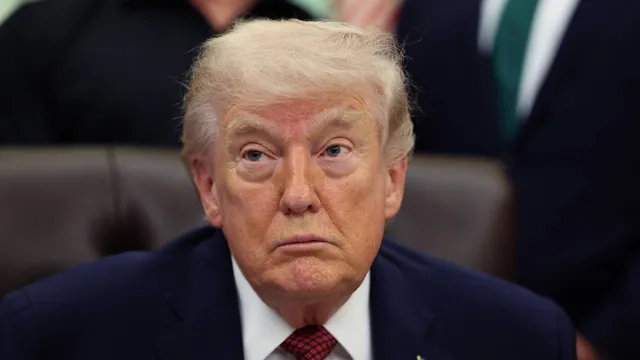
Alex Jones states Trump will be impeached if Democrats gain House control
Alex Jones states Trump will be impeached if Democrats gain House control
- Alex Jones believes Trump will be impeached again if Democrats retake the House in the upcoming midterm elections.
- Prediction markets show a rising likelihood of impeachment, reaching nearly 29 percent odds.
- Despite the increasing chatter about impeachment, considerable challenges remain due to Republican control of the Senate.
Story
In recent months, the political landscape has shifted dramatically in the United States, particularly concerning President Donald Trump's potential for impeachment. Right-wing commentator Alex Jones made assertions about Trump facing an additional impeachment if Democrats regain control of the House of Representatives in upcoming midterm elections scheduled for November. Trump's presidency has historically been turbulent, marked by two previous impeachments—each culminating in acquittals by the Senate. Nevertheless, Jones believes that the outlook for Trump is increasingly precarious as Democrats are expected to gain seats in the midterms, propelling another impeachment attempt. As of April 2026, prediction markets, such as Kalshi, reflect an alarming trend for Trump, showing a near 29 percent chance of impeachment as of early Monday. This figure represents a significant increase in predictions, rising from around 22.1 percent just weeks earlier. It signals a growing belief among traders that Trump could soon face serious consequences as political dynamics shift. Despite this perception among the public and in prediction markets, White House officials have dismissed the likelihood of impeachment, describing it as mere chatter from Democrats who have long aimed to remove Trump from office. Senators have voiced skepticism too, emphasizing that backing for impeachment would presumably remain staunchly opposed by Republicans, who hold a majority in the Senate. With Trump's declining approval ratings—now reported at 37 percent, marking a low point for his second term—his support among Republican voters is also waning, partly attributed to controversies like the Iran war. In a political environment where Trump's party could soon find itself without legislative support, calls for impeachment have reignited. Congressional Democrats are considering options like the 25th Amendment for potential removal. Nonetheless, that amendment requires a majority of cabinet members and the vice president to agree, a scenario unlikely with many appointees being Trump's loyalists. Amidst these discussions, 78 House Democrats have endorsed a bill led by Representative Jamie Raskin advocating for a nonpartisan committee that would allow the pursuit of presidential removal without needing a majority of the cabinet or vice president. This committee would consist of medical professionals and previous officials from both parties to evaluate the president's fitness to serve. Concerns regarding Trump's recent conduct—which included alarming statements about potential violence—have fueled these discussions further. However, there remains considerable inhibition about impeachment proceedings actually moving forward, with prominent Democrats expressing doubts about the effectiveness of initiating another impeachment effort. In sum, as the midterm elections approach, the political atmosphere surrounding President Trump intensifies, making the implications of potential impeachment a pressing issue. In this charged atmosphere, while the threat of impeachment looms again, its successful execution depends heavily on evolving political dynamics and public support. Thus far, the prospect of Trump's removal remains dubious as Republican dominance in the Senate poses a formidable barrier to any serious impeachment endeavors.
Context
The historical impeachments of Donald Trump are significant events in American political history, reflecting deep divisions within the nation and raising questions about the parameters of presidential conduct. Donald Trump, the 45th President of the United States, faced impeachment twice during his term, an unprecedented occurrence that underlines the contentious nature of contemporary American politics. The first impeachment took place in December 2019, spearheaded by allegations of abuse of power and obstruction of Congress in relation to the Ukraine scandal. It was alleged that Trump solicited foreign interference in the 2020 presidential election by requesting that Ukraine investigate his political rival, Joe Biden, and his son, Hunter Biden. The House of Representatives, predominantly controlled by Democrats, voted to impeach Trump along largely partisan lines, making him the third president in U.S. history to be impeached. The Senate trial that followed in early 2020 resulted in Trump's acquittal, predominantly due to a Republican majority that rallied around him, showcasing the partisan split in Congress over the impeachment issue. The second impeachment occurred on January 13, 2021, in the aftermath of the Capitol riot on January 6, where a mob of Trump supporters breached the U.S. Capitol in an attempt to overturn the election results that had declared Joe Biden as the winner. This impeachment was on the grounds of incitement of insurrection, whereby Trump was accused of encouraging violence against the government through his rhetoric before the riot. The House once again voted mostly along party lines to impeach him, making Trump the first president to be impeached twice. Following this, a Senate trial was held, but once again, Trump was acquitted, despite a small number of Republican senators crossing party lines to vote for conviction. The outcome of this trial not only affirmed the deep political divides within Congress but also illustrated the challenges of holding a president accountable for actions viewed by many as undermining democracy. Both impeachments ignited widespread public debate about the effectiveness and implications of the impeachment process itself. Critics argue that the impeachments of Trump represented a misuse of congressional power, while supporters contend that they were essential for upholding constitutional norms and defending the integrity of the electoral process. These events have sent ripples through American society, influencing political discourse and galvanizing both Trump's supporters and detractors. The impeachments also reflect broader concerns regarding the role of partisanship in governance and the extent to which electoral and constitutional accountability should be pursued against a sitting president. Looking back, the historical impeachments of Donald Trump serve as a stark reminder of the volatile nature of U.S. political life and the ongoing debates surrounding presidential power and accountability. As future historians examine these events, they will likely underscore the significance of these impeachments in shaping both the legacy of the Trump presidency and the landscape of American political relations. This moment in history invites reflection on the mechanisms of democratic accountability and the foundational principles that govern the nation's leadership.


