
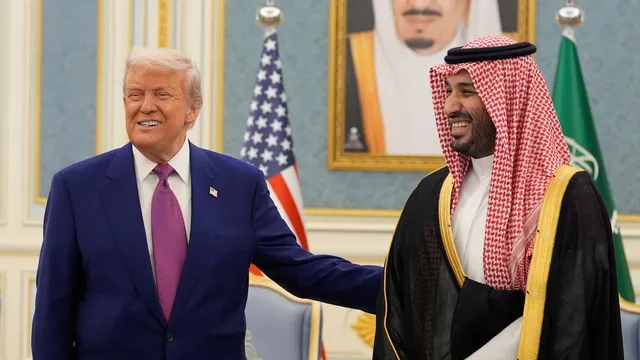
Trump plans controversial F-35 sale to Saudi Arabia
- President Trump announced plans to sell F-35 fighter jets to Saudi Arabia despite concerns from national security officials.
- The deal is part of broader discussions during Crown Prince Mohammed bin Salman's visit to the U.S.
- The F-35 sale could change military dynamics in the Middle East, raising alarms about Israel's qualitative military edge.
Story
On November 17, 2025, President Donald Trump announced the intention to sell advanced F-35 fighter jets to Saudi Arabia during a press conference at the White House. This significant arms sale, which includes a request for 48 jets, is notable as it would give Saudi Arabia military capabilities previously only held by Israel in the region. The announcement coincides with the planned visit of Saudi Crown Prince Mohammed bin Salman, who has been under scrutiny for his regime's actions, notably the murder of journalist Jamal Khashoggi in 2018. Trump's move has raised concerns among national security officials and lawmakers, who fear potential risks to U.S. technology and Israel's military advantage as Riyadh has a security partnership with China. The arms deal has stirred controversy due to the implications for Israel's regional power dynamics, as the country currently relies on its F-35 aircraft for air superiority. Lawmakers and defense experts have expressed unease about the technology transfer, warning that it could compromise strategic advantages over adversaries like Iran. Trump characterized Saudi Arabia as a great ally and emphasized the strategic importance of the sale, framing it within the context of Middle Eastern unrest and opposition to Iran’s nuclear capabilities. Furthermore, there is political pressure domestically concerning the sale, with some Republican members of Congress suggesting a delay until Saudi Arabia formally establishes relations with Israel. This reflects ongoing debates about U.S. foreign policy in the Middle East, particularly regarding the conditions under which advanced military technology is shared with nations that do not have formal diplomatic relations with Israel. Trump has pushed for Saudi normalization with Israel through the Abraham Accords, but the path to such agreements remains fraught with challenges due to regional conflicts and the Palestinian situation. As Crown Prince Mohammed bin Salman arrives in the U.S., discussions around the F-35 deal will likely dominate his meetings with Trump, alongside other investment agreements and security collaborations. This visit marks an important moment in the shifting landscape of Middle Eastern alliances and U.S. defense strategy as the administration navigates complex relationships in a region characterized by volatility and longstanding hostilities.
Context
The defense partnership between China and Saudi Arabia represents a significant evolution in geopolitical relations, reflecting broader trends in global military collaboration and strategic alliances. As both nations seek to bolster their defensive capabilities and enhance regional security, their alliance has garnered attention for its potential implications for both Middle Eastern stability and global power dynamics. This partnership is characterized by increased military cooperation, technology exchange, and joint exercises, positioning both countries to better address emerging threats in their respective regions while countering external influences, particularly from the United States and its allies. Central to this partnership is the exchange of technology and arms, with China emerging as a critical supplier for Saudi Arabia’s military modernization efforts. The Kingdom has initiated several projects aimed at developing its domestic arms industry, with Chinese companies playing an influential role. Through these transactions, Saudi Arabia is not only acquiring advanced weaponry but also seeking to enhance its indigenous production capabilities. This shift symbolizes Riyadh's intention to reduce dependency on traditional defense partners, thereby asserting greater autonomy in its defense procurements, and fulfilling its Vision 2030 plan aimed at diversifying the economy while enhancing national security. Moreover, military exercises and cooperative training programs have become a cornerstone of the Sino-Saudi defense relationship. Such initiatives are designed to promote interoperability between the two nations' armed forces, allowing for more effective responses to security challenges. These activities not only strengthen military ties but also serve as a platform for intelligence sharing and strategic dialogue, further solidifying the partnership. The focus on counter-terrorism initiatives and maritime security, particularly in the context of the Red Sea and Gulf regions, underscores the strategic importance of this alliance in safeguarding regional interests against common threats. In summary, the defense partnership between China and Saudi Arabia signifies a transformative phase in international relations, where traditional alliances are being reconsidered in favor of pragmatic collaborations based on mutual interests. As both nations continue to navigate the complexities of their respective security environments, this partnership is likely to evolve, potentially influencing the balance of power in the Middle East and shaping the dynamics of global military engagements. The implications of this alliance extend beyond bilateral relations and could have far-reaching effects on international security paradigms in the coming years.
