

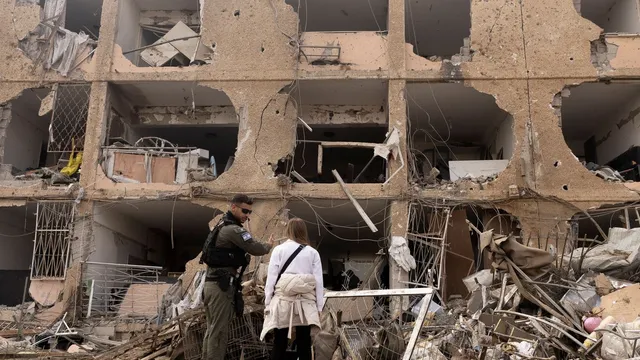
Israel vows to continue war with Iran until regime collapses
Israel vows to continue war with Iran until regime collapses
- The war started on February 28, 2026, with a U.S. and Israeli strike killing Iranian Supreme Leader Ayatollah Khamenei.
- Israeli officials, including Ambassador Michael Leiter, are committed to continuing military actions until the Iranian regime collapses.
- The ongoing conflict has raised questions about U.S. military strategy and the implications of escalating tensions in the region.
Story
The ongoing conflict involving Israel and Iran has escalated significantly over the past month, particularly following a series of devastating attacks carried out by Iranian forces across Israel. This military engagement began when U.S. and Israeli forces launched a coordinated operation targeting Iranian installations on February 28, 2026, resulting in the death of Ayatollah Khamenei, the Supreme Leader of Iran. However, since this initial engagement, efforts to dismantle the Iranian regime have faced substantial setbacks, with progress stagnating and the Iranian government displaying resilience against the assaults. Israeli officials, particularly the head of the Israeli armed forces, General Eyal Zamir, have indicated that the conflict is far from conclusion, contradicting claims made by U.S. President Donald Trump regarding the potential winding down of military efforts in the region. Michael Leiter, Israel's ambassador to the U.S., emphasized the necessity of ongoing military action, stating that Israel would not relent until reaching a point of total regime collapse in Iran. This sentiment reflects a broader strategy that aims not only at neutralizing Iranian military capabilities but at destabilizing its government entirely. The war, which the Trump administration originally suggested would last no longer than four to six weeks, has now extended beyond this timeframe without a clear exit strategy. Recent escalations included rights abuses and threats of attacking civilian infrastructure as a means of exerting pressure on Iran. Concurrently, the conflict has led to significant geopolitical implications, such as the blockade of the strategic Strait of Hormuz by Iranian forces, crucial for oil transportation in the region. The Trump administration faces scrutiny over its military strategy, as questions arise about the true motivations behind such aggressive actions against Iran and the alleged imminent threats reported to justify this war. The U.S. intelligence community has produced conflicting narratives regarding Iran's nuclear ambitions, leading to confusion and emerging skepticism about whether the military campaign is necessary. As the war continues, financial implications mount, with wartime funding requests reaching significant figures, raising concerns among American citizens regarding costs and consequences of the ongoing conflict.
Context
The historical context of U.S.-Iran relations is a complex narrative shaped by a series of pivotal events culminating in both cooperation and conflict. Initially, the relationship between the United States and Iran was relatively amicable, with the U.S. supporting the 1953 coup that reinstated the Shah, Mohammad Reza Pahlavi, after he had nationalized Iranian oil. This intervention established a long-standing alliance between the U.S. and Iran, which lasted for decades as the Shah's regime promoted Western interests in the region. However, growing discontent with autocratic governance and the Shah’s policies, coupled with increasing Western influence, sowed the seeds of revolution in Iran, leading to the establishment of the Islamic Republic in 1979 under Ayatollah Khomeini. This marked a significant turning point in U.S.-Iran relations, transitioning from cooperation to hostility. The U.S. Embassy hostage crisis that same year, where 52 American diplomats and citizens were held hostage for 444 days, epitomized this shift and led to the severance of diplomatic ties between the two nations, a rift that has yet to heal fully. The following decades were characterized by a series of escalating tensions, including the Iran-Iraq War in the 1980s, during which the U.S. provided support to Iraq. Following the war, U.S. relations with Iran became increasingly adversarial, particularly in the context of Iran's support for groups viewed as terrorist organizations by the U.S. and its allies, as well as its pursuit of nuclear technology. The 2000s saw heightened concerns regarding Iran's nuclear program, leading to international sanctions aimed at curtailing its capabilities. Notably, the U.S. classified Iran as part of the "Axis of Evil" in 2002, further intensifying hostilities and rhetoric. Meanwhile, Iran’s regional involvement in the contexts of Iraq and Syria contributed to the perception of Iran as a destabilizing force in Middle Eastern geopolitics, causing alarm among neighboring countries and prompting a range of countermeasures by the U.S. and its allies. A significant diplomatic effort was made during the Obama administration, resulting in the Joint Comprehensive Plan of Action (JCPOA) in 2015, which aimed to limit Iran's nuclear program in exchange for the lifting of sanctions. This agreement represented a temporary thaw in relations and was seen as a diplomatic milestone; however, its implementation faced numerous challenges, including skepticism from Iran's hardliners and periodic violations by both sides. In 2018, the Trump administration's decision to unilaterally withdraw from the JCPOA and reinstate heavy sanctions against Iran marked a severe setback, leading to heightened tensions, military confrontations, and increased hostility in the region. The subsequent killing of Iranian General Qasem Soleimani in a U.S. drone strike in early 2020 catalyzed further escalation, provoking Iran to retaliatory actions, including attacks on U.S. military bases in Iraq. In recent years, the prospect of diplomatic engagement has lingered amid ongoing tensions, particularly with the developments of the Biden administration signaling a potential return to negotiation regarding the nuclear deal. However, the path to rapprochement remains fraught with obstacles, including deep-rooted mistrust, regional power dynamics, and the complex domestic politics within both countries. The historical context of U.S.-Iran relations thus illustrates a tumultuous relationship marked by both conflict and cautious attempts at diplomacy, reflecting broader geopolitical tensions and the evolving landscape of Middle Eastern politics.


