

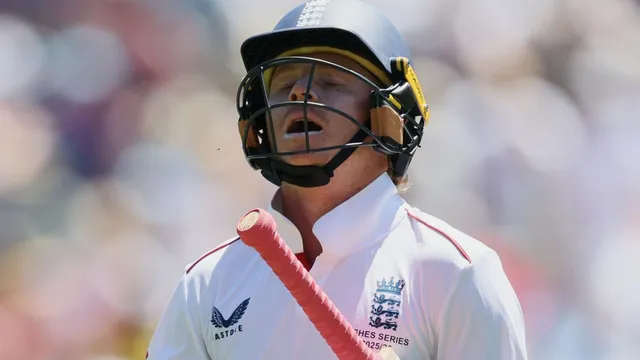
BBG Sports admits Snicko error costs England in Ashes Test
BBG Sports admits Snicko error costs England in Ashes Test
- England's decision review system faced criticism after a miscalibration of the Snicko technology during a crucial moment in the Ashes Test.
- BBG Sports acknowledged their fault, stating the Snicko operator selected the wrong mic, which contributed to the erroneous decision.
- The incident has led England to consider lodging a formal complaint regarding the reliability of the technology used in the series.
Story
During the first day of the third Ashes Test held in Australia, England faced a controversial decision that impacted their innings. England's appeal against Australian batter Alex Carey was denied by the umpire despite a Snicko spike indicating a potential edge. This situation occurred when Carey was at 72 runs, attempting to cut a delivery from Josh Tongue. Following an appeal, the Snicko technology failed to align the audio and visual evidence correctly, allowing Carey to continue his innings and eventually score a crucial century. BBG Sports, the company behind the Snicko technology, publicly acknowledged their fault and stated that the Snicko operator likely selected the incorrect stump mic for audio processing at the critical moment. This misalignment of technology has raised concerns among the England team, prompting their bowling coach David Saker to express dissatisfaction regarding the reliability of the Snicko system throughout the series. Saker indicated that the team may formally lodge a complaint regarding the technology’s performance after this incident, highlighting a growing mistrust among the England players regarding the decision review system. Historically, there were previous instances in the series where the Snicko technology appeared inaccurate, further eroding confidence. Despite the controversies surrounding the technology, Alex Carey went on to complete his century in front of a supportive home crowd, enjoying a standing ovation as he reached the milestone. Conversations around the spirit of cricket regarding this match also gained traction, framing Carey both as a hero and as a controversial figure among England fans due to the nature of the dismissal appeal. The test match proceeded with reduced clarity about the effectiveness of technological aids, leading to broader discussions about the future use of such systems in cricket.
Context
The Decision Review System (DRS) technology in cricket has revolutionized the way the game is officiated, providing players and teams the opportunity to appeal against on-field decisions made by umpires. Initially introduced in the mid-2000s, DRS was aimed at minimizing the number of incorrect decisions, leveraging technology to enhance the accuracy and fairness of the game. The advent of advanced technology such as Hawk-Eye, Ultra Edge (also known as Snickometer), and ball-tracking systems has been a game-changer. Hawk-Eye, in particular, uses a series of cameras positioned around the stadium to create a 3D representation of the ball's trajectory, allowing umpires to make more informed decisions regarding lbw (leg before wicket) appeals. The implementation of DRS has seen a gradual acceptance in international cricket, beginning with trials during Test matches before expanding to One Day Internationals (ODIs) and Twenty20 matches. Initially met with skepticism from players and officials alike, the DRS gained credibility as technological advancements improved its reliability and accuracy. The International Cricket Council (ICC) officially sanctioned DRS for all Test matches in 2009, with the system evolving to incorporate feedback and adjustments based on its use in matches and the preferences of teams and players. Umpires can now rely on DRS to assist them in making critical decisions, with certain limitations in place to address concerns about over-reliance on technology for decision-making. As of 2025, DRS continues to be an integral part of cricket, though it has not been without its controversies. The clear guidelines established for its use, such as the number of unsuccessful reviews available to each team, aim to maintain the balance between the authority of the on-field officials and the technological aids. Criticisms have arisen regarding the accuracy of certain components, particularly in edge detection or in cases when the ball trajectory is too close to call; nevertheless, adaptations in its implementation, like the introduction of on-field umpires' call, have helped mitigate many of these issues. Consequently, the DRS remains a work in progress, consistently refined through application and feedback from the cricketing community. In conclusion, the history of DRS technology in cricket encapsulates a journey of innovation and adaptation, demonstrating how technology can enhance the integrity of sports. Its continuous development and integration into the sport reflect cricket's evolving nature and the need to embrace modern solutions to traditional challenges. As cricket moves forward, the anticipation surrounding future advancements in DRS will likely focus on further refining existing technologies and improving player and spectator trust in the review systems, ensuring that the spirit of the game is upheld.


