

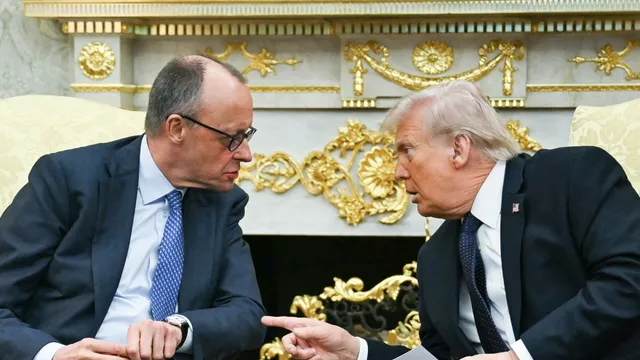
Trump reviews U.S. troop presence in Germany amid rising tensions
Trump reviews U.S. troop presence in Germany amid rising tensions
- President Donald Trump announced the U.S. is actively reviewing its troop levels in Germany amidst political tensions.
- His statement came in response to German Chancellor Friedrich Merz criticizing the U.S. strategy regarding Iran.
- The decision on troop levels could significantly affect NATO's cohesion and Europe's security posture.
Story
In recent developments, President Donald Trump indicated that the U.S. is contemplating a potential reduction of its military forces stationed in Germany. This announcement followed criticisms from German Chancellor Friedrich Merz, who accused the U.S. of being 'humiliated' by Iran and lacking a coherent strategy concerning the war in the region. On Truth Social, Trump expressed that decisions regarding troop levels would be made in the near future, suggesting that the U.S. might realign its military footprint in Europe. The backdrop of Trump's remarks is characterized by increasing geopolitical tensions and challenges within NATO, particularly in how to confront the Iranian situation and its implications for European security. The U.S. has maintained a significant military presence in Germany since World War II, a legacy intended to deter Soviet aggression during the Cold War. Over the years, troop numbers have fluctuated, particularly peaking during moments of heightened rivalry between East and West. Although post-Cold War dynamics led to a significant downsizing of American forces in Germany, the presence now includes approximately 36,000 active duty servicemen and women, reinforcing NATO's collective defense strategy. However, Trump has frequently criticized European allies for inadequate defense spending, questioning the rationale for such a large deployment of U.S. forces on the continent. Chancellor Merz's recent critique during a university address pointed to a sense of disappointment among European leaders regarding U.S. foreign policy, particularly concerning negotiations with Iran. His comments have introduced an element of tension in U.S.-Germany relations, prompting Trump to respond with sharp rebukes. He characterized Merz's remarks as uninformed, further questioning Germany's economic performance amidst these challenges. The interplay of these criticisms reflects broader anxieties as NATO allies navigate their positions regarding defense spending and international engagements. The potential reduction of American troops in Germany holds significant consequences for NATO unity. Many Eastern European states, given ongoing threats from Russia, have urged the U.S. to maintain a robust military footprint in Europe. If troop levels decline, it could spark a fierce debate within NATO, as different member states weigh the implications for collective security and defense strategies. With the ongoing uncertainty concerning Iran and rising energy costs due to blocked maritime routes, the discussion around U.S. military presence is more critical than ever for the stability of the region.
Context
The impact of U.S. troop reduction on NATO is a critical issue with far-reaching implications for transatlantic security and military cooperation. As NATO continues to evolve in response to global threats, the decision to reduce U.S. troops stationed in Europe demands careful analysis. The presence of American forces has historically served as a deterrent against aggression from adversaries, particularly in Eastern Europe, where nations like Poland and the Baltic states remain sensitive to Russian military actions. Any reduction in U.S. military presence could lead to increased vulnerability among these member states and potentially embolden hostile nations to pursue aggressive policies. Moreover, U.S. troop reductions could alter the strategic posture of NATO as a whole. The alliance’s collective defense principle, enshrined in Article 5 of the North Atlantic Treaty, relies heavily on the commitment and capability of member states to respond collectively to threats. A diminished U.S. presence could undermine this principle, resulting in a shift in defense dynamics. European countries may have to reassess their defense expenditures, capabilities, and readiness to fill the gap left by the U.S., driving a renewed emphasis on European defense initiatives and potentially increasing the call for more strategic autonomy within the EU. In addition to implications for military readiness, U.S. troop reductions could also affect diplomatic relations within the alliance. NATO serves not only as a military alliance but also as a platform for political dialogue and cooperation. The U.S. plays a prominent role in shaping NATO policies and strategies; thus, troop reductions could lead to friction among member states, particularly if allied nations perceive a waning commitment from Washington. This could strain relationships, create friction in decision-making processes, and lead to disagreements on shared security objectives, ultimately weakening NATO’s coherence as a unified entity. Finally, the socio-economic impact of U.S. troop reductions on host nations should not be overlooked. American military bases contribute considerably to local economies, providing jobs and stimulating various sectors. A reduction in troops may result in economic challenges for communities reliant on military presence. Additionally, troop withdrawals can influence public sentiment and political dynamics within host nations, where there might be varying opinions on the continuation of U.S. military support. Therefore, the broader consequences of troop reductions extend beyond military strategy and diplomacy to shape economic stability and social cohesion in host countries, which is critical for maintaining effective alliances.


