

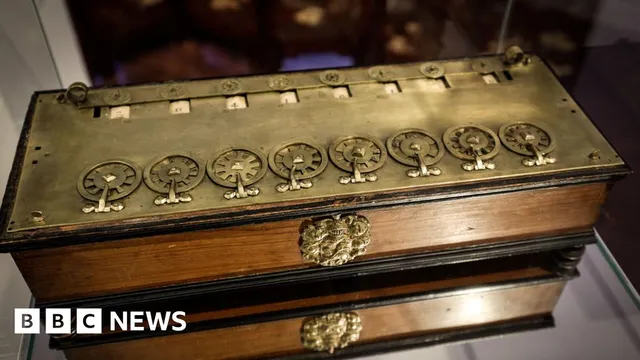
Paris court blocks export of historic calculating machine La Pascaline
Paris court blocks export of historic calculating machine La Pascaline
- A Paris administrative court provisionally blocked the auction of La Pascaline, a significant early calculating machine.
- The decision followed legal appeals from scientists and heritage advocates, asserting its status as a national treasure.
- The case reflects ongoing debates about the significance of preserving historical instruments and cultural heritage.
Story
In Paris, France, a historic calculating machine known as La Pascaline was slated for auction but faced a legal intervention. On an unspecified date, a Paris administrative court provisionally halted the planned sale of this 400-year-old device, designed by mathematician Blaise Pascal in 1642. The court’s decision came as a response to objections from scientists and heritage advocates who argued that the calculator should be classified as a national treasure and preserved for its historical significance. There are only nine units of La Pascaline remaining, making it a rare artifact of early computing. The auction house Christie's had valued La Pascaline between €2 million and €3 million but decided not to proceed with the bidding after the court's provisional ruling. This development occurred despite prior export authorization by France's culture minister, which had been endorsed by experts, including one from the Louvre Museum. However, the court expressed serious doubts regarding the legality of the export certificate, particularly in light of the machine's potential classification as a national heritage object. Following the court's ruling, Christie's expressed their compliance with the decision while awaiting further legal clarity. They emphasized the provisional nature of the ruling and acknowledged the instrument's scientific and historical value, which could support its classification as a protected national treasure. The Association Sites & Monuments, a French heritage group involved in the legal challenge, welcomed the court’s decision, underscoring the importance of preserving notable artifacts like La Pascaline for future generations. This incident not only highlights the ongoing debate regarding cultural heritage and artifact protection but also underscores the significance of La Pascaline as a pioneering invention in the realm of calculation and computing. The case raises broader questions about the ownership, liability, and ethical considerations surrounding historical scientific instruments, particularly as they navigate the complex intersections of commerce, science, and heritage preservation.
Context
La Pascaline, invented by Blaise Pascal in 1642, is recognized as one of the first mechanical calculators. Its creation marked a significant moment in the development of computing technology, paving the way for future innovations. La Pascaline was designed to assist Pascal’s father, who was a tax collector, in performing arithmetic operations more efficiently. This simple yet revolutionary device could add and subtract two numbers directly, and it illustrated the potential for mechanical aids in numerical calculations. The significance of La Pascaline extends beyond its immediate functionality; it symbolized the human quest for efficiency and accuracy in mathematical computation, laying the groundwork for the field of computational devices that would follow over the centuries. The impact of La Pascaline was profound not only at the time of its invention but also in inspiring future generations of inventors and mathematicians. Its introduction represented a shift in how calculations could be performed, moving from manual methods to more reliable mechanical processes. Though it was limited in functionality—and primarily useful for addition and subtraction—the principles behind its design influenced subsequent developments in calculating machines. This shift marked the early stages of automation in mathematics, which would eventually evolve into more complex devices like mechanical calculators and, later, electronic computers. La Pascaline's importance in history lies not just in its invention, but in how it set the stage for subsequent advancements in technology. In the context of the historical progression of mathematics and machine development, La Pascaline holds a revered position. It is often studied within the history of technology as a prime example of early innovation that combined mathematics with engineering. Pascal’s ingenuity in creating this device reflected a growing interest in scientific inquiry and the application of mathematical principles to everyday problems. The machine exemplified the transition from abstract mathematical concepts to practical tools that could help manage and manipulate numerical data effectively. Moreover, La Pascaline is a symbol in the narrative of technological evolution, embodying the spirit of experimentation and the desire to solve complex problems with practical solutions. It laid the foundation for relatives and successors in the realm of calculators, such as Gottfried Wilhelm Leibniz's stepped reckoner and Charles Babbage’s Analytical Engine, showcasing the cumulative nature of technological advancements. In this light, La Pascaline not only served its direct purpose but also played a crucial role in shaping the trajectory of computing, making it an indispensable part of the history of mathematics and technology.


