
military conflicts
uplifting

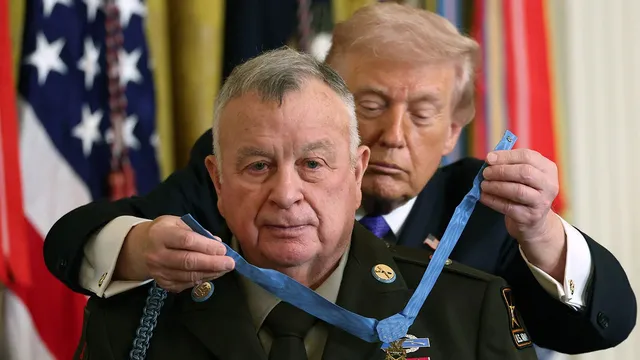
Trump honors soldiers for incredible courage in White House ceremony

Mar 2, 2026, 5:46 PM10
(Update: Mar 2, 2026, 5:46 PM)
president of the United States from 2017 to 2021
land service branch of the United States Armed Forces
official residence and workplace of the President of the United States

Trump honors soldiers for incredible courage in White House ceremony

  • President Donald Trump awarded the Medal of Honor to three U.S. Army soldiers in a White House ceremony.
  • Roddie Edmonds was recognized for saving over 200 Jewish American soldiers during World War II.
  • The event highlights the remarkable acts of bravery exhibited by these soldiers.
Share your opinion
1

Story

In a noteworthy ceremony at the White House, held on Monday, March 2, 2026, President Donald Trump awarded the Medal of Honor to three exceptional U.S. Army soldiers. The event recognized their extraordinary acts of bravery during battle, embodying the very spirit of heroism. One of the honorees, Roddie Edmonds, was hailed for his courageous decision in 1945, where he saved over 200 Jewish American soldiers at the cost of his own safety. He confronted a Nazi officer during World War II, declaring 'we are all Jews here,' which led to the officer lowering his weapon. The other two soldiers, Michael H. Ollis and Command Sergeant Major Terry P. Richardson, were also recognized for their gallant actions. Ollis, remembered for the ultimate sacrifice he made while shielding a wounded Polish soldier, is described by President Trump as an undeniable hero who showed unparalleled bravery in the heat of battle. His act of protection is a testament to the dedication and resilience of the U.S. Armed Forces. This Medal of Honor presentation showcases not only the incredible bravery exhibited by these soldiers but also serves as an enduring reminder of the selflessness found in military service. The ceremony included tributes to their memories and deeds, representing a momentous occasion to honor their legacy. The Medal of Honor is bestowed by the President of the United States to recognize service members who demonstrate gallantry and intrepidity at significant risk to their lives. The recognition honors the valor of those who distinguish themselves by courageous actions beyond the call of duty, setting a high bar for heroism among the ranks of the military.

Context

The Medal of Honor is the United States' highest military decoration, awarded for personal acts of valor above and beyond the call of duty. It was established during the American Civil War on December 21, 1861, and is recognized as a symbol of exceptional bravery and sacrifice. Created initially to honor Union soldiers, the Medal of Honor has evolved over the years to encompass recipients from all branches of the military, including the Army, Navy, Air Force, Marine Corps, and Coast Guard. The establishment of the medal was motivated by the need to acknowledge the heroic deeds of soldiers and to provide a means of recognizing valor in combat, thus setting a standard for honor and bravery that has had lasting implications on military service and American culture. The design of the Medal of Honor has changed slightly since its inception, reflecting different branches of the military and shifting aesthetic sensibilities. The original version, awarded by the Army, features a gold star surrounded by a wreath and bears the image of the goddess Minerva. The Navy and Marine Corps Medals were designed differently, but similarly encapsulate the core values of bravery, sacrifice, and dedication. Over the years, the medal has come to symbolize not only individual courage but also the esteemed history of the U.S. military and its commitment to protecting the nation. The criteria for receiving the Medal of Honor are stringent, requiring thorough investigation and confirmation that the recipient acted in unequivocal defense of their comrades and country. As of today, the Medal of Honor has been awarded to around 3,500 individuals, including notable figures like Theodore Roosevelt, Audie Murphy, and more recently, recipients from the Global War on Terror. Each medal represents a story of extraordinary valor, often in the face of overwhelming odds and grave danger. The stories behind the recipients showcase a diverse range of backgrounds, motivations, and scenarios, highlighting that acts of heroism can come from anyone under the pressure of conflict. The ongoing ceremony to honor recipients signifies not only respect for the individuals but also an acknowledgment of the sacrifices made by military personnel throughout U.S. history. In contemporary times, the Medal of Honor has also faced scrutiny regarding racial and gender inclusivity, with initiatives aimed at rectifying historical omissions. While the vast majority of recipients have been men of European descent, there has been a concerted effort to research and recognize the contributions of individuals from various backgrounds, including women and minority groups. This evolving narrative reflects a broader cultural acknowledgment of diversity and the importance of inclusivity in honoring military service across all demographics. The Medal of Honor ultimately serves as a reminder of the sacrifices made in service to the nation and the virtues of courage and integrity that it stands for.

2026 All rights reserved
