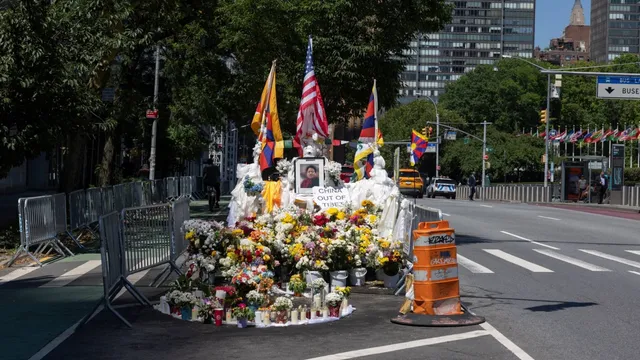
In a tragic event that unfolded near the United Nations headquarters in New York, a Tibetan man named Lobga Rangzen set himself on fire, resulting in his death from severe burns. This incident occurred on July 3, 2026, and was identified by Tibetan advocacy groups as a protest against China's oppressive rule in Tibet. Rangzen, who had been an active participant in peaceful demonstrations advocating for Tibetan rights, livestreamed his final moments on social media, calling for Tibetan independence and unity. His act of self-immolation is noted as the first recorded instance of such a protest by a Tibetan in the United States.
The U.S. State Department responded to this incident by reaffirming its support for the human rights of Tibetans and their aspirations to preserve their culture, language, and religion. A spokesperson emphasized the commitment of the United States to encourage dialogue between China and Tibetan representatives, including the Dalai Lama, without preconditions. This stance reflects a long-standing U.S. policy that has persisted across different administrations, highlighting the importance of human rights protections for Tibetans.
China, on the other hand, has maintained that Tibet is an integral part of its territory and has dismissed international criticisms regarding its governance of the region. Following Rangzen's death, Chinese officials stated that relevant countries should handle the matter according to their domestic laws and asserted that the U.S. is in no position to criticize China on Tibet-related issues. The Chinese government views the Dalai Lama as a separatist and insists on its authority to approve his successor, a point of contention that has fueled tensions between Tibetan advocates and the Chinese state.
Rangzen's self-immolation is part of a broader pattern of protests by Tibetans against the Chinese Communist Party's policies, which have been described as oppressive by international human rights organizations. Since 2009, there have been over 150 self-immolations by Tibetans, primarily within Tibet, as acts of defiance against the Chinese government's control. Advocacy groups have reported that many of these protests are met with severe repercussions, including detentions and disappearances of survivors. The incident in New York has drawn attention to the ongoing struggle for Tibetan autonomy and the dire human rights situation in the region, prompting calls for increased international support for Tibetan rights and freedoms.