

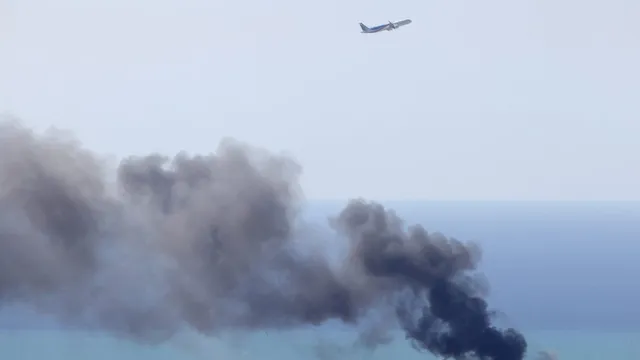
Lebanon keeps airport open amidst rampant airstrikes from Israel
Lebanon keeps airport open amidst rampant airstrikes from Israel
- Lebanon's transport minister Rasamny has decided to keep the airspace open since the start of the war.
- The airport remains operational despite dangerous conditions caused by regular Israeli airstrikes.
- The continuous functioning of the airport highlights both the risks faced by Lebanon and the commitment of its officials to maintain vital air links.
Story
Lebanon, a country facing significant military pressure and uncertainty, has chosen to keep its only international airport open despite the ongoing Israeli strikes. The decision to maintain open airspace was made by Lebanon's transport minister, who emphasized that officials are continually assessing the safety situation at the airport. Regular Israeli airstrikes targeting Hezbollah positions have posed risks, with some explosions occurring alarmingly close to the Beirut-Rafic Hariri International Airport. Since the onset of conflict stemming from Hamas’ attack on Israel in October 2023, the airport has remained a vital lifeline for Lebanon, especially as most international airlines halted flights to the area. While some past events, such as the bombing of the airport in July 2006, raised concerns about safety, officials have found ways to keep flights operating amidst chaos, monitoring developments hourly and adjusting operations accordingly. One passenger recounted witnessing smoke still lingering in the skies as their plane landed, highlighting the precarious situation. The continual operation of the airport is a testament to both the resilience of Lebanon's air traffic management and the courage of the pilots navigating these challenging conditions.
Context
Lebanon's international relations with Israel and Syria are shaped by a complex historical and geopolitical landscape. The ongoing tension with Israel can be traced back to the establishment of the state of Israel in 1948 and the subsequent Arab-Israeli conflicts. Lebanon and Israel have engaged in multiple military confrontations, most notably the 1982 Lebanon War and the 2006 Lebanon War, which were heavily influenced by the presence of Hezbollah, a Lebanese Shiite militant group that opposes Israeli policies. Despite a declared ceasefire, hostilities persist, marked by cross-border skirmishes and mutual accusations of aggression. Diplomatic relations between the two nations remain non-existent, with Lebanon maintaining a policy of resistance against Israeli actions and territorial claims, particularly regarding the Shebaa Farms area, which Lebanon considers occupied territory. In contrast, Lebanon's relationship with Syria is multifaceted, historically characterized by strong political and military ties, especially during the Lebanese Civil War (1975-1990) when Syria intervened on behalf of various factions. Following the civil war, Syria held significant influence over Lebanon's political landscape until its military withdrawal in 2005, prompted by public outcry and international pressure after the assassination of former Prime Minister Rafik Hariri, which many blamed on Damascus. Despite the withdrawal, Syria remains a pivotal player in Lebanon's politics, with various Lebanese factions still aligned with or influenced by Syrian interests, particularly in the context of Hezbollah, which retains strong ties to Damascus. The Syrian civil war, which began in 2011, has further complicated Lebanon's international relations, as it has had a significant spillover effect onto Lebanese territory. The influx of Syrian refugees into Lebanon has strained the country's social fabric and economic resources, challenging its already fragile political system. Lebanese officials have had to navigate a delicate balancing act, maintaining relations with Syrian authorities while addressing internal divisions and external pressures from the international community, particularly regarding refugee policies and border security. Consequently, international relations for Lebanon are marked by a delicate interplay of historical grievances with Israel and a pragmatic, albeit contentious, connection with Syria. Lebanon's positioning is further complicated by the regional geopolitical rivalry between Iran, which supports Hezbollah, and the Gulf Arab states, which are opposed to Tehran's influence. Moving forward, Lebanon's ability to navigate these complex relationships will largely depend on internal political cohesion and external diplomatic engagement aimed at stabilizing its borders and fostering peace in a region marked by uncertainty.


