
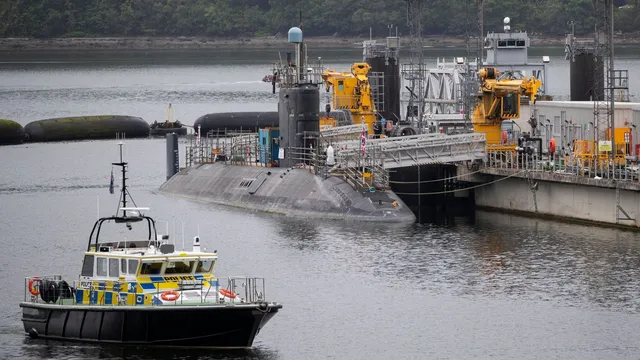
Iranian couple arrested after attempting to breach Faslane naval base security
- On Thursday, at around 5 PM, police apprehended a man and a woman trying to enter Faslane naval base.
- The suspects include a 34-year-old Iranian man; the woman's nationality is currently unknown.
- An ongoing investigation is being conducted by Police Scotland regarding this attempted security breach.
Story
On Thursday, March 19, 2026, a significant security incident occurred at the Faslane naval base in Scotland, which is renowned for housing the United Kingdom's nuclear-armed submarines. Police Scotland reported that two individuals, a 34-year-old Iranian man and a 31-year-old woman, were apprehended while trying to unlawfully enter this critical military facility, which is situated near Helensburgh in Argyll and Bute. Officers became aware of their attempts at approximately 5 PM, leading to immediate action by the police. The Royal Navy confirmed that the suspects had not successfully gained access to the base, and investigations into the incident are ongoing. The identity and nationality of the female suspect remain undisclosed at this time. The arrest of these individuals is particularly alarming in the context of recent geopolitical tensions involving Iran, the United States, and Israel. Following a series of airstrikes on Iran by the US and Israel, which notably resulted in the death of Iran's supreme leader on February 28, there has been an escalated state of response from Iran, including retaliatory attacks on allied states in the Gulf. This backdrop may explain the heightened security measures in place at military installations such as Faslane, home not only to the UK's Vanguard-class ballistic missile submarines but also to a significant number of military personnel. As reports emerge, analysts indicate that the Faslane base, considered Britain's most crucial military installation, likely has significant implications for national security. It supports not only the Royal Navy's nuclear capabilities but also serves as a focal point for various anti-war protests and movements advocating for nuclear disarmament. Groups like the Campaign for Nuclear Disarmament (CND) and Trident Ploughshares have long targeted this site, mounting demonstrations against its operations. Notably, a peace camp has been established outside the base since 1982. Despite the serious nature of the incident and the ongoing nature of the investigation, the Royal Navy has refrained from offering comments beyond confirming the arrests. This restraint raises questions about the nature of the suspects' intentions and the potential security vulnerabilities that might be present at military installations designed to protect nuclear assets. As inquiries continue, further details about the motivations behind the attempted breach and the implications for security protocols at military sites remain to be seen.
Context
The death of a supreme leader in the Middle East can have far-reaching implications that exacerbate existing tensions within the region. The political landscape in the Middle East is often characterized by power vacuums and sectarian divisions, and the demise of a leader, especially one with significant influence, can lead to instability as various factions vie for control. This struggle can escalate into broader conflicts, impacting not only the nation where the leader has passed but surrounding countries as well. As seen in past incidents, such as the aftermath of the Arab Spring and the fall of leaders in countries like Iraq and Libya, power transitions can destabilize an entire region due to the intertwining of local grievances with regional rivalries. The potential rise of extremist groups in this chaotic environment further complicates the situation, making it a breeding ground for violence and conflict. Moreover, the death of a supreme leader can signal a shift in alliances and enmities that have defined Middle Eastern geopolitics for years. Countries may reassess their strategies, as new leadership often brings about changes in domestic and foreign policies. The reaction of regional powers—both adversaries and allies—will play a pivotal role in shaping the aftermath. For example, the power struggles that might ensue can encourage external actors to intervene, which may further inflame tensions and lead to unintended consequences. Historically, when leaders with a significant cult of personality pass away, we have seen both immediate escalations in violence as well as long-term consequences, as new leaders take starkly different approaches to international relations. Public sentiment also contributes significantly to the instability following such a death. The people's reaction can vary widely; some may rally around the new leadership, while others could mobilize against it, especially if there are perceived illegitimacies or grievances tied to the succession. In a region marked by deep-seated mistrust of authority, the legitimacy of the incoming leadership will significantly impact its ability to govern effectively and maintain stability. Local populations may engage in protests, calls for reform, or even armed resistance, complicating the security landscape and further straining relationships between different societal groups. In conclusion, the death of a supreme leader can catalyze a cascade of events that exacerbate tensions in the Middle East, as various factions seek to capitalize on the resulting power vacuum. The implications of such a death are profound, given the region's complex web of alliances, rivalries, and socio-political dynamics. The interplay of direct and indirect consequences underscores the fragility of peace and stability in the Middle East, making it imperative for policymakers to consider the multifaceted repercussions that arise from such leadership transitions.
