

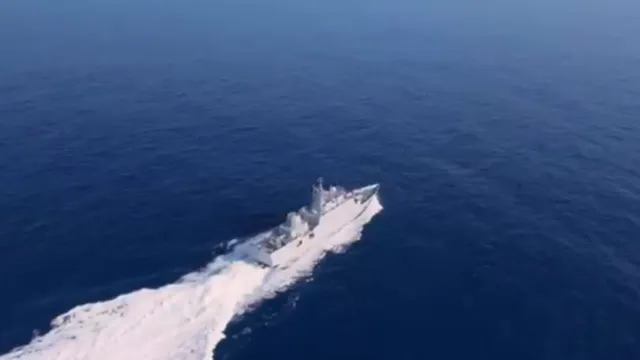
Droupadi Murmu makes history aboard INS Vagsheer submarine
Droupadi Murmu makes history aboard INS Vagsheer submarine
- Droupadi Murmu became the first Indian president to board a submarine since APJ Abdul Kalam.
- She observed operational drills and interacted with the crew of the INS Vagsheer during a two-hour cruise.
- The event reflects India's commitment to enhance its naval capabilities through indigenous construction.
Story
In a groundbreaking move for India, Droupadi Murmu, the President and Supreme Commander of the Armed Forces, participated in a submarine drill aboard the INS Vagsheer. This significant event occurred on a Sunday, marking the first time an Indian president has boarded a submarine since APJ Abdul Kalam’s tenure. The submarine is part of India's indigenous Kalvari-class, which reflects the country's commitment to enhancing its defense capabilities. During her two-hour journey, Murmu observed operational drills and interacted with the crew, reinforcing the importance of undersea warfare in securing national maritime interests. This engagement is not just ceremonial; it symbolizes a powerful statement about India's growing confidence in indigenous naval construction. The INS Vagsheer is notable as the sixth submarine from the French-designed P75 Scorpene project. Commissioned in January, it aims to bolster India's naval strength as part of a strategic initiative involving domestic manufacturing and modernization. As the Indian Navy aims to expand its fleet to over 200 warships and submarines by 2035, President Murmu's involvement underscores the critical role of the submarine force in maritime security. The navy highlighted that such high-profile visits emphasize the integration of the Supreme Commander with the defense forces in operational contexts. By familiarizing herself with current military capabilities, Murmu seeks to bridge the gap between leadership and the practical realities faced by service members. Furthermore, the Indian government actively encourages defense collaborations with friendly nations to enhance its 'Make in India' initiative. Currently, over 54 vessels are being constructed in Indian shipyards, with the expectation that they will all be operational by 2030. This initiative not only aims at bolstering India's defense but also at promoting economic growth through local manufacturing. President Murmu's dive into the depths of the ocean aboard the Vagsheer exemplifies a turning point in India’s naval history, highlighting the significance of submarine capabilities and indigenous production in maintaining a credible deterrence.
Context
The Kalvari-class submarine project represents a pivotal advancement in the underwater warfare capabilities of the Indian Navy. This class of submarines is based on the Scorpène-class submarine design, developed jointly by France's Naval Group and India's Mazagon Dock Limited. The project was initiated to enhance India’s strategic defense capabilities and to maintain regional maritime security at a time when there is an increasing necessity for modern naval assets to counter diverse threats in the Indian Ocean Region. The Kalvari-class submarines are designed for various roles such as anti-surface warfare, anti-submarine warfare, intelligence gathering, and reconnaissance missions, showcasing a multifaceted approach to maritime security. The first of the class, INS Kalvari, was commissioned into service in December 2017, followed by several others, with plans for a total of six submarines to be built under the project. Each submarine is equipped with advanced stealth features, state-of-the-art sensors, and combat systems to ensure operational effectiveness. The submarine's design emphasizes reduced underwater radiated noise, enhanced sensor technology, and sophisticated countermeasure systems, providing the Indian Navy with a substantial edge in both deterrence and offensive operations. The integration of indigenous technologies and systems also showcases India's growing capabilities in advanced defense manufacturing. The Kalvari-class submarines incorporate several modern technological features, including an Air-Independent Propulsion (AIP) system that allows these submarines to remain submerged for extended periods without surfacing. This capability significantly enhances their stealth and operational endurance, making them formidable assets in naval warfare. Their armament includes contemporary torpedoes and anti-ship missiles, which are critical for engaging various maritime threats effectively. Additionally, through the acquisition of these submarines, India aims to bolster its ability to project power in the region, thus improving its deterrence posturing against any potential adversaries. The project reflects India's commitment to indigenization and self-reliance in defense production. Strategic partnerships and collaboration with international defense firms have accelerated the transfer of technology to India, fostering a more robust defense industrial base. The completion and induction of the Kalvari-class submarines into the Indian Navy symbolize a significant milestone in India’s defense modernization efforts. As geopolitical dynamics continue to evolve, the Kalvari-class submarines are poised to play an imperative role in assuring India's maritime security and contributing to the stability of the Indian Ocean Region.


