

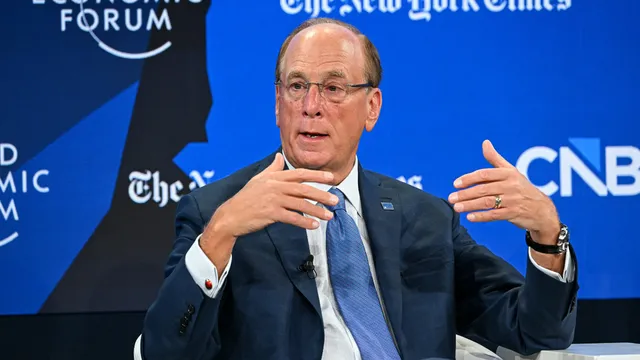
Larry Fink predicts oil prices will drop after Iran conflict ends
Larry Fink predicts oil prices will drop after Iran conflict ends
- The U.S. military action against Iran has caused gasoline prices to increase by 20%.
- Larry Fink expressed confidence that oil prices could drop below 50 dollars once the conflict with Iran is resolved.
- Fink suggested that short-term volatility in energy markets should not deter investors.
Story
The ongoing conflict involving the United States and Iran has led to significant price increases in the energy market, particularly for gasoline. Since the U.S. military action against Iran on February 28, 2026, the national average price of regular gasoline has surged from $2.94 to $3.58 per gallon, marking a 20% increase. In light of market volatility, BlackRock's CEO, Larry Fink, assured investors that these short-term fluctuations are not a source of concern for the asset management firm. This sentiment arises despite the increasing pain at the pump for consumers and uncertainty in energy markets caused by geopolitical tensions. On a recent segment of Fox News with anchor Bret Baier, Fink expressed confidence that the current war would not have lasting negative economic effects. He projected that, should hostilities with Iran come to an end, oil prices could potentially stabilize significantly. Fink noted that a neutralized Iranian oil market could lead to oil prices dropping to around $50 per barrel. In context, he explained that volatility incited by uncertainty often generates fear but maintained his belief in a return to normalcy. Furthermore, Fink also addressed criticisms surrounding BlackRock's corporate policies, focusing on Diversity, Equity, and Inclusion (DEI) initiatives and Environmental, Social, and Governance (ESG) factors. He acknowledged that the pendulum had swung too far in the past five years regarding such initiatives, leading BlackRock to begin rolling back its DEI efforts due to changing U.S. legal and policy environments. His comments highlight a broader debate on the effectiveness and future of corporate responsibility initiatives and their impacts on investment strategies. Overall, as energy markets fluctuate due to shifting geopolitical situations, Fink's stance reflects a buoyed perspective aiming to reassure investors worried about the market's short-term trajectory. He encourages investors to look beyond immediate crisis impacts as they strategize for future gains in a potentially stabilized post-conflict scenario in Iran.
Context
The economic impact of the US-Iran conflict has historically carried significant weight, influencing global markets, regional stability, and international relations. The tension between the two nations has often led to heightened security risks in the Middle East, resulting in fluctuating oil prices, trade disruptions, and a general sense of uncertainty in financial markets worldwide. This volatility is primarily linked to Iran's role as a key oil producer and the strategic importance of the Strait of Hormuz, through which a substantial portion of the world's oil supply passes. Any escalation of conflict could potentially lead to supply constraints, driving prices up and impacting economies around the globe. In terms of direct economic consequences, sanctions imposed by the United States on Iran have far-reaching implications. Sanctions have crippled Iran's oil exports and hindered its economic growth, leading to inflation and currency devaluation within Iran. Additionally, the sanctions have affected neighboring countries, particularly those dependent on trade with Iran or reliant on Iran's energy resources. This regional economic instability often prompts foreign investors to withdraw from the market, exacerbating economic downturns and limiting growth prospects not just for Iran, but also for its trade partners. The US-Iran conflict's impact extends beyond immediate economic concerns, affecting the larger arena of geopolitical relationships. As the US exerts pressure on Iran through sanctions and military presence, it complicates its relationships with key allies and adversaries in the region. Countries like Saudi Arabia and Israel often align with the US stance against Iran, while other nations, notably Russia and China, may seek to strengthen their ties with Iran as a counterbalance to US influence. This evolving dynamic can result in shifts in trade patterns, political alliances, and military strategies that further complicate the economic landscape. Moreover, public sentiment and domestic politics in both the US and Iran play a pivotal role in shaping economic outcomes. In the US, the narrative surrounding the conflict often aligns with national security interests, impacting governmental policy decisions and, ultimately, economic sanctions. Conversely, in Iran, the government may use external conflict as a means to rally nationalistic sentiment, justifying economic hardships in light of external pressures. The interplay between domestic politics and international conflicts creates a complex framework whereby economic conditions are often manipulated for political gain, underscoring the need for careful analysis when assessing the overall economic impact of the US-Iran conflict.


