

Trump threatens insurrection act invocation in response to protests in Minnesota
Trump threatens insurrection act invocation in response to protests in Minnesota
- Protests erupted in Minneapolis following two shootings involving ICE agents.
- President Trump threatened to invoke the Insurrection Act if local officials do not stop dissent.
- The situation poses essential questions about federal authority and local governance.
Story
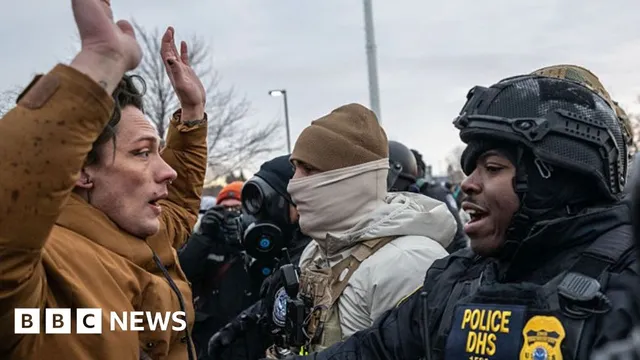
In the United States, particularly in Minnesota, significant unrest has emerged following two shootings involving Immigration and Customs Enforcement (ICE) agents. On January 7, federal officers shot a woman named Renee Good during a protest against ICE's actions. Social tensions escalated as a Venezuelan man was also shot in the leg during a traffic stop incident days later, inciting further protests against federal immigration enforcement. Amid these clashes, President Donald Trump declared that he would invoke the Insurrection Act if local politicians failed to quell the unrest, citing the need to protect ICE agents amid claims of 'attacks' against them. The Insurrection Act, a historical law dating back to the 19th century, grants the president extraordinary powers to utilize military forces domestically without congressional approval during insurrections or domestic unrest. Trump’s threats to employ this act mark its potential invocation for the first time in over three decades due to escalating protests that have sparked concern among federal officials. As protests in Minneapolis intensified, federal law enforcement utilized tear gas and flashbangs against demonstrators who opposed ICE operations, leading to heightened friction between local and federal authorities. Minnesota Governor Tim Walz criticized the federal government’s approach, referring to ICE practices as organized brutality, while expressing that the situation in the city was not sustainable. Local leaders, including Minneapolis Mayor Jacob Frey, have also condemned the presence of federal personnel, viewing it as an infringement on local autonomy and public safety. The conflict has raised urgent discussions about immigration policies and the federal treatment of states and their communities, especially in light of the disparities resulting from increased immigration enforcement scrutiny. In the wake of heightened tensions, Trump's public statements on social media have outlined his administration's stance against alleged lawlessness and 'professional agitators' in Minnesota who, he claims, are responsible for attempts to disrupt ICE operations. Trump’s rhetoric, linking local politicians to insurrectionist behavior, signals a troubling escalation as he positions himself as either a defender of law or instigator of conflict, depending on one’s political perspective. As protests continue, many state officials are calling for the withdrawal of ICE, with implications on policy, community safety, and federal versus state governance looming larger in national discourse.
Context
The Insurrection Act has played a significant role in the history of the United States, providing the President with the authority to deploy federal troops within the country to suppress civil disorder, insurrection, or rebellion. Originally passed in 1807, the Act was designed to give the federal government a refined ability to address serious disturbances when state authorities could not or would not act. The historical context surrounding the Act highlights its usage during critical periods in American history, including the Civil War and civil rights movements, serving as a tool for both federal intervention and state sovereignty debates. Throughout its history, the Insurrection Act has been invoked sparingly, often amidst pressing national crises. One notable instance occurred during the Civil War when President Abraham Lincoln used the Act to quell riots and maintain the Union's stability. The Act also came into play during the Reconstruction era, where federal troops were deployed in Southern states to enforce laws protecting the civil rights of newly freed African Americans. These examples illustrate the Act's capacity to confront rebellion and ensure law and order during tumultuous times, reflecting the complexities and challenges faced by the federal government. In the latter half of the 20th century, the Insurrection Act's relevance resurfaced during civil rights protests, notably in 1965 when President Lyndon B. Johnson utilized the Act to address violent protests in Selma, Alabama. This deployment underscored the federal government's role in upholding citizens' rights against state-level resistance. More recently, discourse around the Insurrection Act has gained traction in contemporary political discussions, particularly as the dynamics of civil unrest have evolved, raising questions about its application and implications for personal freedoms and the balance of power between state and federal authorities. The Insurrection Act remains a contentious topic as it embodies the struggle between civil liberties and the need for federal intervention in times of upheaval. Critics argue that the Act can lead to an overreach of federal power, potentially infringing on state rights and the principles of democracy. Supporters contend that it is an essential mechanism to restore order and protect citizens in critical situations. As the United States progresses into the 21st century, the Insurrection Act continues to be an important piece of legislation, reflecting the ongoing tension in defining the limits and responsibilities of government power in maintaining public order.


