

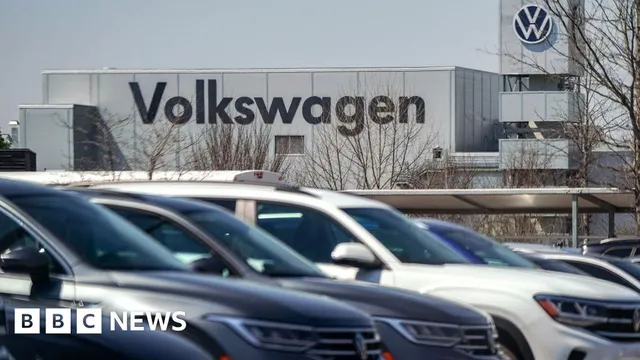
Volkswagen announces dramatic job cuts as profits plummet
Volkswagen announces dramatic job cuts as profits plummet
- Volkswagen's post-tax profits have decreased dramatically by 44%, reaching the lowest level since 2016.
- The company plans to cut 50,000 jobs in Germany by 2030 including layoffs across key brands such as Audi and Porsche.
- Urgent cost reductions are required as Volkswagen seeks to improve its profit margins in a highly competitive market.
Story
In early 2026, Volkswagen, Europe's largest carmaker, announced its intention to reduce its workforce by 50,000 jobs in Germany by the year 2030, due to a significant drop in profits. The company reported that its post-tax profits fell by about 44%, marking the lowest profit level since 2016. Chief Executive Oliver Blume communicated to shareholders that these layoffs would impact the entire group, including major brands like Audi and Porsche. This decision comes in the wake of various challenges faced by the automotive industry, notably a decline in demand from China, heightened competition, and the financial burdens associated with transitioning to electric vehicles. The firm has already made strides towards cutting jobs, striking a deal with unions to reduce more than 35,000 positions by 2030 in a socially responsible manner, aiming to save approximately €15 billion. Volkswagen's struggles are exacerbated by the imposition of U.S. tariffs on car imports and competition from rapidly growing Chinese brands, which have increasingly entered the European market, causing significant market share shifts and a drop in sales. Last year, the firm's net profit after tax plummeted from €12.4 billion to €6.9 billion, highlighting the dire financial situation facing the automotive giant. Volkswagen anticipates a recovery in the coming year, but the finance chief, Arno Antlitz, emphasized the need for rigorous cost reductions to maintain a viable profit margin. Projecting core profit margins between 4% and 5.5% for 2026, which are still potentially lower than the previous year's 4.6%, he acknowledged that further measures were necessary to improve profitability in the long run. This has prompted an urgent reassessment of the company's operational strategy as it seeks to navigate a fundamentally changed market landscape. The broader economic implications of Volkswagen's decision might also reverberate throughout the German job market and economy, as the automotive sector is a significant contributor to both. With rising concerns about stagflation and stagnant economic conditions in Europe, particularly in Germany, the government's focus on preserving jobs and stimulating economic growth will be critical as the country grapples with escalating costs and a no-growth economy. Employers may be shifting their priorities to conserving cash during this uncertain period, which could further exacerbate unemployment rates and wage stagnation across various sectors.
Context
The competition between Chinese and European carmakers has intensified significantly in recent years, driven by rapid advancements in technology, varying consumer preferences, and shifting market landscapes. Emerging as a global powerhouse, the Chinese automotive industry has leveraged governmental support, vast domestic markets, and aggressive investment in electric vehicle (EV) technology to expedite its growth. Firms like BYD, NIO, and Geely have established themselves not only in China but are also increasingly seeking to penetrate European markets, known for strong regulatory frameworks and high consumer standards. This expansion is fueled by the European Union's commitment to green technologies and reducing CO2 emissions, which aligns with the electric-focused strategies of many Chinese manufacturers. In contrast, traditional European automakers, such as Volkswagen, BMW, and Mercedes-Benz, face mounting pressure from both government regulations and emerging competition, prompting them to accelerate their own transition to electrification and innovation in autonomous driving technologies. As the competition intensifies, car manufacturers from both regions are adopting various strategies aimed at securing market share. European companies are increasingly investing in partnerships, collaborations, and technology sharing with established tech firms and start-ups to enhance their capabilities in EV and autonomous vehicle development. Conversely, Chinese automakers are aggressively marketing their products internationally and establishing manufacturing partnerships overseas to mitigate tariffs and logistical challenges, making their offerings more competitive in price. The differing approaches to innovation and market entry strategies have created a complex dynamic, where traditional automotive powerhouses are at risk of losing their established advantage. Furthermore, consumer behavior is evolving, with younger generations showing a strong preference for sustainability and tech integration in vehicles. Chinese brands, being more agile and digital-native, are adept at catering to these preferences. While European brands possess a storied legacy in craftsmanship and engineering excellence, they must adapt to these changing consumer values or risk obsolescence. The competition is set to heat up as both Chinese and European automakers navigate key challenges, including supply chain disruptions, production costs, and regulatory compliance, all while striving to out-innovate each other in the development of next-generation vehicles. Ultimately, the competition between Chinese and European carmakers is emblematic of a larger global shift in the automotive industry towards electrification and sustainability. As market dynamics continue to evolve, the outcome will hinge on how quickly and effectively each region's car manufacturers can adapt to these challenges and opportunities. Collaboration may emerge as a critical technique, enabling actors from both sectors to share knowledge, resources, and innovations to meet the demands of a rapidly changing market. The resultant interplay between competition and cooperation will undoubtedly shape the future of transportation, impacting consumers, the environment, and the global economy.


