

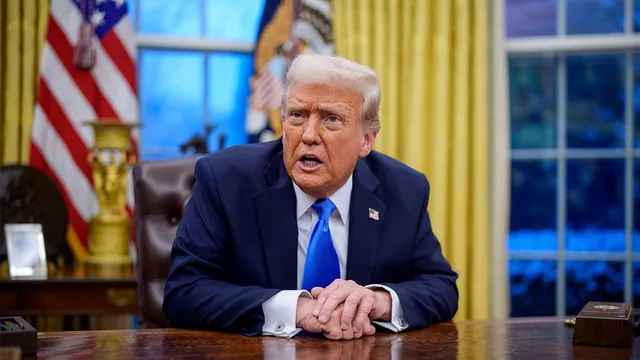
Trump cuts federal payments to sanctuary cities citing protection of criminals
Trump cuts federal payments to sanctuary cities citing protection of criminals
- President Donald Trump announced the cessation of federal payments to sanctuary cities starting February 1, 2026.
- He accused these jurisdictions of protecting criminals and contributing to fraud and crime.
- This decision is likely to fuel legal battles and significant political opposition from affected cities.
Story
In a speech delivered at the Detroit Economic Club, President Donald Trump declared that his administration would stop federal funding to sanctuary cities and states from February 1, 2026. He accused these jurisdictions of harboring criminals and contributing to fraud, indicating that refusal to cooperate with federal immigration enforcement justified this decision. Trump expressed concerns over the impact of such policies on public safety and national resources, asserting that they protected individuals who commit crimes. Trump specifically criticized the leadership in states like Minnesota, alleging that a significant level of fraud was occurring, and suggested the state's governmental leaders had failed to recognize or address these issues adequately. Furthermore, Trump outlined new immigration enforcement strategies, emphasizing the need for strict policies to control immigration and prevent misuse of public services. He indicated that such actions were essential, as many community resources were being stretched to accommodate undocumented immigrants. The announcement also served as a warning to states and cities resisting federal immigration laws, including those with established sanctuary policies which prevent local enforcement agencies from participating in federal immigration operations. This opposition has been a contentious issue, leading to legal battles over the extent of federal authority to withhold funding based on immigration compliance. The announcement was part of a broader initiative by the Trump administration to enhance immigration controls, particularly in areas where local leaders have prioritized sanctuary policies, which are designed to protect undocumented immigrants. This declaration was expected to result in immediate backlash from the affected cities and states, which argued that they rely on federal funds for essential services. Leaders from these municipalities have consistently asserted that their sanctuary policies do not shield violent criminals but rather protect vulnerable populations from unjust deportation. The move also came against the backdrop of ongoing legal disputes regarding the Trump administration's authority to enforce its immigration policies versus local jurisdictions' rights to establish their own immigration stances. The decision to cut federal payments prompted concerns about its implications for community resources, particularly essential programs for low-income families. Observers anticipated that cities would likely challenge this funding withdrawal in court, arguing that the federal government lacks legal grounds for such severe measures. The situation creates a complex dynamic where state and local leaders face the need to address community safety and welfare while navigating their stances on federal immigration law enforcement.
Context
The history of sanctuary cities in the United States has evolved significantly over the decades, with roots tracing back to the early 1980s. Initially, the term 'sanctuary' was used to describe places that provided refuge to Central American migrants fleeing civil wars and violence in their home countries. Local jurisdictions began to adopt policies that limited cooperation with federal immigration enforcement, motivated by humanitarian concerns and a commitment to protect vulnerable immigrant communities. Over the years, these practices expanded, giving rise to a broader movement advocating for the rights of undocumented immigrants and the establishment of sanctuary cities across the nation. As the concept of sanctuary cities gained traction, various local governments enacted ordinances declaring themselves as safe havens for undocumented individuals. These policies often aim to foster trust between immigrant communities and local law enforcement agencies, encouraging individuals to report crimes without fear of deportation. The movement reflected a growing awareness of the economic and social contributions made by immigrants, as well as recognition of the need for inclusive policies that uphold public safety while respecting human rights. Throughout the 1990s and 2000s, the designation of sanctuary cities became more prominent, particularly amid rising anti-immigrant sentiment and more aggressive federal enforcement measures. Notably, the 1996 Illegal Immigration Reform and Immigrant Responsibility Act inadvertently spurred the creation of sanctuary policies, as localities pushed back against the federal government's attempts to mandate local involvement in immigration enforcement. Cities like San Francisco and Los Angeles openly declared their status as sanctuaries, explicitly denying police departments the authority to detain immigrants solely based on their immigration status. This marked a significant shift in the relationship between federal and local authorities in immigration matters. In recent years, the sanctuary city movement has faced renewed scrutiny and challenges, especially during the Trump administration, where immigration policies became a focal point of political debate. Some state governments attempted to restrict or penalize sanctuary cities, citing concerns over public safety and rule of law. However, advocates for sanctuary policies argue that such measures are essential for community trust and safety, fostering cooperation between immigrant populations and law enforcement. The ongoing dialogue surrounding sanctuary cities reflects broader national conversations about immigration policy, community integration, and the balance between local autonomy and federal authority, signifying that the history of sanctuary cities in the U.S. is far from over.


