
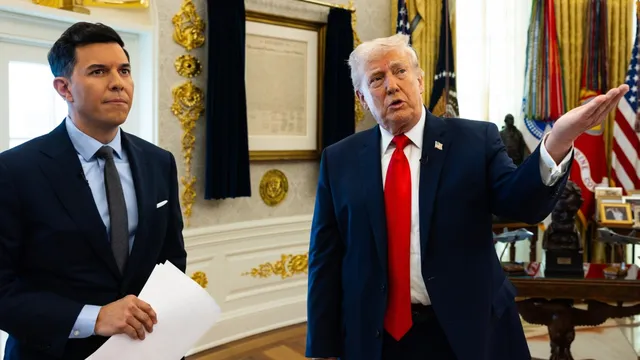
Trump repeatedly makes false claims during NBC interview
- Trump made several misleading claims about economic inflation during his interview.
- He asserted that 25 million people entered the U.S. illegally under Biden, a statement lacking factual support.
- These inaccuracies and the interview context emphasize the need for critical evaluation of political statements.
Story
Recently, in an interview with NBC News conducted by Tom Llamas, Donald Trump discussed various topics including immigration enforcement, artificial intelligence, and his perspectives on upcoming elections. This interview took place amid increased scrutiny of federal immigration operations in Minneapolis, following two deadly shootings by federal officers. Trump asserted that under the Biden administration, 25 million people had entered the U.S. illegally and repeated unfounded claims about election fraud during the 2020 presidential election. However, NBC News provided a fact-check highlighting several inaccuracies in Trump’s statements regarding the economy, crime, and immigration. During the interview, Trump mistakenly claimed that he inherited the worst inflation in U.S. history, yet the highest recorded inflation occurred in 1980, not during his presidency. Current inflation rates have been relatively low since 2022, declining steadily through 2025. Furthermore, Trump incorrectly asserted that crime rates benefitted from his federal law enforcement efforts, ignoring substantial data that indicates crime has been decreasing consistently across major cities. The discussion of immigration reform was particularly poignant, as Trump suggested that a 'softer touch' was necessary following the tragic incidents involving federal officers in Minnesota. This statement reflects a shift in approach in response to heightened public attention on homicide and immigration enforcement. Trump's remarks about immigration included inflated figures regarding the number of criminals entering the U.S., which have been challenged by fact-checkers, casting doubt on the validity of his claims. Overall, Trump's interview highlighted both his perspectives on pressing national issues and the ongoing debate over his ability to accurately represent factual information as a public figure. The NBC News fact-check serves as a vital resource for understanding the truth behind Trump's statements and the implications they may have on public perception and policy discussions moving forward.
Context
Inflation is a critical economic factor that measures the rate at which the general level of prices for goods and services rises, eroding purchasing power over time. In the United States, historical inflation rates have varied significantly, influenced by factors such as economic growth, monetary policy, supply and demand shocks, and external events. From the early 20th century through to the present day, the fluctuation in inflation rates has had profound effects on the economy, impacting everything from consumer spending to interest rates and investment decisions. In the aftermath of events such as World War I and II, the Great Depression, and the oil crises of the 1970s, inflation rates have reflected the societal and economic shifts during those turbulent times. The Consumer Price Index (CPI) is a common measure used to assess inflation and has provided important insights into economic conditions across different eras. In the decades following World War II, the United States enjoyed a period of relative price stability, with inflation rates mostly contained within a few percentage points. However, this changed in the 1970s when the US faced stagflation, a combination of stagnant economic growth, high unemployment, and rapidly increasing inflation, prompting monetary policy shifts that have shaped modern economic frameworks. The Federal Reserve, in response to rising inflation during this challenging period, adopted tighter monetary policies aimed at controlling inflation, which resulted in high-interest rates peaking at over 20% in the early 1980s. The late 20th and early 21st centuries have also seen fluctuating inflation rates, particularly during periods of recession and recovery. The 2008 financial crisis brought about a deflationary period where inflation decreased significantly, providing challenges in policy formulation for economists. The response to the crisis, mainly through quantitative easing and low-interest rates, has sparked debates about potential inflationary pressures in the long term. As of late 2023, rising inflation has resurfaced as a concern, influenced by various factors such as supply chain disruptions, labor shortages, and the economic impacts of the COVID-19 pandemic, leading to a renewed examination of inflationary trends and the effectiveness of policy responses. Looking at the trajectory of inflation rates historically allows for a deeper understanding of broader economic trends and the intricacies of the American economy. A comprehensive analysis reveals significant correlations between inflation rates and major economic policies, demographic shifts, and global events. Tracking these rates enables policymakers and economists to devise strategies aimed at stabilizing the economy, maintaining purchasing power, and ensuring sustainable economic growth. Understanding the historical context of inflation rates in the US is not only crucial for anticipating future trends but also for crafting informed decisions that will shape the economic landscape moving forward.
