
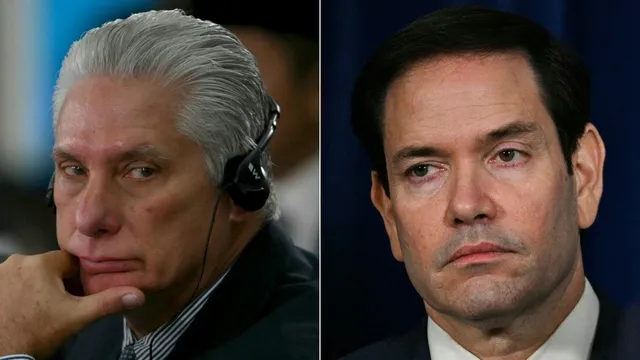
Cuban envoy criticizes Rubio's fixation on regime change
- Ernesto Soberón Guzmán criticizes Marco Rubio's calls for regime change in Cuba.
- Cuba's government expresses willingness to negotiate with the U.S. based on sovereignty and mutual respect.
- The ongoing political tension highlights the complexity of U.S.-Cuba relations and the need for dialogue.
Story
Cuba, a nation long under U.S. scrutiny, has faced renewed pressure from American politicians advocating for regime change. In recent remarks, Ernesto Soberón Guzmán, Cuba's ambassador to the United Nations, specifically targeted Marco Rubio, the U.S. Secretary of State, for his consistent calls for the overthrow of Cuba's communist government. Soberón Guzmán asserted that Rubio's family history doesn't reflect the typical Cuban exile narrative, suggesting that Rubio has based his political career on a reactionary segment of the Cuban community that is predominantly centered on confrontation. He implied Rubio is rather detached from the reality of life in Cuba, pointing out that many emotional arguments being made are rooted in personal bias rather than insightful understanding of the current state of the Cuban populace. As political tensions continue, Cuban officials have expressed a strong desire for dialogue with the United States, with the ambassador advocating for cooperative discussions on various issues, including health research and drug trafficking. He stated that Cuba maintains a zero-tolerance policy regarding drug control and has cooperated on this front in the past. The Cuban government is willing to negotiate terms based on mutual respect and equality, navigating around issues deemed intrusive or offensive. This message aligns with Cuba's broader aim to reaffirm its sovereignty amid U.S. interventions and criticisms. Former President Donald Trump’s administration had intensified a hardline approach towards Cuba, which included a prominent political role for Rubio, who expressed enthusiasm for potential regime change. Trump referred to Cuba as a nation ‘ready to fall’ and presumed control over its future as a possibility aligned with U.S. interests. These interactions have sparked social media posts which playfully suggest Rubio may have ambitions similar to controlling Cuban affairs. In his responses, Soberón Guzmán also addressed the implications of U.S. criticism regarding Cuba’s international relationships, highlighting the notion that Cuba has the inherent right to establish relations with any country it chooses, much like the United States. In a climate marked by extensive geopolitical maneuvering, Cuba has reiterated the opportunity for discussions devoid of pressure or preconditions. The ambassador emphasized the need for both parties to engage sincerely and without pretense, aiming for durable solutions over superficial exchanges. As recent history has shown, dialogue between the two nations is essential, especially as both could potentially benefit from collaborative efforts rather than confrontation and division. The trajectory of U.S.-Cuba relations continues to unfold against a backdrop of deep-seated animosities and political gamesmanship, yet the path towards reconciliation remains a critical focal point for both nations moving forward.
