

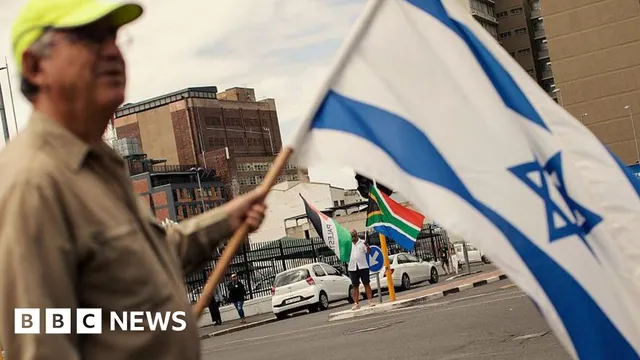
South Africa expels Israeli envoy over diplomatic violations
South Africa expels Israeli envoy over diplomatic violations
- South Africa declared Ariel Seidman persona non grata for violating diplomatic norms.
- The expulsion was due to insulting comments about President Cyril Ramaphosa and failure to notify of Israeli officials' visits.
- This incident reflects ongoing tensions and recent legal actions by South Africa against Israel.
Story
In late January 2026, South Africa announced the expulsion of Ariel Seidman, the charge d'affaires at the Israeli embassy. This decision followed accusations from South Africa of repeated violations of diplomatic protocols and insulting social media posts directed at President Cyril Ramaphosa. The expulsion order mandated Seidman to leave the country within 72 hours. This incident escalated a longstanding tension between the two nations, particularly after South Africa's legal actions against Israel in the International Court of Justice over allegations of genocide against Palestinians. Foreign relations between South Africa and Israel had already been strained due to these tensions. The circumstances leading to Seidman's expulsion involved claims that the Israeli embassy had undermined South African sovereignty through actions like failing to inform local authorities about visits from senior Israeli officials. The South African foreign ministry emphasized that the actions posed a direct challenge to diplomatic norms. The use of Israeli social media channels to issue derogatory remarks against the President was central to these accusations, with authorities citing that such violations had prompted the decision. Israel responded swiftly to the expulsion by declaring Shaun Edward Byneveldt, the South African representative to Palestine, as persona non grata, ordering him to leave Israel within the same timeframe. This tit-for-tat diplomatic move highlights the escalating tensions fueled by mutual accusations and reciprocal retaliations. Israel's government branded the actions of South Africa as baseless, reiterating the narrative that portrays their stance on the conflict as unjust. The backdrop of this diplomatic fallout includes South Africa’s historic support for the Palestinian cause, which dates back to its own struggle against apartheid. Throughout the years, South Africa has leveraged its position to criticize Israeli policies towards Palestinians, culminating in its approach to international law through court cases. The recent escalation in diplomatic ruptures has raised concerns about how such actions will affect broader geopolitical relationships, including those with allies like the United States, which has traditionally supported Israel in international matters.
Context
The current status of South Africa-Israel relations has been characterized by a complex interplay of historical, political, and social factors. Since the end of apartheid in the early 1990s, South Africa has sought to position itself as a leader in the global arena, often prioritizing its commitment to human rights and social justice. This ideological stance has significantly influenced its foreign policy towards Israel, especially in light of the ongoing Israeli-Palestinian conflict. South Africa's government, particularly under the leadership of the African National Congress (ANC), has openly criticized Israeli policies, particularly those relating to the treatment of Palestinians, which has contributed to a cooling of relations between the two countries in recent years. This has led to a shift towards a more pro-Palestinian narrative and support for various initiatives aimed at promoting peace and justice in the region. In recent years, diplomatic ties have experienced fluctuations, as evidenced by the criticisms and actions taken by South African leaders against Israel. For instance, the South African government has frequently condemned Israeli military actions in Gaza and has spoken out against the expansion of Israeli settlements in the West Bank. Furthermore, the South African government has expressed its support for the Boycott, Divestment, Sanctions (BDS) movement, which seeks to apply economic pressure on Israel as a means to compel compliance with international law related to the Palestinian territories. This support reflects a foundational commitment to solidarity with the Palestinian cause and signals a distinct international posture from that of many Western nations. The challenges of maintaining diplomatic relations between South Africa and Israel are compounded by the presence of diverse opinions within South African society. While the government takes a strong stance against Israel, there exist various levels of engagement from different sectors, including economic and cultural interactions. Some South African businesses and civil society organizations still pursue partnerships with Israeli counterparts, reflecting a nuanced and multifaceted relationship. Moreover, the Jewish community in South Africa remains active, seeking to foster dialogue and understanding between the two nations. This duality creates a complex environment wherein the official governmental position may not wholly reflect the opinions of all societal stakeholders. Looking to the future, the trajectory of South Africa-Israel relations will likely continue to be shaped by regional and international developments. Factors such as the evolving nature of the Israeli-Palestinian conflict, changing global alliances, and internal South African political dynamics will play significant roles. It remains essential for both nations to navigate their relationship carefully, considering both historical contexts and contemporary aspirations. As global pressures and anti-apartheid sentiments linger, South Africa's commitment to supporting Palestinian rights may further strain its ties with Israel while simultaneously shaping its identity on the world stage. Understanding this intricate landscape will be key for stakeholders aiming to promote peace and cooperation in a polarizing environment.


