
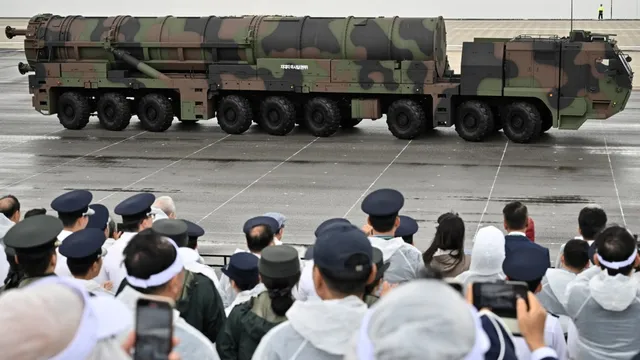
South Korea deploys powerful missile against North Korea's nuclear threat
- South Korea has implemented the Hyunmoo-5 ballistic missile as part of its military strategy amidst rising nuclear threats from North Korea.
- The missile is capable of delivering an 8-ton warhead, targeting underground facilities associated with North Korea's missile program.
- This deployment signifies a shift in military dynamics in the region and highlights the growing tensions between South and North Korea.
Story
South Korea has intensified its military preparedness amid ongoing tensions with North Korea, successfully deploying the advanced Hyunmoo-5 ballistic missile. This significant development comes as part of South Korea's military response strategy, particularly designed to counter North Korea's expanding nuclear capabilities. The Hyunmoo-5 missile, which measures 65 feet long and carries an unprecedented 8-ton warhead, was first reported to have begun deployment in late 2025, with completion expected by the end of President Lee Jae Myung's administration in 2030. It aims to enhance South Korea's deterrence capacity and is designed to specifically target underground facilities that may harbor North Korean missile systems and leadership. Despite international sanctions and diplomatic efforts aimed at curtailing North Korea's nuclear program, the North has continued to advance its military technology and strengthen its nuclear arsenal, as articulated by its leader, Kim Jong Un. The South Korean strategy, known as the three-axis system, incorporates preemptive and retaliatory measures against perceived threats from the North. Analysts have noted that the size and capability of the Hyunmoo-5 missile highlight a significant escalation in South Korean military technology, setting a precedent for other nations in the region. The need for such a missile comes amid the growing concerns of an arms race on the Korean Peninsula, with possible implications for neighboring countries like Japan and China. By enhancing its missile capabilities, South Korea aims to establish what Defense Minister Ahn Gyu-back refers to as a “balance of terror.” This move could cause an arms race reaction among neighboring countries, raising alarms about regional stability and security dynamics. As a result, the deployment of this missile not only impacts South Korea's defense posture but also the geopolitical landscape in Northeast Asia. Moving forward, observers are keen to see how North Korea will respond to South Korea's military enhancements, particularly amidst continuing international pressure. While the South focuses on its missile program development, the broader implications of this arms race may tip the balance of military power in the region, demanding close scrutiny from global powers. This escalation underscores the urgent need for de-escalation dialogue to prevent further military provocations and to bring about stability in the region.
Context
In recent years, the relationship between South Korea and North Korea has been characterized by a mixture of diplomatic engagements and heightened tensions. Historically strained due to the Korean War and subsequent conflicts, the interactions between the two nations have led to significant developments, particularly concerning denuclearization talks and inter-Korean agreements. High-level meetings have taken place intermittently, with leaders from both sides expressing a desire to improve relations; however, substantive progress has often been hindered by differing priorities and external influences. The ongoing security concerns surrounding North Korea's nuclear program continue to be a major point of contention in any diplomatic exchange, necessitating a multi-faceted approach to mitigate risks and foster communication. Within this context, key moments such as the Singapore Summit and subsequent trilateral talks involving the United States and South Korea have played critical roles in shaping the diplomatic landscape. The evolution of South-North relations gained momentum post-2018 when the diplomatic thaw led to a series of summits aimed at reducing tensions. The Panmunjom Declaration, which called for reconciliation and comprehensive cooperation, represented a notable step forward. These efforts included cultural exchanges, sports collaboration, and agreements to reduce military confrontations. Despite initial optimism, subsequent events such as missile tests conducted by North Korea and internal political shifts within South Korea have led to a reevaluation of engagement strategies. As of early 2026, there is a palpable sense of uncertainty regarding the future of the inter-Korean dialogue, especially in light of the global geopolitical context, including the role of China and the United States in influencing the dynamics of the Korean Peninsula. Economic considerations also play a crucial role in shaping the relationship between the two Koreas. The potential for economic collaboration, particularly in areas such as infrastructure, trade, and tourism, is often highlighted in discussions aimed at easing tensions. However, international sanctions imposed on North Korea due to its nuclear ambitions significantly limit the scope for meaningful economic cooperation. South Korea's approach has often involved balancing domestic economic interests with the broader security concerns posed by its northern neighbor, creating a complex interplay between engagement and caution. The future of this economic relationship may depend on progress in nuclear talks, as any steps towards denuclearization could pave the way for a gradual lifting of sanctions and increased economic exchanges. Public sentiment in both nations towards each other remains a significant factor that influences political decisions and the potential for future relations. In South Korea, there is a mixed view towards North Korea, shaped by ongoing security threats and historical grievances. In contrast, North Korean propaganda often portrays South Korea in a negative light, which affects public perception in the North. Grassroots movements and initiatives aimed at fostering understanding and communication between people on both sides could be critical in breaking down longstanding stereotypes and building a foundation for lasting peace. As we move into 2026, the hope remains that through continued dialogue, mutual respect, and international cooperation, the prospects for improved relations between South Korea and North Korea can be realized.
