

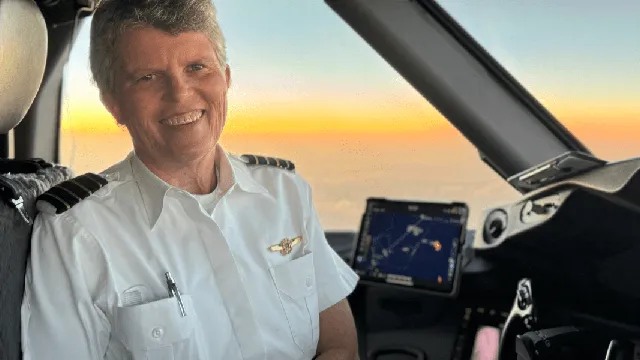
Chresten Wilson breaks barriers as United Airlines' first female senior pilot
Chresten Wilson breaks barriers as United Airlines' first female senior pilot
- Chresten Wilson began her journey to becoming a pilot at age 9 and demonstrated unwavering commitment to her dream.
- She progressed from flight engineer to captain, now flying the Boeing 787 and logging international routes.
- Her upcoming milestone reflects the growing opportunities for women in aviation and encourages others to pursue their dreams.
Story
In the United States, Chresten Wilson has made significant strides in the aviation industry, preparing to become the most senior female pilot in United Airlines' history after dedicating 42 years to her career. Wilson's interest in aviation began at the young age of 9, where she expressed her ambition to be a pilot. Shortly after moving to Denver with her family, she pursued her dream by enrolling in college and starting formal flight training while studying. Despite the male-dominated field of aviation, Wilson's determination ultimately led her to secure a position at United Airlines at the age of 22. With a career that evolved from flight engineer to captain, Wilson now operates flights on the Boeing 787 out of San Francisco. She averages about 12 days a month in the air, focusing primarily on long-haul international routes, such as Australia and New Zealand. The demand for airline pilots is high, with forecasts showing a need for 660,000 new pilots worldwide in the next two decades due to increased air travel and an upcoming wave of retirements, which positions Wilson’s achievement at a pivotal moment for the industry. Wilson acknowledges the sacrifices that come with being an airline pilot, especially during the early years when seniority is hard to achieve. She emphasizes that new pilots will often miss family events, including birthdays, while they build their careers. Wilson encourages aspiring pilots to remain dedicated and apply early, suggesting that perseverance can pave the way to success in a challenging field. Her insights reflect both the joys and difficulties of a career in aviation, while her accomplishment serves as inspiration for women and newcomers in the industry. As she steps into this historic role, Wilson embodies the message that aspiring pilots should not be deterred by the lack of representation or societal doubts. Her journey illustrates the resilient spirit, dedication, and unwavering commitment required to succeed in a field that has traditionally been male-dominated. In doing so, she paves the way for future generations of female pilots to enter and thrive in aviation.
Context
The history of women in aviation is a remarkable narrative of courage, innovation, and perseverance, stretching over a century. Women's contributions to aviation began to gain recognition in the early 20th century. Pioneers like Amelia Earhart, who became the first woman to fly solo across the Atlantic Ocean in 1932, not only broke records but also shattered societal norms about women’s roles. She inspired many by advocating for women's rights and encouraging women to pursue careers in fields traditionally dominated by men. The early aviation industry, predominantly male, saw women gradually claiming their space as pilots, engineers, and entrepreneurs, playing crucial roles in both commercial and military aviation during times of war and peace. During World War II, women took on unprecedented roles within the aviation sector. Organizations such as the Women Airforce Service Pilots (WASP) were established to enable women to participate in flying military aircraft, freeing men for combat roles. This era showcased the capabilities of women in aviation and laid the groundwork for future advancements. Following the war, however, many women faced barriers and were often pushed back into traditional gender roles, but their contributions were instrumental in ensuring that women would not be overlooked in aviation's future endeavors. The second wave of feminism in the 1960s and 1970s reignited the fight for gender equality, impacting the aviation industry along with other sectors. Women began to be more visibly represented in pilot seats and engineering roles as policies changed to support their aspirations. The establishment of various aviation organizations dedicated to women, such as the Ninety-Nines, established in 1929 by a group of female pilots including Earhart, provided networks and mentorship, fostering a sense of community and encouraging younger women to pursue aviation. These efforts contributed to an increasing number of women earning pilot licenses and taking leadership roles in aviation. Today, women continue to break barriers in various areas of aviation, from the cockpit to aerospace engineering and management positions. Organizations and initiatives now focus on promoting STEM (Science, Technology, Engineering, and Mathematics) education among young girls, showing them pathways to careers in aviation. Despite significant advancements, challenges remain, such as the need for more women in leadership roles and equitable treatment in the industry. However, the history of women in aviation serves as an inspirational tale of resilience, demonstrating that with determination and support, women can and do achieve excellence in aviation, paving the way for future generations.


