

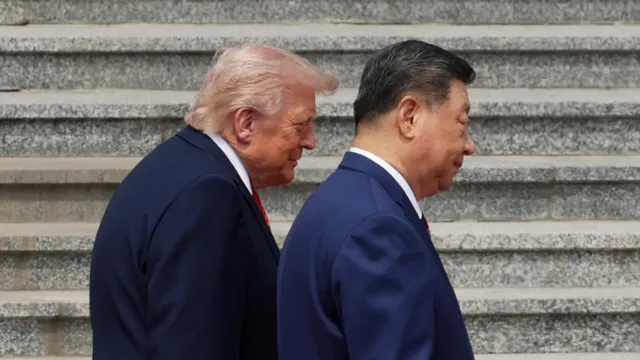
Trump meets Xi in Beijing amid trade tensions
Trump meets Xi in Beijing amid trade tensions
- The U.S. delegation included influential cabinet members and business executives.
- The discussions focused on economic cooperation, trade relations, and regional security.
- Such high-stakes meetings are critical for maintaining bilateral relations amidst ongoing tensions.
Story
In Beijing, President Trump and President Xi Jinping engaged in a summit aimed at addressing key issues between the United States and China. The U.S. delegation, comprising top cabinet members and significant business leaders, accompanied Trump, signifying the importance of economic cooperation in their discussions. Key officials such as Treasury Secretary Scott Bessent and Defense Secretary Pete Hegseth were present, despite their critical views on China. The talks addressed complex matters, including trade relations, Taiwan, and energy flow in the Strait of Hormuz, showcasing the delicate balance both leaders must maintain in their bilateral relationship. The presence of prominent business executives emphasized the potential economic interests at stake, particularly as they sought improved access to the Chinese market. Key players like Kelly Ortberg from Boeing and Brian Sikes from Cargill were eager to negotiate terms that could benefit their industries while illustrating a larger theme of U.S. corporations pushing for favorable arrangements with China. Any economic agreements reached during this meeting were seen as crucial for both nations given the historical context of the ongoing trade war and increasing tensions over various geopolitical issues. Additionally, discussions included South China Sea tensions and China's export controls on technology, indicating a multifaceted approach to U.S.-China relations. Although there were warm gestures, underlying disputes regarding military and economic policies remained prominent. Trump's positions had often relied on a tough-on-China narrative, thus amplifying the stakes for both sides during these high-level talks. As negotiations continued, there was a clear sense that both nations were attempting to frame their future interactions as constructive and stable despite serious challenges. The event not only showcased diplomatic engagement but also highlighted how both leaders maneuvered politically within their respective nations. President Xi aimed to project stability and leadership, contrasting Trump's often unpredictable approach. The outcome of the summit remains nuanced as both sides seek a way to cooperate while addressing historical grievances, setting the stage for future interactions. Ultimately, the meeting underscored a significant moment in international relations whereby economic and political spheres intersect intensely, necessitating cautious diplomacy ahead.
Context
The history of U.S.-China diplomatic relations has been complex and multi-faceted, shaped by a range of historical, political, and economic factors. The relationship began in the late 18th century when American ships first docked in China. However, significant diplomatic relations did not commence until the mid-20th century, particularly after the establishment of the People’s Republic of China (PRC) in 1949. The initial years were marked by tensions, largely due to ideological differences stemming from the Cold War, which saw the U.S. align itself with Taiwan as the legitimate government of China while the PRC was viewed as a communist adversary. This dichotomy was cemented by Taiwan's inclusion in international organizations and U.S. support, which further strained relations with the mainland. Yet, the geopolitical landscape began to shift in the 1970s, creating opportunities for dialogue and engagement between the two nations. One of the pivotal moments in U.S.-China relations came in 1971 when then-Secretary of State Henry Kissinger undertook a secret trip to China, paving the way for President Richard Nixon's historic visit to Beijing in 1972. This visit marked a thawing of relations and led to the formal establishment of diplomatic ties in 1979. The accord allowed for a trade partnership and fostered cultural exchanges, enabling both nations to benefit from economic engagement. Importantly, the U.S. acknowledged the One China Policy, reaffirming that Taiwan was part of China. However, the relationship remained tenuous, with diplomatic overtures often punctuated by conflicts over human rights issues and military tensions in the Taiwan Strait. As the global economy expanded in the late 20th century, the U.S. and China increasingly relied on each other for trade and investment. China's entry into the World Trade Organization (WTO) in 2001 marked a significant step in integrating the Chinese economy with the global market and solidified U.S.-China economic relations. However, this cooperation was not without its challenges. Economic imbalances, trade deficits, intellectual property rights violations, and currency manipulation became points of contention. The relationship further deteriorated in the late 2010s with mounting tensions surrounding trade wars, national security concerns, and differing views on global governance and climate change. These developments reflected not only economic rivalries but also a broader strategic competition for influence. More recently, the onset of the COVID-19 pandemic intensified scrutiny of China’s handling of the outbreak, exacerbating existing tensions. The U.S. accused China of lack of transparency and responsibility while China criticized what it perceived as misinformation from the U.S. media and government. Under the Biden administration beginning in 2021, the approach to China has focused on a combination of competition and cooperation, especially regarding climate change and public health, while still addressing human rights issues and aggressive posturing in the Indo-Pacific. As both nations navigate this complex tapestry of competition and collaboration, the future of U.S.-China relations remains uncertain and critical, particularly as it bears significant implications for global stability and economic prosperity.


