

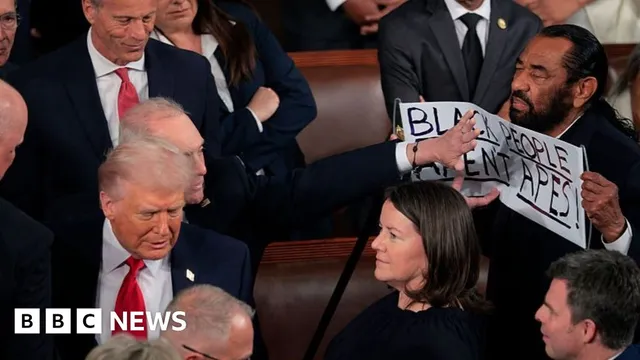
Trump confronts critical challenges during State of the Union address
Trump confronts critical challenges during State of the Union address
- Donald Trump delivered a crucial State of the Union address on February 24, 2026, highlighting economic and immigration challenges.
- With key elections approaching, Trump faces increased pressure to appeal to a wider range of voters, beyond just his base.
- Successful communication during this address may impact his party's chances in the midterm elections.
Story
On February 24, 2026, President Donald Trump delivered his State of the Union address amid significant national challenges. As he prepares for the midterm elections, Trump is dealing with a more challenging political landscape. His previous unimpeded governance has met obstacles in the form of low approval ratings, particularly concerning the economy and immigration policy. With Democrats leading in polls, Trump must energize his base and present a compelling message to regain support. The address is seen as crucial for rallying Republicans, especially with control of the House nearing a tipping point. Economically, inflation and rising costs have emerged as pressing issues for American voters, prompting Trump to focus his speech on affordability and economic strategy. Political analysts emphasize the importance of addressing these concerns honestly, as many Americans feel the direct impact of national policies on their everyday lives. Trump's efforts to shift blame towards his predecessor, Joe Biden, for the economic challenges may resonate poorly if he fails to acknowledge the hardships faced by everyday citizens. Public sentiment reflects a significant downward trend for Trump, with polling indicating dissatisfaction among key voter demographics. If he cannot successfully convey a message of hope and action, his party’s prospects in the impending elections may suffer dire consequences. Trump’s need to show a greater understanding of issues affecting all Americans, and not just his political base, is underscored by recent election results where Democrats performed remarkably well in gubernatorial races, further emphasizing the urgency of his communication tonight. The State of the Union serves as an essential platform for Trump to navigate these turbulent waters. Historical context indicates presidential addresses tend to shape public perception significantly; thus, the stakes are exceptionally high for Trump to deliver a speech that resonates deeply. His administration still holds Republican dominance in Congress, yet the looming threat of losing this control to Democrats in upcoming elections necessitates a deft and strategic response. The pressure is on for Trump to articulate a solid plan for improvement in a manner that reassures voters while galvanizing his party's supporters ahead of a potentially transformative electoral period.
Context
The impact of inflation on American voters in 2026 is a multifaceted issue that intertwines economic, social, and political ramifications. As inflation has surged over recent years, primarily due to factors such as supply chain disruptions, energy price volatility, and expansive fiscal policies, American voters have increasingly felt the strain on their purchasing power. Consequently, this financial pressure has influenced voter sentiment, aligning economic concerns with political attitudes and choices. Voters are demonstrating acute awareness of how inflation affects their daily lives, leading to heightened scrutiny of governmental actions and responses to the current economic landscape. Moreover, the demographics of affected voters are diverse, encompassing varying income levels, educational backgrounds, and geographic regions. Lower-income households and those relying on fixed incomes have been particularly vulnerable to the adverse effects of inflation, experiencing a disproportionate decline in their standard of living. Such economic hardships are prompting these voters to seek accountability from elected officials and government entities, passionately advocating for policies that target inflation reduction and cost-of-living adjustments. The growing divide between constituents' experiences of economic hardship and the perceived effectiveness of government initiatives has significant implications for voter mobilization and electoral outcomes. Political parties are keenly aware of the urgency surrounding inflation, with candidates shaping their platforms to resonate with the concerns of those grappling with rising costs. Incumbents may find themselves under increased pressure to deliver tangible solutions to alleviate inflationary pressures, while challengers leverage economic discontent to position themselves as viable alternatives. The political discourse is thus evolving, as discussions around wage growth, job creation, and economic stability gain prominence in campaigns. Voter engagement is notably heightened, as citizens become more motivated to participate in the electoral process to influence the direction of economic policy. Looking ahead, the 2026 electoral landscape will likely see significant shifts as inflation continues to dominate voter concern. The potential for grassroots movements advocating for economic reform to take shape suggests that the political climate may be leaned towards candidates who prioritize economic issues. Additionally, the ongoing dialogue about inflation could galvanize voter turnout in unprecedented ways, as individuals seek to ensure their voices are heard in the face of economic challenges. In conclusion, the interplay between inflation and voter sentiment in America will continue to evolve, demanding rigorous analysis and responsive political strategies as we approach the next election cycle.


