

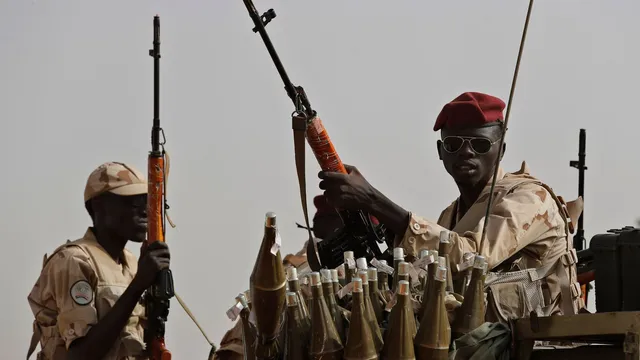
Marco Rubio urges halt to arms supply for Sudan's paramilitary forces
Marco Rubio urges halt to arms supply for Sudan's paramilitary forces
- The U.S. Secretary of State has called for the cessation of military support to the RSF accused of severe atrocities in Sudan.
- The RSF's role in the humanitarian crisis has resulted in significant casualties and displacement in the region.
- Marco Rubio's comments may impact diplomatic efforts toward reaching a ceasefire amid ongoing violence.
Story
The ongoing conflict in Sudan has escalated, particularly involving the paramilitary Rapid Support Forces (RSF). The RSF has been accused of committing violent acts, including mass killings and atrocities in el-Fasher, leading to international concern. During a recent meeting, U.S. Secretary of State Marco Rubio advocated for stopping the flow of military support to the RSF, highlighting their involvement in severe humanitarian crises which have left thousands dead and millions displaced. He emphasized that the responsibility extends to countries allegedly supplying arms to the RSF and called for partner nations to join in addressing these dire conditions. In response to Rubio's remarks, an adviser to the RSF claimed that such comments undermine efforts to reach a ceasefire, stating that the Sudanese army is also culpable in rejecting peace initiatives. The conflict has already resulted in substantial casualties and forced over 12 million people from their homes, highlighting the severe humanitarian impact of these hostilities. Reports indicate that more than 150,000 people have been killed, and satellite images reveal the extent of destruction and bloodshed. The situation is increasingly dire, with many civilians unable to access food, water, and medical services. The United Nations has also weighed in, calling for an immediate end to the influx of arms and foreign fighters into the conflict, urging all involved parties to take meaningful steps toward a resolution. The RSF has denied allegations of wrongdoing and has shifted blame to the Sudanese army backed by external forces. Rubio has pointed out that the RSF is significantly supported by foreign countries, including the UAE, which have been accused of facilitating arms shipments while denying culpability. As the war continues, aid organizations struggle to address the humanitarian crisis, which is worsening by the day. The conflict, which has now lasted over two years, has seen shifting front lines, intensifying violence, and growing international scrutiny. The situation calls for a collective global response to mitigate the humanitarian crisis and restore peace in Sudan.
Context
The conflict in Sudan has deep historical roots traced back to a combination of colonial legacies, ethnic tensions, and disputes over resources. The colonial period, particularly British and Egyptian rule from 1899 to 1955, created a distinct divide between the North and South of Sudan, which intensified existing cultural and ethnic disparities. The North, predominantly Arab and Muslim, was favored in governance and infrastructure development, while the South, inhabited by various ethnic groups with diverse beliefs, received less attention. When Sudan gained independence in 1956, these inequities were left unresolved, sowing the seeds of resentment and conflict that would erupt into civil wars later on, particularly from 1955 to 1972 and again from 1983 to 2005, as different factions in the South fought for autonomy and equality. The 2005 Comprehensive Peace Agreement provided a temporary resolution, granting the South greater self-governance and leading to the eventual independence of South Sudan in 2011. However, the underlying issues between various ethnic groups within Sudan remained and even escalated into new conflicts, with the Darfur Region facing a significant humanitarian crisis due to violent clashes among government forces, various rebel groups, and ethnic militias starting in 2003. Post-independence, the situation in Sudan continued to deteriorate as the lack of a unified national identity and unresolved issues from colonial rule resurfaced. The rise of the National Congress Party under Omar al-Bashir introduced an authoritarian rule that further deepened ethnic divisions. The Bashir regime's campaigns against perceived threats, especially in Darfur, led to widespread atrocities, including ethnic cleansing and mass displacement, bringing international condemnation and sanctions. In response to these internal conflicts, the African Union and later the United Nations sought to intervene, deploying peacekeeping forces to mitigate violence and assist with humanitarian efforts. However, the complexity of tribal affiliations and the plethora of factions competing for power rendered these interventions challenging and often inadequate to restore lasting peace. In 2019, ongoing protests against Al-Bashir's regime culminated in his ousting, leading to a transitional government composed of both civilian and military leaders. Though there was initial optimism for a new era of democratic governance, lingering tensions and power struggles have posed significant obstacles to achieving stability. The continued existence of armed groups, political unrest, and demands for justice from victims of previous conflicts complicate the transition. The economy, battered by years of war and isolation, and challenges like inflation and resource scarcity further exacerbate the situation, prompting fears of renewed violence and civil strife. As of November 2025, the Sudan conflict remains a complex tapestry woven from historical grievances and contemporary struggles for power and resources. Various factors, including the aspirations of diverse ethnic groups, the role of international actors, and the internal dynamics of the transitional government, will shape Sudan's future. The international community remains deeply concerned with efforts to foster a sustainable peace process that respects the rights and identities of all Sudanese people. Addressing the historical injustices and promoting inclusive governance will be crucial for breaking the cycle of conflict and achieving long-term stability in the region.


