

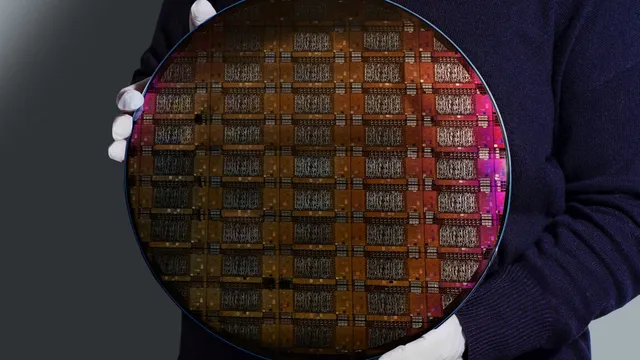
IBM announces breakthrough with new quantum computing processors
IBM announces breakthrough with new quantum computing processors
- IBM has built two new quantum processors, Loon and Nighthawk, as part of its architecture updates.
- Loon focuses on supporting error-corrected logical qubits, while Nighthawk aims to lower error rates for algorithm testing.
- These advancements indicate IBM's commitment to leading in quantum computing technology amid rising competition.
Story
In 2025, IBM confirmed advancements in its quantum computing technology by building two new processors as part of a long-planned architecture update. This announcement was a follow-up to commitments made by IBM earlier in the year, specifically in June. The first processor, Loon, is designed to support error-corrected logical qubits, featuring long-distance connections essential for specialized error correction methods. Meanwhile, the second processor, Nighthawk, aims to reduce error rates, enabling researchers to test algorithms that could demonstrate quantum advantage. Error correction is crucial for the performance of quantum technologies, making the development of efficient processors a top priority for IBM. These advancements come amidst a competitive landscape where other companies, particularly in the trapped-ion sector, are striving for similar milestones. Notably, quantum computers manage qubit operations using laser technology, making performance reliant on minimizing error rates to lessen the number of qubits needed for effective computation. IBM's strategy focuses on solidifying its leading position in the industry by experimenting with innovative ways of integrating multiple qubit gates to improve performance scalability. Another significant development from IBM is its collaboration with Nvidia, resulting in an enhanced compiler that optimizes operations on quantum hardware. These collaborative efforts point to a broader trend in the quantum computing sector where partnerships are becoming integral to technological advancements and competitiveness. This integration of established computing technology with new quantum methods is seen as a potential pathway to achieve better performance outcomes. Quantum Art, another player in this space, has also announced initiatives that utilize GPUs to create a more efficient algorithm execution chain for quantum hardware. Their approach contrasts with traditional methods by introducing multicore quantum computing concepts, where clusters of ions perform operations. The founders believe this new direction could help mitigate the complexities arising from moving numerous ions and executing individual operations, presenting a potential edge over competitors. With these developments, the race to achieve scalable, efficient quantum computing continues to intensify as companies strive to establish dominion over a transformative technological landscape.
Context
Quantum computing represents a revolutionary advancement in computational capabilities, leveraging the principles of quantum mechanics to process information in ways that classical computers cannot. However, the inherent fragility of quantum states poses a significant challenge to the reliable operation of quantum computers. Errors can arise from various sources, including environmental noise, imperfect quantum gates, and decoherence. Consequently, error correction is crucial for the practical deployment of quantum computing technologies, enabling the execution of complex calculations with a high degree of accuracy. Researchers have been developing methods specifically tailored for this purpose, known as quantum error correction (QEC) codes, which are designed to detect and correct errors that may occur during quantum computation without directly measuring the quantum states involved and collapsing them due to the principles of quantum mechanics. One of the most prominent QEC codes is the surface code, which provides a framework for error correction that is relatively efficient and fault-tolerant. The surface code operates on a two-dimensional lattice of qubits, encoding logical qubits into physical qubits arranged in a way that facilitates the detection and correction of errors through localized operations. This method has gained traction due to its ability to scale effectively with the number of physical qubits, making it a feasible option for large-scale quantum computers. Moreover, the error thresholds associated with the surface code indicate that, beyond a certain error rate of physical qubits, the logical quantum information can be preserved for long periods, emphasizing its potential for real-world applications. Research into QEC is not only focused on the development of effective codes but also on the underlying physical implementations necessary to realize these codes in a quantum computing setting. Approaches such as measurement-based quantum computation and topological quantum computation also explore error correction from different angles, aiming to enhance the robustness of quantum information processing. Innovations in the creation and manipulation of qubits, such as those based on superconducting circuits, trapped ions, and photonic systems, are critical in advancing the feasibility of QEC techniques. As researchers continue to refine these methods, the integration of error correction schemes into existing quantum architectures will play a pivotal role in overcoming current limitations and pushing towards practical quantum computing solutions. As quantum technologies progress, the importance of error correction will only increase. The ongoing collaboration among theorists, experimentalists, and engineers is essential to fully realize the potential of quantum computing, ensuring that errors can be effectively managed and mitigated. The challenge of quantum error correction is a fundamental issue that blends quantum theory with practical engineering, requiring a multi-disciplinary approach for its resolution. Understanding and addressing these challenges are crucial not only for the development of stable quantum computers but also for the future of quantum technologies across various fields, including cryptography, optimization, and complex systems simulation.


