
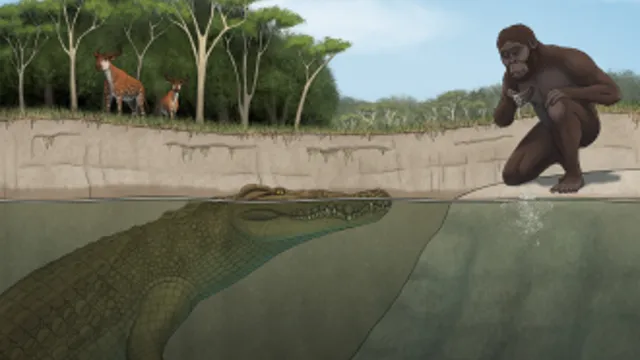
New species of giant crocodile hunted our ancestors
- Researchers discovered Crocodylus lucivenator, weighing up to half a tonne and growing 15 feet long, in Ethiopia.
- This species was the largest predator of its time, primarily preying on Australopithecus afarensis, our ancient ancestors.
- The findings highlight the threats early hominids faced from predators like this giant crocodile in prehistoric ecosystems.
Story
In Ethiopia, researchers have identified a new species of giant prehistoric crocodile named Crocodylus lucivenator, which would have posed a significant threat to early human ancestors over 3 million years ago. This crocodile, known as Lucy's hunter, grew to lengths of 12 to 15 feet and weighed between 600 to 1,300 pounds, making it the largest predator in its ecosystem. It hunted by ambushing its prey in rivers and lakes, targeting the hominid species Australopithecus afarensis, closely related to modern humans. The discovery was made through the analysis of museum specimens collected in the Ethiopian capital, Addis Ababa, in 2016. Researchers examined 121 catalogued remains, including skulls and teeth, revealing notable physical traits like a large hump in the middle of the snout. This feature is similar to that seen in the American crocodile but not in the Nile crocodile, suggesting it could have played a role in attracting mates. The study indicates that this crocodile existed in a diverse habitat during the Pliocene era, which included various ecosystems such as woodlands, wetlands, and grasslands. Its remarkable ability to survive in these different environments distinguishes it from other species at the time. Researchers believe that the crocodile's ambush predatory behavior made it a significant threat to early hominids, with scientists speculating that it would have seen Australopithecus afarensis as a potential meal. The findings contribute to the understanding of prehistoric ecosystems and the interactions between early humans and megafauna. The relationship between Crocodylus lucivenator and its environment showcases the complex web of life and predation before extinction led to significant changes in the landscapes occupied by our ancestors.
Context
The impact of prehistoric predators on early humans is a complex and multifaceted topic that sheds light on our ancestors' survival strategies and adaptation mechanisms. Early humans, particularly those belonging to the genus Homo, coexisted with a variety of large predators, including saber-toothed cats, giant hyenas, and cave bears. These formidable creatures posed significant threats to the safety and survival of early human populations. Predation pressure likely instigated the development of specific behavioral, social, and technological adaptations as human groups sought to minimize the risks associated with living in proximity to these predators. Early humans adapted by developing tools for hunting and defense, establishing communal living arrangements for higher protection, and employing strategies to avoid or confront predators effectively during their hunting and gathering activities. The relationship between early humans and their predators was not solely one of fear and avoidance. Evidence suggests that early humans were, at times, able to hunt and dominate these predators, potentially for food, materials, or even social standing within their groups. The successful hunting of large predators could have provided nutritional benefits, such as protein and fat, which were essential for the development of early humans, particularly in enhancing cognitive abilities and facilitating more complex social structures. Furthermore, the competition with large carnivores may have played a vital role in driving early human innovation, as they cultivated advanced weaponry and communal strategies to tackle the challenges posed by their environment. Additionally, the presence of large predators influenced early human migration patterns. As environments changed due to climatic shifts, early human groups might have relocated to areas with less predation risk or beneficial resource availability. This would augment our understanding of how early humans interacted with their ecosystem and influenced their development as a species. The adaptations made in response to predators laid foundational behaviors that contributed to the eventual rise of modern human societies. In conclusion, the mutual relationship between prehistoric predators and early humans significantly shaped the evolutionary trajectory of our ancestors. Facing the constant threat of predation motivated early human innovation and adaptation, resulting in technological advancement and social cooperation. The ability of early humans to not only survive but thrive in the presence of such formidable predators illustrates the resilience and ingenuity of our species. By examining these interactions, we gain valuable insights into the development of early human cultures, societal structures, and the essential survival skills that ultimately contributed to human success on a global scale.
