

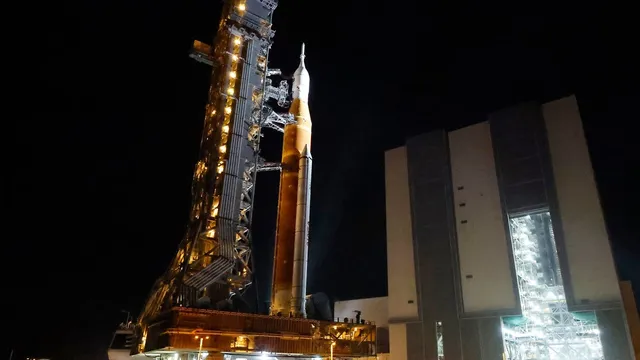
NASA sets April launch for Artemis II mission to the moon
NASA sets April launch for Artemis II mission to the moon
- NASA is rolling back its moon rocket to the launchpad for the Artemis II mission.
- The mission is set to launch between April 1 and April 6, 2024.
- This journey will take astronauts farther than any humans have gone before in space.
Story
In Florida, NASA is preparing for a significant milestone in space exploration with the Artemis II mission, which aims to take astronauts on a journey around the moon. The mission marks the agency's first crewed flight on the Space Launch System rocket and the Orion spacecraft. According to recent announcements, NASA is targeting a launch window from April 1 to April 6, 2024, after conducting extensive repairs and maintenance on the rocket and spacecraft. The announcement followed a series of delays due to technical issues encountered during pre-launch tests. The mission will involve four astronauts, including three American astronauts and one Canadian astronaut, who will test key systems in deep space, demonstrating NASA's commitment to future space habitation. The Artemis II mission is part of a broader goal to establish a lunar presence and ultimately pave the way for human exploration of Mars. The crew is currently in quarantine to ensure they remain healthy as launch day approaches. The team aims to achieve important testing objectives while in orbit, ensuring all life support, navigation, and communication systems function properly, all while illustrating the advancements in technology since previous lunar missions. Artemis II is anticipated to not only break records by sending the crew further than any humans have previously ventured but also serve as a precursor for building out NASA's Lunar Gateway, which will facilitate ongoing human activity in lunar orbit.
Context
NASA's lunar missions have played a pivotal role in exploring and understanding our closest celestial neighbor. The history of these missions traces back to the early 1960s with the ambitious Apollo program, which was initiated with the primary goal of landing humans on the Moon and returning them safely to Earth. Apollo 11, launched on July 16, 1969, became the landmark mission that culminated in the first human footsteps on lunar soil, as astronauts Neil Armstrong and Edwin "Buzz" Aldrin descended onto the Moon's surface on July 20, 1969, while Michael Collins remained in lunar orbit. The success of Apollo 11 not only fulfilled President John F. Kennedy's goal of reaching the Moon before the end of the decade but also showcased the capabilities of human ingenuity and engineering excellence in space exploration. In total, the Apollo program included six successful lunar landings, concluding with Apollo 17 in December 1972, which remains the last time humans visited the Moon. Following the end of the Apollo program, NASA focused more on robotic exploration of the Moon and other planets, shifting its mission on lunar studies toward uncrewed missions. This included the Lunar Reconnaissance Orbiter, launched in 2009, which provided detailed mapping of the Moon, enabling scientists to identify potential landing sites for future missions and understand the Moon's geology and resources. These robotic missions have contributed immensely to our knowledge of the Moon’s surface and have laid the groundwork for future exploration goals, including the plans for human returns to the lunar surface. During this period, other nations, such as the Soviet Union and more recently China and India, have also made considerable strides in lunar exploration, furthering our understanding of the Moon and its origins. In recent years, NASA has reignited its lunar ambitions with the Artemis program, aiming not just to return humans to the Moon but to establish a sustainable human presence by the end of the decade. Artemis I, an uncrewed mission, is planned to test the Space Launch System and the Orion spacecraft, paving the way for future crewed missions. Artemis II will serve as the first crewed flight of the program, scheduled to carry astronauts around the Moon, while Artemis III is aimed at landing astronauts on the lunar South Pole, a region rich in water ice and other resources that could support lunar infrastructure and exploratory efforts. This sustained human exploration of the Moon is expected to not only advance scientific knowledge but also serve as a stepping stone for future human missions to Mars. NASA's lunar missions reflect a continuum of exploration that has evolved with advancements in technology and a deeper understanding of space science. The collaboration of various international space agencies, private commercial entities, and scientific communities marks a significant shift from the race of the 20th century to a cooperative spirit of exploration in the 21st century. With an increasing emphasis on sustainable lunar exploration, ongoing missions promise to unlock the mysteries of not only the Moon but also the broader cosmos, ensuring that humanity's presence in space will continue to grow and evolve.


