

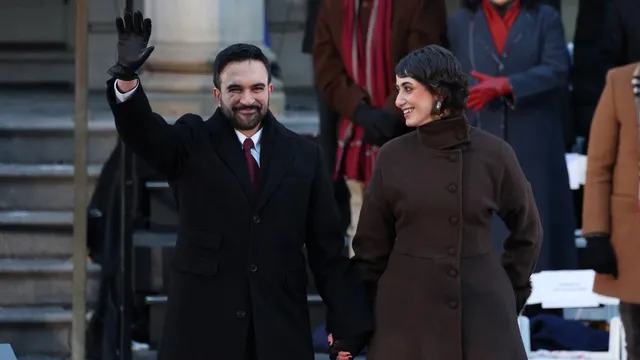
Mamdani revokes executive orders on anti-Semitism and Israel on his first day
Mamdani revokes executive orders on anti-Semitism and Israel on his first day
- Zohran Mamdani took office as New York City's mayor on January 1, 2026, promising to be inclusive of all New Yorkers.
- His first actions included revoking executive orders issued by his predecessor that supported Israel and defined antisemitism.
- These decisions prompted backlash from the Israeli government and local Jewish leaders, raising concerns about safety and community relations.
Story
On January 1, 2026, Zohran Mamdani was inaugurated as the new mayor of New York City. His first actions included revoking executive orders issued by former Mayor Eric Adams, particularly concerning the support for Israel and the adoption of the International Holocaust Remembrance Alliance's (IHRA) definition of antisemitism. This decision was met with immediate backlash from various quarters, including the Israeli government and local Jewish leaders, who expressed concern over the implications for Jewish safety and potential increases in antisemitic attacks in the city. Mamdani's controversial election campaign had already highlighted issues related to Israel, with his platform attracting both staunch supporters and vocal critics. During his inauguration, an attendee held up a photo of a young girl allegedly killed by Israeli forces, which underscored the ongoing conflict and tension associated with Mamdani's public statements regarding the Israeli-Palestinian situation. Critics pointed out that his approach may alienate important segments of the New York City population, particularly Jewish residents, as he sought a balance between advocating for Palestinian rights and addressing antisemitism within the city. While Mamdani committed to being a mayor for all New Yorkers, statements made during his campaign and subsequent actions have raised eyebrows among political leaders. For instance, Mamdani's description of Israel as an apartheid state has added complexity to his administration's relationship with Jewish communities, who are wary of increased tensions amid existing anti-Jewish sentiments. His support for progressive policies like freezing rent and universal childcare further suggest a broad, transformative agenda that could strain his relationship with various demographic groups within the city. In light of his controversial decisions, Mamdani's administration will need to navigate a highly charged political environment marked by concerns over safety, free speech, and community relations, especially regarding Israel and the Palestinian cause. As he attempts to fulfill his promise of inclusivity, the struggles faced by his administration in balancing these multifaceted perspectives will likely define his tenure as mayor and shape the future discourse on these critical issues in New York City.
Context
The recent decision by Mamdani to revoke the International Holocaust Remembrance Alliance (IHRA) definition of antisemitism has sparked significant discussions and debates within various communities and institutions. The IHRA definition, which was adopted by numerous countries and organizations worldwide, aimed to provide a clear and comprehensive framework for identifying antisemitism, thus helping to combat discrimination and prejudice against Jewish individuals. Mamdani's revocation raises questions about the implications of such a move and the potential impact it may have on the fight against antisemitism and broader societal attitudes towards Jewish communities. Critics of the IHRA definition argue that it can sometimes be weaponized to stifle legitimate criticism of Israeli policies and actions, conflating political discourse with antisemitism. They posit that Mamdani's decision reflects a growing recognition of the need for a more nuanced understanding of antisemitism that does not restrict freedom of expression. Supporters of the IHRA definition, however, express concern that revoking this widely accepted framework could lead to a dilution of efforts to confront antisemitism, allowing space for intolerance and discrimination to proliferate without a clear standard for accountability. Understanding the ramifications of Mamdani's choice requires careful consideration of the socio-political landscape that informs discussions of antisemitism today. As public conversations evolve, it is essential to maintain a balance between preserving the safety and dignity of Jewish communities while ensuring that legitimate political discourse remains uninhibited. How this balance is navigated will significantly affect future strategies to combat antisemitism and promote understanding among diverse populations. Going forward, it is vital for stakeholders at all levels, including policymakers, community leaders, and educators, to engage in constructive dialogue regarding definitions of antisemitism and the most effective approaches to combat it. This situation presents both challenges and opportunities for redefining how society addresses antisemitism, ensuring that any adopted frameworks are inclusive, effective, and reflective of contemporary realities. As the discourse continues to unfold, the implications of Mamdani's decision will undoubtedly be monitored closely by those dedicated to fostering a just and equitable society.


