

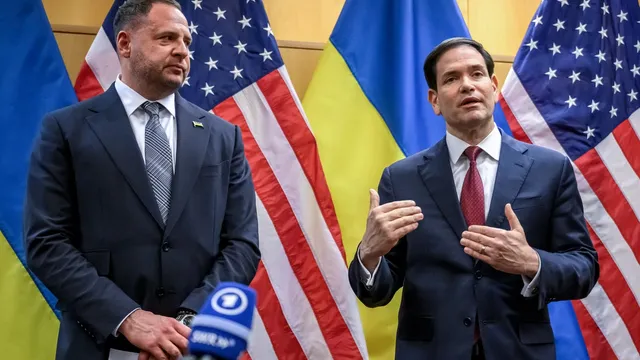
Marco Rubio claims significant progress in Ukraine peace negotiations
Marco Rubio claims significant progress in Ukraine peace negotiations
- U.S. Secretary of State Marco Rubio recognized significant advancements in the negotiations aimed at creating a peace framework for Ukraine.
- European officials have raised concerns about the U.S. peace plan heavily favoring Russian interests and insist on modifications to protect Ukraine.
- The ongoing violence in Ukraine, including recent drone attacks, heightens the urgency for a viable peace agreement.
Story
In Geneva, Switzerland, on November 23, 2025, U.S. Secretary of State Marco Rubio announced 'tremendous progress' in the peace talks between American and Ukrainian officials addressing the ongoing conflict in Ukraine. The discussions aimed to refine a U.S. peace plan that reportedly favors Russian interests, necessitating considerable adjustments for Ukraine’s support. The geopolitical landscape complicates these negotiations, with European allies expressing doubts concerning the plan, fearing it undermines Ukraine’s sovereignty and security. The backdrop of the talks reflects heightened tensions as Russian drone strikes continue to target Ukrainian cities, with civilian casualties reported, particularly in Kharkiv. This environment underscores the urgency for a diplomatic solution, as Ukraine faces immense challenges on the battlefield and within its domestic political sphere. Reports indicated that the original 28-point plan included provisions that acknowledged Russia's control over Crimea and parts of the Donbass, alongside limits on Ukraine's military, which elicited strong resistance from Kyiv and its western allies. Despite these contentious aspects, officials, including European leaders, have noted a willingness to negotiate a modified proposal that seeks to address some of these concerns and emphasize a commitment to Ukraine's sovereignty. Rubio affirmed that adjustments to the proposal were expected, particularly to incorporate feedback aimed at making it more palatable for Ukraine. Key issues remain unresolved, but optimism surrounds the potential for a framework that could facilitate future discussions. As the stakes rise with increased military pressure from Russia, the need for a viable peace agreement intensifies. Leaders are balancing diplomatic negotiations with the real-time implications of ongoing violence and public sentiment within their own countries. The urgency voiced by U.S. leadership and the broader coalition of NATO allies suggests they are keenly aware that the window for resolving this conflict is narrowing, and a clear direction must be forged before circumstances worsen further.
Context
The conflict between Ukraine and Russia has deep historical roots, stemming from complex political, cultural, and social ties. Ukraine was a part of the Soviet Union until its dissolution in 1991 when it gained independence. However, the relationship between the two nations has remained contentious, with issues of national identity, historical grievances, and territorial disputes playing significant roles. The backdrop of this conflict is further complicated by Ukraine’s strategic position between Europe and Russia, leading to divergent national aspirations. In the 1990s, Ukraine sought to establish its sovereignty and forge closer ties with Western Europe, a move that was met with resistance from Russia, which viewed Ukraine as part of its sphere of influence. Over the years, issues such as economic dependence and political alignment have exacerbated tensions, setting the stage for conflict. The situation escalated dramatically in 2014 when Russia annexed Crimea following Ukraine's Euromaidan protests, which resulted in the ousting of pro-Russian President Viktor Yanukovych. The annexation was widely condemned by the international community, leading to sanctions against Russia. Concurrently, armed conflict erupted in Eastern Ukraine, particularly in the Donetsk and Luhansk regions, where pro-Russian separatists declared independence, prompting a military response from the Ukrainian government. This conflict has resulted in thousands of deaths and displacement, creating a humanitarian crisis. Efforts to reach a diplomatic resolution have seen limited success, with agreements such as the Minsk protocols failing to achieve lasting peace. In the years that followed, the conflict has evolved into a geopolitical tug-of-war, involving not only Ukraine and Russia but also Western powers. NATO's expansion eastward is perceived by Russia as a direct threat to its security, leading to heightened military posturing along Europe’s eastern flank. Ukraine, in contrast, has actively pursued integration with Western institutions, seeking military and economic support from NATO and the European Union. This dynamic has further entangled the conflict in broader global issues, including energy security, as Ukraine serves as a key transit route for Russian natural gas exports to Europe. As of late 2023, the conflict remains unresolved, with sporadic fighting continuing in Eastern Ukraine and periodic diplomatic efforts failing to produce a concrete peace settlement. The ongoing war has profound implications for regional stability and international relations, with each side firmly entrenched in its positions. The situation poses significant challenges not just for Ukraine and Russia, but for the global community, as efforts to broker peace must navigate a complex landscape of national interests, historical legacies, and present-day realities. In the face of ongoing hostilities, the potential for further escalation remains a critical concern, underscoring the necessity for sustained dialogue and compromise.


