

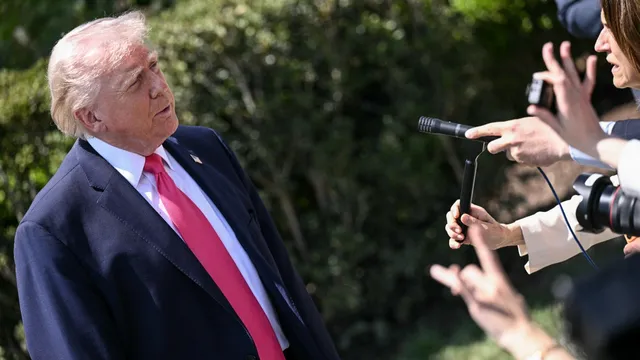
Trump attacks Pope Leo over foreign policy and crime response
Trump attacks Pope Leo over foreign policy and crime response
- Pope Leo criticized Donald Trump's foreign policy and actions against Iran, calling for peace.
- Trump retaliated by labeling the Pope as 'weak on crime' and shared controversial imagery.
- The public dispute threatens to fracture support from Catholic voters for the Republican Party.
Story
In a significant and contentious exchange, U.S. President Donald Trump engaged in a public feud with Pope Leo, the first American pope, which has raised concerns among Catholic voters. The conflict began after Pope Leo criticized Trump's foreign policy, specifically regarding military actions against Iran, labeling them 'truly unacceptable' and calling for peace during Easter Mass. Trump's response was to demean the pope in a social media post, referring to him as 'weak on crime.' This remark has not only drawn ire from Catholic leaders but has also added to the fractured relationship between the presidency and the Catholic voting bloc ahead of the upcoming midterm elections. The pope reiterated his call for peace, emphasizing that those who perpetuate wars often manipulate the name of God for their gains. During his more recent visit to Cameroon, he condemned leaders who finance wars, describing the ongoing violence in the region as an 'endless cycle of destabilization and death.' Republican leaders have expressed concern over the fallout from Trump's comments and the implications for their party's standing among Catholic voters, particularly after the 2020 election in which President Joe Biden won 50% of the Catholic vote against Trump's 49%. Prominent Catholic voices joined Pope Leo in emphasizing the need for peaceful resolution, criticizing Trump for an AI-generated image he shared depicting himself as a Christ-like figure. The Ancient Order of Hibernians moreover termed Trump's actions 'sacrilege' and a defamation of their faith, intensifying the backlash against the president and threatening the stability of his political support among religious Americans. Some Church leaders articulated their disapproval of Trump's approach, indicating a divergence between the conservative Catholic base and the president's actions, which could have far-reaching effects as the midterms loom. In the context of these tensions, significant theological discussions emerged around the notion of a 'just war' as defined by the Catholic Church. Bishop James Massa clarified that such wars can only be deemed just when they are in self-defense after all peaceful solutions have been sought and exhausted. Both Trump and the pope stand firm in their positions, with Trump suggesting Iran is a threat to global stability and the pope remaining vigilant in his advocacy for peace amidst violent conflict. The underlying issues of morality, leadership, and the responsibilities associated with both roles continue to play out on the national stage, as the Republican Party navigates the complexities of their voter base and the principles of the Catholic faith.
Context
The relationship between the Catholic Church and the political sphere in the United States has often been fraught with tensions, particularly highlighted by the interactions between various U.S. administrations and the papacy. Central to these tensions is the conflict that arose during the presidency of Donald Trump, which sparked quite a reaction from various Catholic bishops. The bishops were tasked with navigating the complexities of Trump’s policies and rhetoric, which were often in stark opposition to the Church’s teachings on issues such as immigration, social justice, and environmental stewardship. This report aims to explore the responses of the Catholic bishops to the conflicts brought about during Trump's presidency and the broader implications for the Church's engagement in political discourse. \n\nThe Catholic bishops, representing a broad spectrum of the Church in the United States, expressed concern over Trump’s stance on immigration, particularly his administration’s efforts to build a border wall and the harsh treatment of undocumented immigrants. In various statements and letters, bishops highlighted the Catholic social teaching that emphasizes the dignity of every human life and the importance of welcoming the stranger. Their response included public denouncements of policies that they deemed harmful, and they rallied their congregations to advocate for more humane treatment of immigrants. This was evident in initiatives and campaigns undertaken by bishops across the country who sought to provide assistance and support to migrant communities, reflecting the Church's commitment to its core values.\n\nFurthermore, the bishops also criticized Trump's environmental policies, particularly his withdrawal from the Paris Agreement, arguing that such actions contradicted the Church’s mission to protect God’s creation. The bishops issued statements that connected environmental stewardship with moral responsibility, framing climate change as a pressing issue that disproportionately affects the poor and marginalized—groups the Church advocates for. This highlighted the bishops’ willingness to engage in broader societal conversations, linking faith with actionable insights on global issues. It also reinforced their role as moral leaders who must speak out on matters that affect the common good. \n\nIn the face of these challenges, it is important to recognize the role of the Catholic bishops as both spiritual leaders and as advocates for justice, whether addressing local or global concerns. Their responses to the Trump-Pope conflict reflect a commitment to the social teachings of the Church and the forging of a path that respects human rights and moral values. As the political landscape continues to evolve, the ongoing dialogue between Catholic leadership and political figures will remain crucial in shaping the future interactions between faith and governance in the United States.


