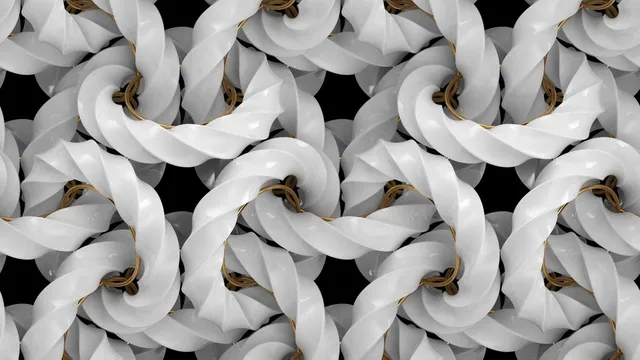
Braid theory is a fascinating area of mathematics that has evolved significantly since its inception. It primarily deals with the study of braids, which can be visualized as strands of hair intertwined in various configurations. The mathematical formalization of braids began in the 19th century, with the work of mathematicians such as Emil Artin, who introduced the concept of braid groups in 1947. These groups provide a rigorous framework for understanding the algebraic properties of braids, allowing mathematicians to explore their symmetries and transformations. The braid group on n strands, denoted as B_n, consists of equivalence classes of braids where two braids are considered equivalent if one can be transformed into the other through a series of allowed moves, known as braid operations. This foundational work laid the groundwork for further developments in the field, connecting braid theory to various branches of mathematics, including topology and algebraic geometry.
As braid theory progressed, it became increasingly clear that it had profound implications beyond pure mathematics. In particular, it found applications in areas such as knot theory, where the study of knots is closely related to the study of braids. The relationship between knots and braids is established through the process of "closing" a braid, which involves connecting the ends of the strands to form a knot. This connection has led to significant advancements in understanding the properties of knots and their classifications. Furthermore, braid theory has also been instrumental in the development of quantum computing and quantum field theory, where braids are used to model particle interactions and topological quantum computing.
In the late 20th and early 21st centuries, braid theory experienced a resurgence of interest, particularly with the advent of new technologies and interdisciplinary research. The interplay between braid theory and physics has been particularly fruitful, with researchers exploring the connections between braids and anyons, which are quasi-particles that exist in two-dimensional systems. These anyons exhibit braiding statistics, meaning that the order in which they are exchanged affects the overall state of the system. This property is crucial for the development of topological quantum computers, which promise to be more robust against errors than traditional quantum computers. The exploration of these connections has led to a deeper understanding of both mathematical structures and physical phenomena, showcasing the versatility and relevance of braid theory in contemporary research.
Today, braid theory continues to be a vibrant area of study, with ongoing research exploring its connections to various mathematical disciplines and real-world applications. The development of new techniques and tools, such as computational methods for analyzing braids and their properties, has opened up new avenues for exploration. As researchers delve deeper into the intricacies of braid theory, they uncover new relationships and insights that not only enhance our understanding of mathematics but also contribute to advancements in technology and science. The history of braid theory is a testament to the power of mathematical inquiry and its ability to bridge diverse fields, highlighting the enduring significance of this captivating area of study.