
politics
controversial
update

DNA evidence from Nancy Guthrie's home may prolong investigation

Apr 21, 2026, 6:47 PM20
(Update: Apr 22, 2026, 8:11 PM)
American politician

DNA evidence from Nancy Guthrie's home may prolong investigation

  • A retired FBI agent revealed that a hair sample found at Nancy Guthrie's home is under DNA testing.
  • The Pima County Sheriff's Department confirmed that they have been collaborating with the FBI during the investigation.
  • The analysis of the hair sample could significantly delay the case, potentially taking weeks or even months.
Share opinion
Tip: Add insight, not just a reaction
2

Story

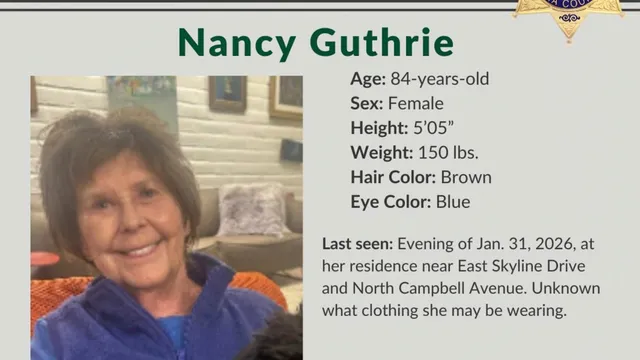
In February 2023, Nancy Guthrie, the 84-year-old mother of Today co-host Savannah Guthrie, was reported missing from her home in the Catalina Foothills neighborhood of Tucson, Arizona. The investigation into her disappearance immediately involved the Pima County Sheriff's Department in collaboration with the FBI. Evidence collected at the scene led authorities to believe that Guthrie did not leave voluntarily, as indicated during a news conference by Sheriff Chris Nanos. More than two months after her disappearance, a significant piece of evidence came to light when a hair sample was found at her home. This hair sample was subsequently sent for DNA analysis to a lab in Florida. Retired FBI agent Jennifer Coffindaffer, who has been commenting on the case, mentioned that the DNA found is not considered new evidence but is key to ongoing investigations. Coffindaffer emphasized that the analysis could take weeks or even months due to the complexities of DNA testing. The Pima County Sheriff's Department has been transparent in stating that they have worked with the FBI from the start of the inquiry and are actively pursuing leads. The sheriff mentioned in previous statements that they possess DNA evidence believed to be workable, although they have not disclosed if the hair sample has a root, which is critical for DNA testing. Nanos indicated the presence of multiple DNA sources at the crime scene, raising further questions about the circumstances surrounding Guthrie's disappearance. The case has garnered significant media attention, particularly due to Savannah Guthrie, who took a leave of absence from the Today show to focus on her family during this crisis. Efforts to find Nancy have included the release of images of a person who appeared to tamper with the security camera at her home on the day she went missing. The FBI is offering a reward of up to $100,000 for information leading to her recovery or the conviction of those involved in her disappearance. As the investigation continues, both local law enforcement and the public remain hopeful for answers regarding Nancy Guthrie's whereabouts.

Context

The impact of DNA evidence on missing person cases has been profound, revolutionizing the methods by which law enforcement agencies search for and identify individuals who have disappeared. Since its introduction into the criminal justice system, DNA analysis has provided a reliable means of determining biological relationships and individual identities, significantly enhancing the chances of solving cases that might otherwise remain cold. The precision of DNA profiles and the ability to match them with relatives or other biological samples have not only facilitated the identification of remains but also helped to connect missing persons to potential perpetrators or locations. In cases of missing persons, DNA evidence plays a crucial role in various stages of investigation. Firstly, it aids in the initial search and identification efforts. When human remains are found, DNA profiling can be used to confirm identities quickly, allowing families to receive closure more rapidly. Moreover, it assists in clearing up cases where individuals may have been misidentified or where remains are incomplete or degraded. This capability is particularly vital in mass casualty events, such as natural disasters or accidents, where traditional identification methods might fail due to dismemberment or obfuscation of physical characteristics. Furthermore, the use of DNA evidence extends beyond just identification; it enhances the investigative process itself. When law enforcement collects DNA samples from relatives of missing persons, they can create a familial DNA database, which allows for a comparison of found DNA against the profiles of family members. This has led to breakthroughs in cases that might have long gone unresolved, offering new leads through familial connections. The integration of such genetic genealogy techniques has proven effective in establishing not only the identities of missing individuals but also the circumstances surrounding their disappearances. However, while the advantages of DNA evidence are clear, there are also challenges and ethical considerations that must be acknowledged. The reliance on DNA must be balanced with respect for privacy and the potential for misuse of genetic data. Moreover, some individuals may be skeptical of law enforcement's use of such evidence, raising concerns about consent and data protection. Despite these challenges, the continuing evolution of DNA technology and methodologies holds great promise for improving the outcomes of missing persons cases, ensuring that more individuals are found and that families can achieve the closure they deserve.

2026 All rights reserved
