
military conflicts
provocative
impactful

Kim Jong Un accelerates nuclear navy ambitions with new destroyer tests

Mar 5, 2026, 1:00 AM20
(Update: Mar 5, 2026, 10:34 AM)
General Secretary of the Workers' Party of Korea and 3rd Supreme leader of North Korea
sovereign state in East Asia

Kim Jong Un accelerates nuclear navy ambitions with new destroyer tests

  • Kim Jong Un inspected his new destroyer, the Choe Hyon, at the Nampo shipyard.
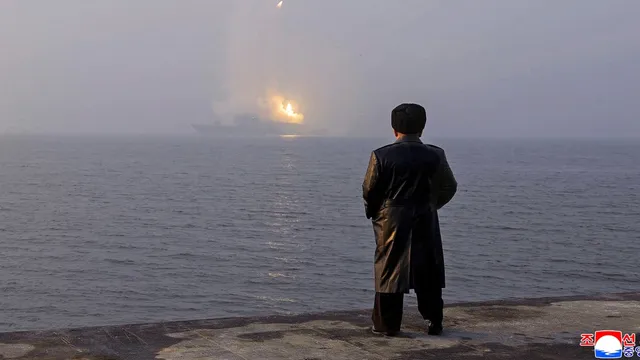
  • He observed missile tests from the destroyer, indicating progress in nuclear naval capabilities.
  • These developments signal North Korea's aim to formally assert maritime claims and expand military presence.
Share your opinion
2

Story

In early March 2026, Kim Jong Un, the leader of North Korea, conducted a two-day inspection of a newly built destroyer at the Nampo shipyard, which is part of his broader initiative to enhance the country's naval capabilities. During this period, he observed a test launch of cruise missiles from the warship, highlighting his commitment to accelerate the nuclear armament of the navy. This destroyer, named Choe Hyon, was first unveiled in April 2025 and is considered a significant advancement in expanding North Korea's operational range and preemptive strike capabilities. The development of the Choe Hyon is emblematic of North Korea's military aspirations, which include further naval enhancements, and marks a shift in focus from solely ballistic missile advancements to naval power. Kim's inspections are indicative of North Korea's strategic military objectives and the potential for heightened tensions in the Korean peninsula, especially as he has also called for the construction of two warships each year over the next five years. Moreover, during the Workers' Party congress, Kim reiterated his agenda for expanding North Korea's nuclear arsenal, indicating a hard-line stance toward South Korea and its maritime boundaries. Analysts suggest that these military developments could signal preparations for formal declarations regarding maritime claims, which may challenge waters that South Korea controls, further complicating the already volatile inter-Korean relations. As North Korea continues to bolster its military capabilities, the region's dynamics remain influenced by Kim's national defense strategy, which emphasizes the significance of both nuclear and conventional naval forces.

Context

North Korea has been strategically advancing its military capabilities over the past few decades, with significant emphasis placed on nuclear technology and naval power. Understanding North Korea's military framework is crucial, especially in the context of its nuclear ambitions and the potential implications for regional and global security. The Democratic People's Republic of Korea (DPRK) has invested heavily in developing nuclear weapons, viewing them as a deterrent against perceived threats, particularly from the United States and its allies. The nuclear program has evolved rapidly, with North Korea successfully conducting multiple nuclear tests and claiming to have developed intercontinental ballistic missiles capable of striking targets far beyond its borders. In addition to its nuclear arsenal, North Korea has increasingly focused on enhancing its naval capabilities. The nation's navy remains relatively small compared to others in the region; however, it has made strides in developing submarines capable of launching ballistic missiles, known as submarine-launched ballistic missiles (SLBMs). This move is significant as it allows North Korea to potentially expand its strike capabilities and makes its missile launches harder to detect and intercept. The development of these submarines is seen as a critical component of North Korea's doctrine of asymmetric warfare, leveraging limited resources to counter larger and more technologically advanced military forces. The integration of nuclear capabilities with naval assets exemplifies North Korea's strategy to ensure the survivability of its nuclear forces. By deploying SLBMs from submarines, the DPRK can maintain a second-strike capability even in the face of a first-strike attack by adversaries. This development raises concerns among neighboring countries and the broader international community regarding the stability of the Korean Peninsula and the potential for miscalculations during a crisis. The strategic significance of North Korea's nuclear and naval advancements could lead to a regional arms race, prompting nations to bolster their own military capabilities in response. In conclusion, the interplay between North Korea's nuclear ambitions and its naval modernization efforts reflects a complex military strategy designed to enhance its deterrent posture. As the situation continues to evolve, it necessitates ongoing monitoring and analysis to assess the potential risks and impacts on regional and global security. The international community must remain vigilant and engaged in diplomatic efforts to address the challenges posed by North Korea's military capabilities, particularly in light of its nuclear advancements and naval developments.

2026 All rights reserved
