

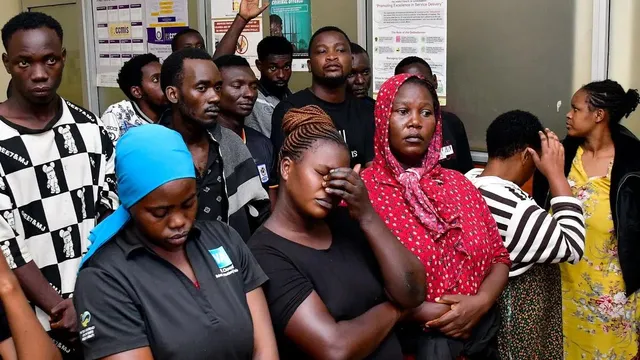
Violence escalates with seven killed during Uganda's presidential election
Violence escalates with seven killed during Uganda's presidential election
- Vote counting began on January 15, 2026, amid allegations of voter suppression and an internet shutdown.
- Violence ensued as at least seven people were reported killed, with accusations of security forces targeting opposition supporters.
- The situation illustrates Uganda's ongoing political turmoil and the challenges surrounding democratic governance.
Story
Uganda has recently witnessed a tense presidential election marked by serious allegations of voter suppression and violence. Vote counting commenced on January 15, 2026, amid an internet shutdown that hindered communication and reports of incidents at polling stations. Opposition leader Bobi Wine accused the authorities of detaining his polling agents, particularly in rural areas, which severely undermined his ability to monitor the election process and protect against electoral fraud such as ballot stuffing. Despite Museveni's assurances of a fair election using biometric voting machines, the opposition alleged that the polling conditions strongly favored the ruling party, raising concerns about the legitimacy of the election results. The aftermath of the election spiraled into deadly confrontations, highlighting a significant breakdown in order as supporters of both Museveni and Wine clashed. Reports emerged of Bobi Wine being taken forcibly from his compound by security forces, leading to widespread accusations from the National Unity Platform (NUP) party regarding his safety. The government, while denying these claims, stated that Wine was safe at home under police protection. The electoral violence left at least seven people dead, with various reports suggesting the possibility of up to ten casualties. Eyewitness accounts described scenes of chaos, with police engaging in lethal encounters with alleged armed groups supporting Wine. The police asserted that they acted in self-defence against what they termed machete-wielding ‘goons’ during a nighttime raid. Contrarily, opposition leaders characterized these events as a massacre and alleged that unarmed individuals were unjustly shot. This violent environment accentuates the longstanding political tensions in Uganda, where the incumbent president, Yoweri Museveni, has prolonged his rule since taking power in 1986. With the elections under severe scrutiny, analysts indicate that such unrest is reflective of the public's desire for change in governance and the ramifications of prolonged political dominance. Public demonstrations were reported in various areas, showcasing the deep-seated frustration and anger among citizens regarding the political process. Museveni’s continued presidency, which appears set to extend into a fifth decade, raises questions about the future political landscape of Uganda and whether this election will mark a turning point or merely an extension of past conflicts.
Context
The history of political unrest in Uganda is marked by significant events that have shaped its contemporary political landscape. Following independence from British colonial rule in 1962, Uganda experienced a tumultuous period characterized by political instability, power struggles, and civil conflict. The early years were overshadowed by the inability of political leaders to maintain unity and effectively govern the country. The rise of Milton Obote's government, which was initially viewed as a stabilizing force, quickly devolved into conflict due to claims of authoritarianism and the suppression of dissent. This set the stage for the eventual coup led by Idi Amin in 1971, which further exacerbated the climate of fear and unrest in the nation. Amin's brutal regime left a legacy of human rights abuses, economic decline, and social fragmentation that significantly impacted Ugandan society. Following Amin's ousting in 1979, the country saw a brief period of hope under the leadership of various transitional governments. However, political turmoil remained rampant as Obote returned to power, leading to an escalation of violence, particularly in northern Uganda, where various rebel groups emerged to challenge the government. The most notable among these was the Lord's Resistance Army (LRA), led by Joseph Kony, which became infamous for its atrocities against civilians, including mass abductions and child soldier recruitment. The prolonged conflict resulted in widespread human suffering and displacement, particularly in rural areas, fostering a cycle of poverty and instability that continues to affect Uganda today. The political unrest in Uganda took a significant turn with the rise of the National Resistance Army (NRA), led by Yoweri Museveni, who seized power in 1986. Museveni's administration initially brought relative peace and economic recovery, which garnered international support. However, over the years, concerns regarding democratic governance, human rights violations, and political repression have emerged. Election cycles have often been marred by allegations of fraud, violence, and the silencing of opposition voices. Notably, the 2016 election was marked by widespread unrest and accusations of electoral malpractice, further straining the relationship between the government and opposition parties. As of January 2026, the political environment in Uganda remains fraught with challenges. Tensions continue to mount as opposition leaders, including Robert Kyagulanyi (Bobi Wine), face increasing governmental pressure and harassment. The ruling party's grip on power has raised questions about the future of democracy in Uganda, as civil society groups and international observers advocate for reforms and respect for human rights. The legacy of past conflicts still influences current political dynamics, showcasing the need for comprehensive dialogue and reconciliation to address the deep-rooted issues lingering from decades of unrest. As Uganda moves forward, the interplay of political engagement, civil rights, and economic stability will play crucial roles in shaping the nation's destiny.


